IPcook (ipcook.com) sells residential proxy traffic by the gigabyte, and the gigabytes never expire. On 14 October 2026 it charged $3.20 for 1 GB, falling to $2 a GB at 100 GB and $0.70 at 3,000 GB; its main plans have kept the same prices since its shop appeared in June 2025. Its terms name the operator, HoosTag CO., Limited of Hong Kong, and its refund policy gives 24 hours for unused purchases. The domain itself carried a Chinese registrar's placeholder page in 2016, and the current registration dates from March 2025. For small orders, DataImpulse charges less per gigabyte; from 1,000 GB, IPcook does.
What IPcook sells
Its main product is rotating residential traffic from what it calls "55M+ Real Residential IPs", billed by the gigabyte under "Pay as you go, traffic never expired". Each plan allows sticky sessions of up to 24 hours, free geo-targeting and up to 10 sub-accounts. An unlimited plan sells residential traffic by speed instead, "starting at $350/30 days for 100 Mbps", which is the $11.67 a day in its page title.
Its ISP and datacenter proxies are sold through a configurator by location and period. Their page titles advertise unlimited traffic that "Starts at $0.05" and costs "from $0.04", without saying per what. The site also carries setup guides for antidetect browsers and proxy tools, and pages for buying with a card or PayPal.
The price curve
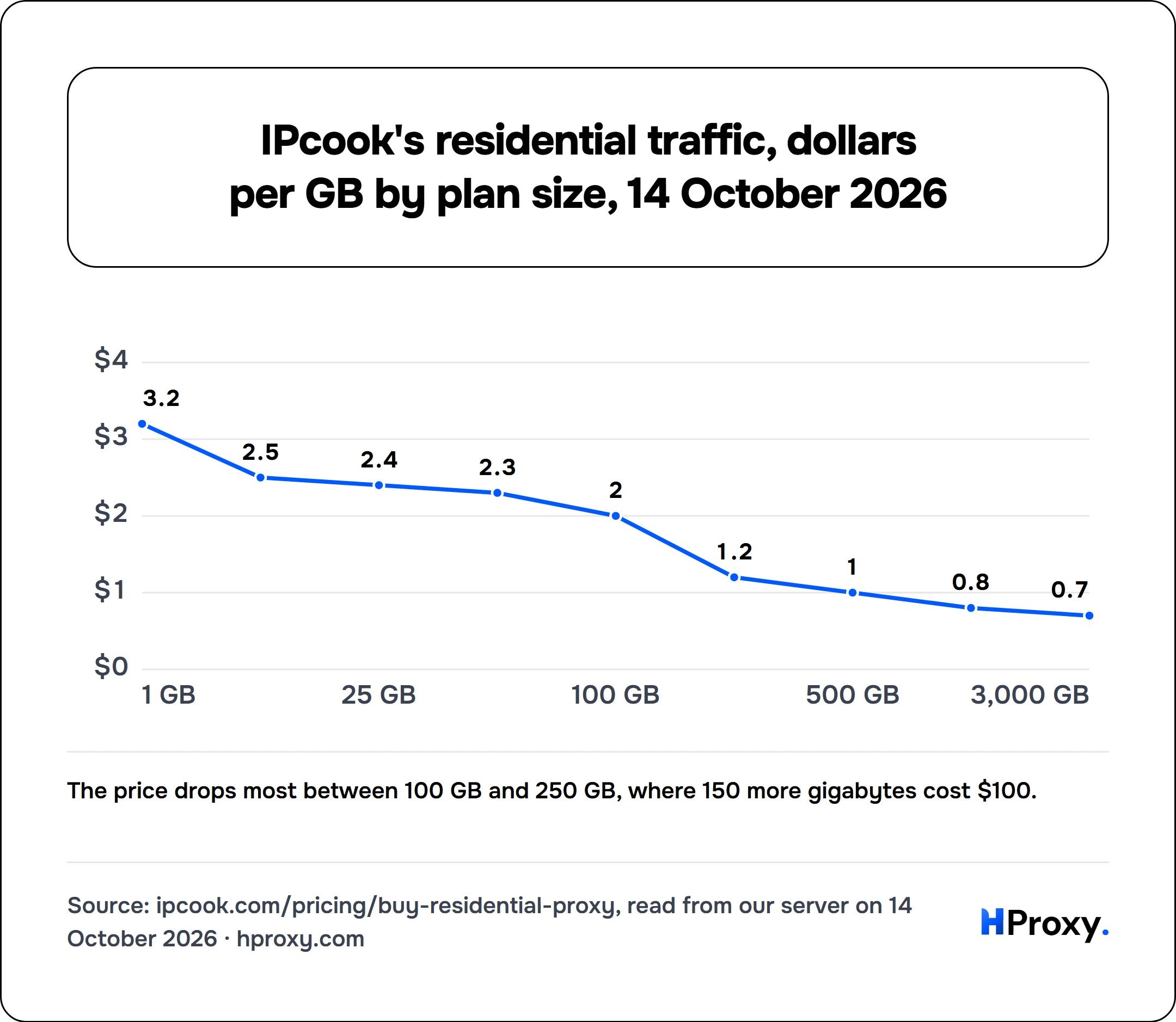
From 1 GB to 100 GB the price per gigabyte falls slowly, from $3.20 to $2. The 250 GB plan then costs $300, only $100 more than 100 GB for two and a half times the traffic. The 1,000 GB plan is called "Small Enterprise"; beyond the listed plans, an "Enterprise" tier offers custom prices, advertised from "$0.3 /GB Lowest".
Each plan shows an "Original Price" crossed out next to its price, with a saving such as "Save 75%". The original price is always the plan's gigabytes at the 1 GB rate: $80 for 25 GB, $3,200 for 1,000 GB. The saving measures each plan against IPcook's own smallest one.
How the prices moved
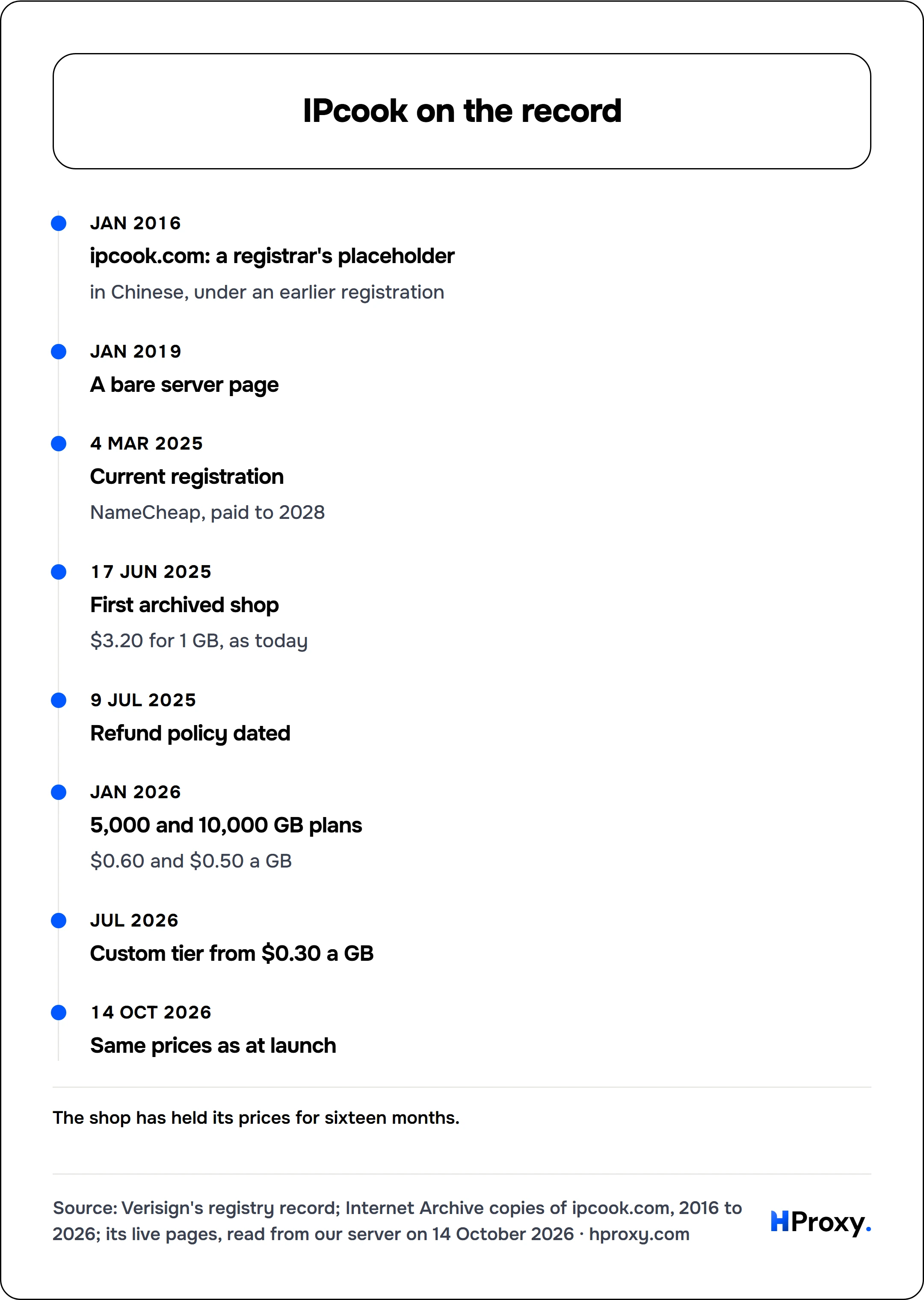
They barely moved. The first archived copy of the shop, of 17 June 2025, listed $3.20 for 1 GB, $2.40 at 25 GB and $0.80 at 1,000 GB, the prices of today. In January 2026 the page added a 5,000 GB plan at $0.60 a GB and a 10,000 GB plan at $0.50, shown against an "Original Price" of $32,000. By July 2026 the 10,000 GB plan had given way to the custom "Enterprise" tier.
Jan 2016
ipcook.com: a registrar's placeholder
in Chinese, under an earlier registration
Jan 2019
A bare server page
4 Mar 2025
Current registration
NameCheap, paid to 2028
17 Jun 2025
First archived shop
$3.20 for 1 GB, as today
9 Jul 2025
Refund policy dated
Jan 2026
5,000 and 10,000 GB plans
$0.60 and $0.50 a GB
Jul 2026
Custom tier from $0.30 a GB
14 Oct 2026
Same prices as at launch
The fine print
Refunds in 24 hours, if unused. The refund policy, "Last Updated: July 9, 2025", allows a full refund "within 24 hours of purchase" if the service shows "zero bandwidth consumption". After that, a refund needs a service that is "non-functional due to issues on IPcook's end" and evidence such as error logs. A purchase made "using cryptocurrency" is never refunded, and "All refund decisions are final and at the sole discretion of IPcook."
Two windows in two documents. The terms of service describe the same right differently: requests "within three days of purchase may be considered" for technical issues, and otherwise "all fees paid are non-refundable". A buyer who relies on the three days may meet the 24 hours.
Checks and limits. IPcook may "request identity verification documents for accounts exhibiting high-volume usage or suspicious activity patterns". Reselling its service "requires explicit written authorization". Its liability to a paying customer is capped at the fees paid in the three months before the event.
Who runs IPcook
The terms are specific: "IPcook is independently operated by HoosTag CO., Limited", described as "a legal entity, incorporated in Hong Kong, registration No. 76639471", at Unit 98 of the Union Hing Yip Industrial Building, Hing Yip Street, Kwun Tong. The about page gives the same address, and the terms choose "the laws of Hong Kong".
We could not confirm the company. OpenCorporates' copy of the Hong Kong register held no company named HoosTag when we searched on 14 October 2026. The number in the terms has eight digits, the length of a Hong Kong business registration number; the company numbers in the register copy we read have seven. We did not search the Hong Kong register itself, which charges for company particulars.
The domain is older than the shop. In January 2016 ipcook.com showed a Chinese registrar's page announcing the name as registered, and in 2019 a bare web server page. The current registration was made on 4 March 2025 through NameCheap and runs to 2028. The archive's first copy of the proxy shop is from June 2025.
How it compares
At 100 GB, IPcook sits between the two sellers we read the same day:
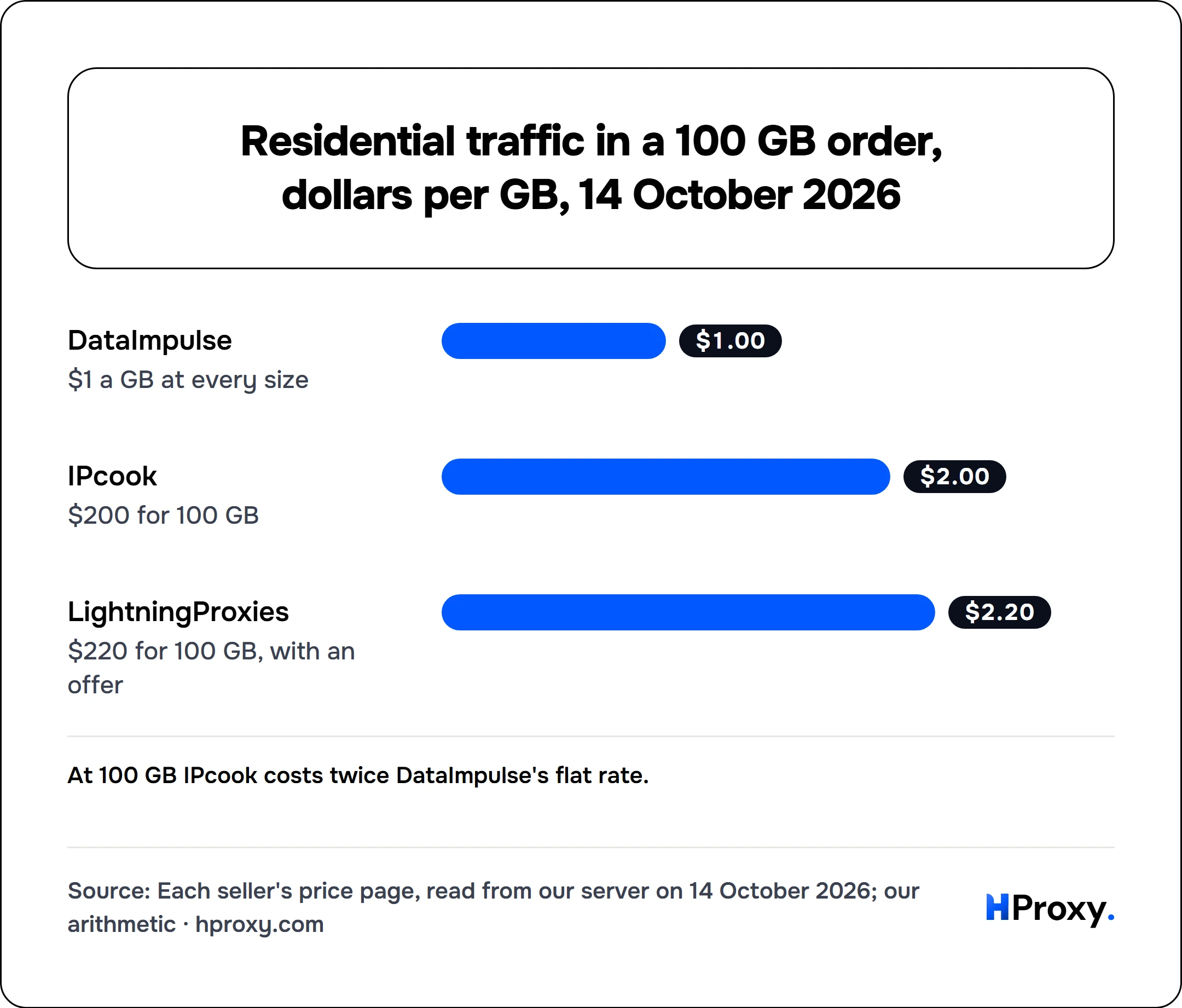
DataImpulse charges $1 a GB at any size and says its traffic never expires, so it costs less than IPcook below 500 GB and the same at 500 GB. From 1,000 GB IPcook's $0.80 is lower. At the smallest order, IPcook's $3.20 for 1 GB undercuts Webshare's $3.50 and LightningProxies' $4.50.
Where HProxy fits
We sell residential traffic too, $0.50 per GB, from a balance that never expires, under Obsidian UG (haftungsbeschränkt), named in our terms and findable in the German register. Whichever seller you choose, check the first proxies you get with our free proxy checker.
Which one to pick
- IPcook for 1,000 GB or more at $0.80 a GB or less, with traffic that never expires, if you pay by card or PayPal.
- DataImpulse for any order under 1,000 GB, at $1 a GB.
- Webshare or IPcook for a single gigabyte to test, at $3.50 or $3.20.
What we could not find out
We could not confirm HoosTag CO., Limited in any register we read. We do not know what IPcook's ISP and datacenter prices are per, since its configurator shows them only after a selection we did not make. Nothing was bought and no IPcook proxy was tested, so its speed and success rate are its own word. Our next reading of these pages is due by 14 January 2027.
Sources
- ipcook.com: home, about, residential, unlimited, ISP and datacenter price pages, terms of service, privacy and refund policies, its robots file and sitemap, read from our server on 14 October 2026.
- The Internet Archive's copies of ipcook.com, 2016 to 2026, among them the shop and price pages of June 2025, January 2026 and July 2026.
- Verisign's registry record of ipcook.com, 14 October 2026.
- OpenCorporates: a search of Hong Kong companies for HoosTag, 14 October 2026.
- The price pages of DataImpulse, Webshare and LightningProxies, read from our server on 14 October 2026.
- Our own residential price: HProxy's live price table, 14 October 2026.