The answer to "what should I use instead of Proxy302" depends entirely on why you are leaving. Price, a commitment, a country, a support experience and a blocked target all point at different replacements.
What is on file for Proxy302
Their site is proxy302.com.
We price the providers we can source and date, and Proxy302 is not currently one of them. The rest of this page is about what to check when you read their pricing yourself.
Check the reachable rate, the minimum, the expiry terms and the failure billing, and date your note. A price without those four attached is not a price.
The site, as it reads today
On 9 September 2026 the site introduced itself as "【官网】Proxy302-全球代理IP自助超市,按需付费,无阶梯定价,即充即用". The blurb under their search result reads: "Proxy302是最灵活多样的全球代理IP超市,支持HTTP、SOCKS5协议代理,7*24小时技术支持。汇集全球优质IP资源,覆盖超过195+个国家,6500万+IP,为企业和个人用户提供安全可靠的网络解决方案。"
What else that page states, without interpretation:
The product lines named on that page are SOCKS5. Payment methods mentioned: crypto. Their pricing page is titled "Pricing, Proxy302".
Every line above is a quotation from their marketing rather than a measurement by us. It is included because it is checkable, not because it is evidence of performance.
Age, and why it matters here
The domain was registered on 1 November 2020, through GoDaddy.com, LLC, which makes it about 5 years old. We pulled that from the registry on 23 April 2026. The current registration term ends 1 November 2026.
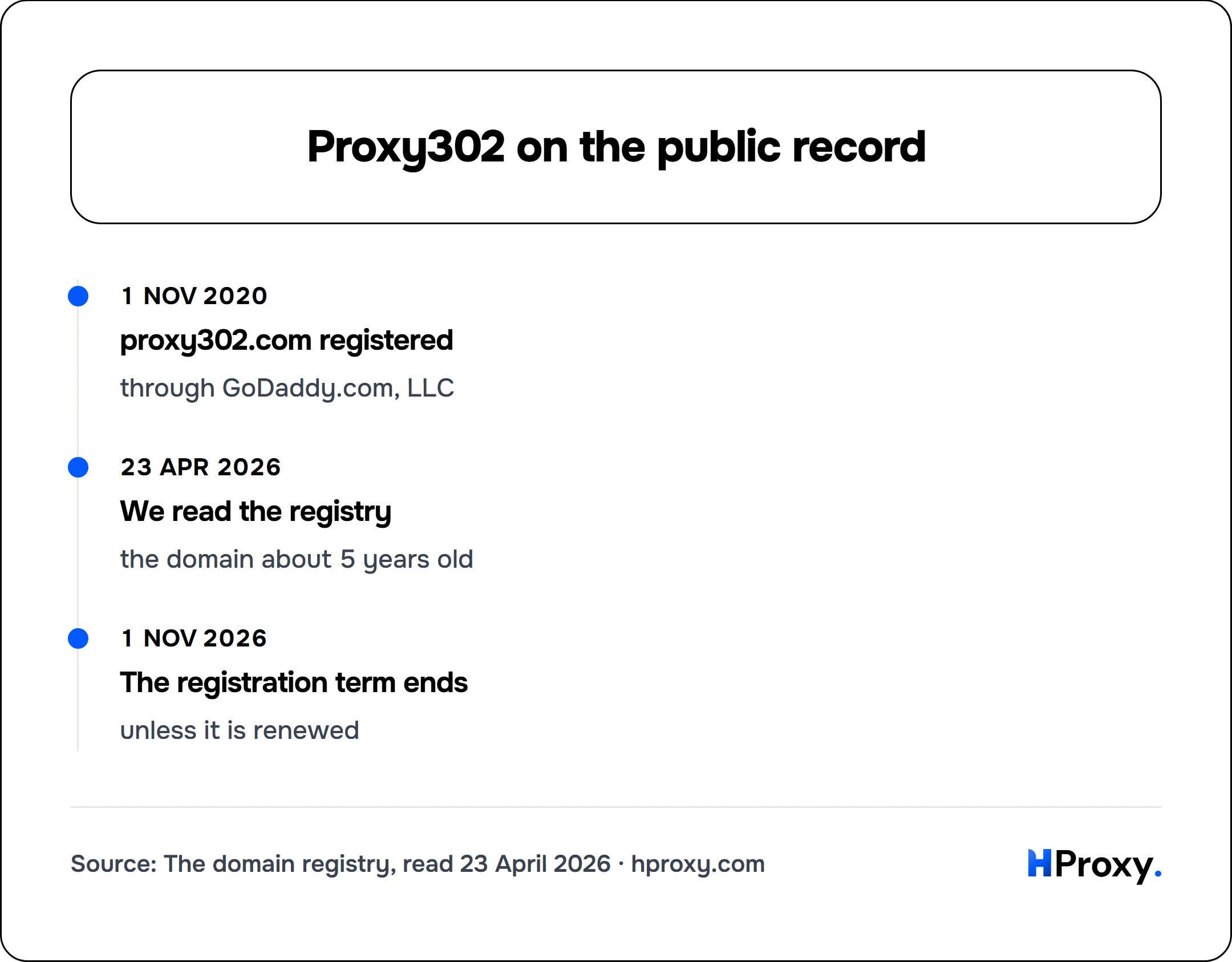
1 Nov 2020
proxy302.com registered
through GoDaddy.com, LLC
23 Apr 2026
We read the registry
the domain about 5 years old
1 Nov 2026
The registration term ends
unless it is renewed
None of it predicts success rate. It is here because domain age and archive depth are free to check, and a provider whose public record starts last quarter deserves a smaller first order.
Their published surface
Our own crawl reached 76 of their pages. The mix was 4 blog pages, 8 pricing pages and 4 use-case pages.
Site size is a signal about marketing budget rather than network quality, and the two are frequently unrelated. It is useful for a different reason: a provider with many pricing pages is usually segmenting hard, and a provider with none is selling by quotation.
What a pricing page leaves out
A commitment is part of the price
Treat a required call with a salesperson as a cost. It delays the work, it usually arrives with an annual term attached, and it exists because the published price is negotiable in one direction only.
The reputation you inherit
Ask how many accounts can sit on one address at once. Where the answer is unlimited or unspecified, price the plan as shared regardless of what the product is called.
The line item hidden in the success rate
Some vendors bill every request, some bill only successful ones, and the difference is the whole comparison once a target starts blocking. A cheap rate with a fifty percent success rate is twice its advertised price.
The rows that decide it
Here are the comparisons that survive contact with a real workload:
| Question to ask | Proxy302 | HProxy |
|---|---|---|
| Entry price | Not verified by us, read their page | From $0.44/GB, pay as you go |
| Does unused balance expire? | Not published clearly, ask before paying | Never |
| Minimum commitment | Check the current terms, this one moves | None |
| Identity checks | Their terms page answers this | Card orders are screened, and verification is sometimes requested |
| Targeting | Check the current terms, this one moves | Country, city and ISP |
| Free way to evaluate | Their terms page answers this | Free proxy list and proxy checker |
Where a cell points you at their terms, that is because the answer moves and a stale quotation would be worse than none. The missing row, in every table of this kind, is the one only your own measurement can fill.
What to do instead of reading more comparisons
The steps below take about ten minutes and settle the question properly.
- Put a few dollars on each account. Trials are fine for a first look, but paid traffic is what you will actually be buying.
- Run them against the site you actually care about, using the code you actually run, within the same hour.
- Track the success rate and the bandwidth. A cheap gigabyte that fails half the time is not cheap.
- Run a sample of the addresses through an independent lookup, because advertised geography and actual geography differ more often than the market admits.
- Choose on the measurement, not the marketing, and expect the answer to change within a year.
Where else buyers look
If this one does not fit, these are the nearest comparable providers we have written up, each on the same terms as this page.
- Rainproxy alternatives
- Rampageproxies alternatives
- rapidproxy.io alternatives
- Rateproxy alternatives
Our own position
Our end of it is a wallet, four proxy types and no contract. Residential begins at $0.44 per GB and the balance does not expire. The free proxy list and checker are open to anyone, and they are the fastest way to see how we treat measurement before you spend anything.