Brand protection teams use proxies to see marketplaces, ads and websites the way a shopper in each market sees them, and to repeat those checks at scale. The job needs four things: exits in the countries where you sell, a proxy type each site accepts, sessions that hold while you collect proof, and a record a platform will act on. Residential or mobile exits suit pages shoppers see, while a datacenter exit is enough for many site and domain checks. When we sent one plain search from our own datacenter address to eight marketplaces, four refused it.
What brand protection is, and why it starts with a search
Brand protection is the work of finding and removing what uses a brand without permission: fake listings, unauthorized sellers, impersonating ads and accounts, and lookalike domains. The scale is large: an OECD and EUIPO report put counterfeit goods at an estimated 467 billion US dollars of world trade in 2021. Clothing, footwear and leather goods made up 62 percent of seized fakes, and China accounted for 45 percent of reported seizures. Around 65 percent of seizures involve small parcels and mail, and counterfeiters advertise online.
Platforms remove a great deal on their own, and Amazon says it seized more than 15 million counterfeit products in 2025, and its Counterfeit Crimes Unit has pursued more than 32,000 bad actors since 2020. It also gives brands a search tool, Project Zero, to find counterfeit listings and remove them themselves. Domains follow the same pattern: WIPO handled over 6,200 domain name cases in 2025, its highest caseload on record. In each channel, someone has to find the listing, the ad or the domain first.
What a platform needs from you
A finding only counts once a platform can act on it. Under Article 16 of the EU Digital Services Act, a notice must give "the exact URL or URLs" and a substantiated reason why the content is illegal. Notices from trusted flaggers get priority under Article 22, so every check should leave a record like this:
| Field to log | Why it matters |
|---|---|
| The exact URL | The notice has to point to it. |
| Date and time, in UTC | Listings change and disappear. |
| Exit country, city and type | The page depends on where it was seen from. |
| A full-page screenshot | It shows what the shopper saw. |
| Seller or account id, and the price | They tie the listing to a seller. |
| Where you reported it, and the answer | It shows the follow-up. |
Why the place you check from matters
Ads are placed by location: Google Ads lets advertisers show ads in the places they select, from whole countries down to a radius around a location, using signals such as settings, devices and behavior. An ad that impersonates your brand in one city can be invisible from an office in another.
Some sites also show different visitors different pages, and Google defines cloaking as "presenting different content to users and search engines" to mislead, and its ad policy bans ads that try to trick its review. Both rules exist because the practice exists, and a check from a known company network may get the clean version.
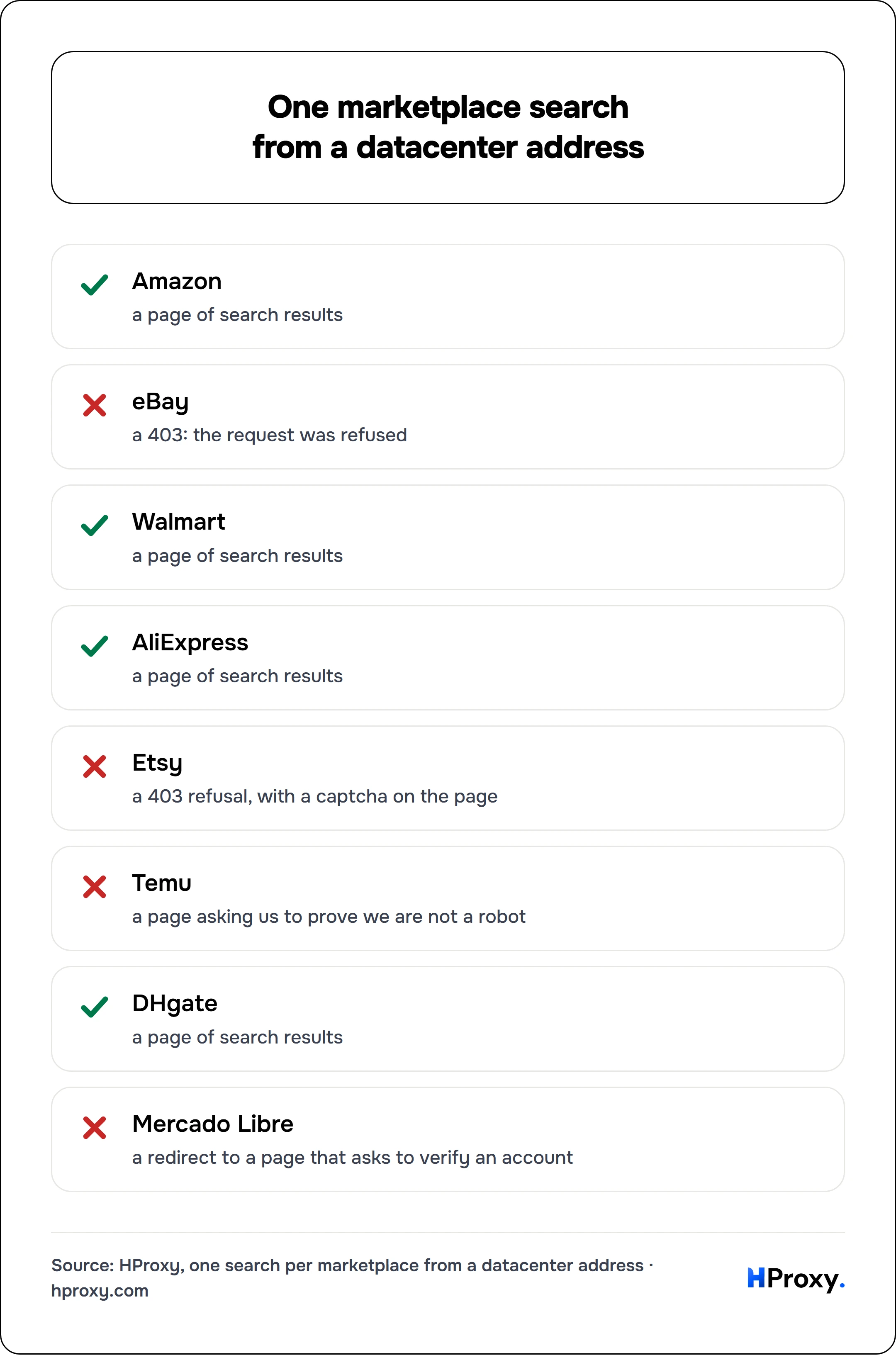
Marketplaces also treat hosting addresses differently from shoppers: on 26 September 2026 we sent one plain search for "running shoes" from our own server, a hosting address, to eight marketplaces:
| Marketplace | What one search from a datacenter address got |
|---|---|
| Amazon | A page of search results. |
| eBay | A 403 status, which means the request was refused. |
| Walmart | A page of search results. |
| AliExpress | A page of search results. |
| Etsy | A 403 refusal, with a captcha on the page. |
| Temu | A page asking us to prove we are not a robot. |
| DHgate | A page of search results. |
| Mercado Libre | A redirect to a page that asks to verify an account. |
- Amazona page of search results
- eBaya 403: the request was refused
- Walmarta page of search results
- AliExpressa page of search results
- Etsya 403 refusal, with a captcha on the page
- Temua page asking us to prove we are not a robot
- DHgatea page of search results
- Mercado Librea redirect to a page that asks to verify an account
That is one request each, from one address, on one day. It is a look, not a block rate, and the four that answered may refuse the hundredth request.
Which proxy type fits which check
| Check | Proxy type | Why |
|---|---|---|
| Listing sweeps on marketplaces | Rotating residential, per country | You see the listings a shopper in that country sees. |
| One seller store, page by page | Sticky residential or a static ISP address | The session keeps one address. |
| Ads and their landing pages | Residential or mobile, in the target city | Ads are aimed at places and devices. |
| Lookalike domains and fake sites | Datacenter first | Cheap for plain sites; move up when one refuses you. |
| Minimum advertised price checks | Residential in the retailer market | You see the price a local shopper sees. |
Every row assumes public pages and each site's own terms. Where a marketplace refuses you, the answer is its brand programme, not more addresses.
Our guide to rotating and static residential proxies covers the session choice in more depth.
The setup
- List your markets: where you sell, and where the fakes ship from.
- Choose exits per market: country for broad sweeps, and state, city or network where ads or prices differ locally.
- Confirm the location of an exit before you rely on it, with a tool such as our proxy location checker.
- Rotate for discovery, then hold a sticky session for the evidence pass.
- Log the six fields from the table above on every check, with no gaps.
- Report through the channel each platform offers: Project Zero or Brand Registry on Amazon, notice and action in the EU, the UDRP at WIPO for domains.
There is no fixed number of addresses: you need an exit in each market you check, and each site's own rate limits still apply.
What breaks, and when
- Hosting addresses get refused: four of the eight marketplaces we tried turned away a single search from one. Take the refusal as the site's answer, and report through its own channel.
- Narrow targeting runs dry: our gateway returns an error when nothing free matches a city or network, and the fix is to widen it.
- Sticky sessions break: a failed session can keep failing after release, so start a new session id instead of retrying.
- Location data disagrees: in one of our support cases, two fraud-scoring databases placed a UK address in the US, because its network is registered to a US company.
- Cloaking still works on some checks: no proxy type guarantees the shopper view on a site that is set on hiding it.
- The rules stay yours: our terms make the customer responsible for the terms, robots.txt and rate limits of every site they reach, so keep to public pages.
Proxies for brand protection at HProxy
Brand protection is one of the permitted business uses in our terms. Residential proxies come in two pools. Lite is targeted by country: one GB costs $0.50, falling to $0.44/GB at 2,000 GB+. Premium adds ISP, state and city targeting with sticky sessions up to 24 hours, from $1.49 for one GB down to $1.00/GB at 1,000 GB+, and it is the pool for ads and prices that change by city. For one seller store, a static ISP address costs $2.70/IP for a month, and mobile proxies on 4G and 5G carrier addresses cost $1.50/GB for ads aimed at phones.
Sources
Read on 26 September 2026:
- Global trade in fake goods reached USD 467 billion, OECD, 7 May 2025 (archived copy of 25 September 2026), on the OECD and EUIPO report Mapping Global Trade in Fakes 2025.
- 2025 Trustworthy Shopping Experience Report, Amazon.
- 2025 Marks Record-Breaking Year for WIPO Domain Name Disputes, WIPO, January 2026.
- Regulation (EU) 2022/2065, the Digital Services Act, Articles 16 and 22, Official Journal of the European Union, 19 October 2022.
- Spam policies for Google web search, Google Search Central, updated 28 August 2026.
- Abusing the ad network and Target ads to geographic locations, Google Ads Help.
- Our own probe of eight marketplaces from one datacenter address, 26 September 2026, and our gateway documentation.