Choose an enterprise proxy provider on what you can check, not on what its page says. Write your workload down first, then ask each provider for the document behind every claim, test the pool on your own targets, and read the terms you would sign. The eight checks below take a business from a written need to a signed order, and each one names the paper to ask for.
In this guide, an enterprise proxy provider sells a business outbound IP addresses for data work: price monitoring, ad checks, brand protection and market research. That is a different product from the forward proxy a company runs for its own staff, such as a secure web gateway. It has nothing to do with a corporate proxy in the sense of a shareholder vote.
What seven providers publish for business buyers
We read the business pages of seven providers on 26 and 27 September 2026, and the SLA, DPA, certificate and sourcing documents those pages link to. Six state an uptime figure, but only two publish an SLA that defines downtime and pays credits, and both set 99.9 percent. None of the 99.99 percent figures has a public SLA behind it. Four name a security standard, and one of them links the certificate itself. Six say their IPs are sourced ethically or with consent, and one of those publishes how a device joins the pool and how its owner leaves.
| Provider | Uptime figure and SLA | Security standard |
|---|---|---|
| Live Proxies | A success rate, no SLA | None named |
| DoubleData | 99.9%, credits in a private contract | "Compliant with" ISO 27001 |
| ProxyWing | 99.99%, no SLA | None named |
| Decodo | 99.99%, no SLA | ISO/IEC 27001, certificate not shown |
| SOAX | 99.9% on Premium, public SLA with credits | Working towards ISO 27001 and SOC 2 |
| Infatica | 99.9%, no SLA | ISO/IEC 27001 certificate linked |
| Rayobyte | 99.9%, public SLA with credits | None named |
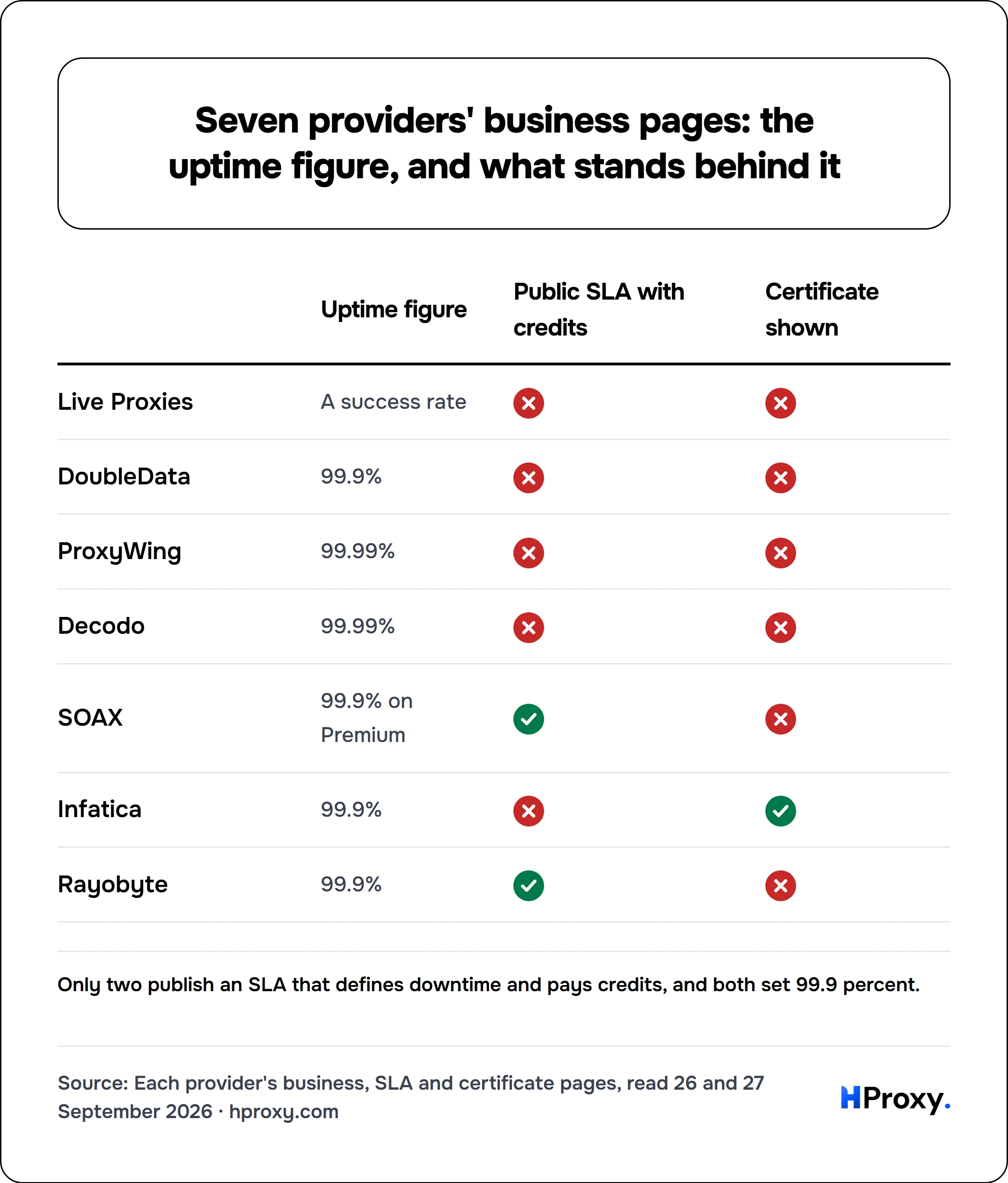
| Uptime figure | Public SLA with credits | Certificate shown | |
|---|---|---|---|
| Live Proxies | A success rate | no | no |
| DoubleData | 99.9% | no | no |
| ProxyWing | 99.99% | no | no |
| Decodo | 99.99% | no | no |
| SOAX | 99.9% on Premium | yes | no |
| Infatica | 99.9% | no | yes |
| Rayobyte | 99.9% | yes | no |
Each cell is what that provider published on its own pages, or in the documents they link, when we read them, and a private contract can promise more. Three of the seven also set a minimum spend, a commitment or a starting volume; check 7 shows what those look like. We also checked the eight guides that rank for these searches. Seven of them link no standard, no regulator and no court at all.
What to write down before you contact a provider
A provider can only answer the questions you can state. Put these on one page:
- The sites you will reach, and the countries or cities you need.
- The proxy type: rotating residential, static ISP, datacenter or mobile.
- How long one session must keep its IP, and how many requests run at once.
- The monthly volume, in GB or in IP addresses.
- Whether the traffic carries personal data, and who in the company signs off.
The same page becomes your test plan in check 6.
The eight checks
Work through them in order. All but one need only documents and questions; check 6 needs a small test budget.
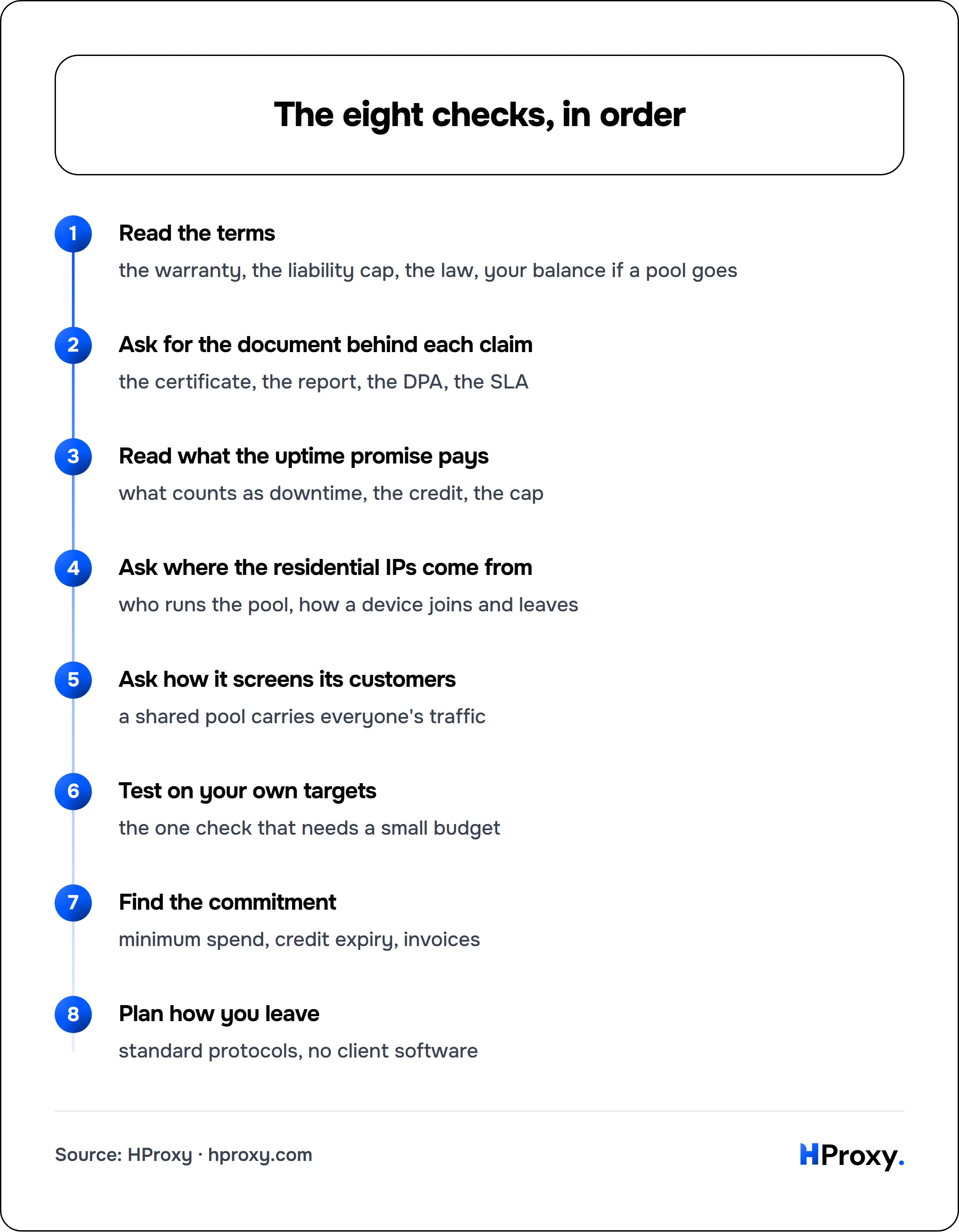
Read the terms
the warranty, the liability cap, the law, your balance if a pool goes
Ask for the document behind each claim
the certificate, the report, the DPA, the SLA
Read what the uptime promise pays
what counts as downtime, the credit, the cap
Ask where the residential IPs come from
who runs the pool, how a device joins and leaves
Ask how it screens its customers
a shared pool carries everyone's traffic
Test on your own targets
the one check that needs a small budget
Find the commitment
minimum spend, credit expiry, invoices
Plan how you leave
standard protocols, no client software
1. What do the terms say?
The contract decides what a provider owes you, not the landing page. Read four clauses before anything else. The warranty clause says whether the service is provided "as is" or with a promise. The liability clause sets a cap on what you can recover, and says what that cap is tied to. The law clause names the country whose law applies and the court that hears a dispute. The last one says what happens to your balance when the provider withdraws a pool.
Then read the acceptable-use section, which lists the jobs the provider has agreed to carry, and check that yours is on it.
2. Which document stands behind each claim?
A claim on a web page is marketing until someone signs it. For each one, ask for the document and read three things: who issued it, what it covers, and until when.
| The page says | Ask for | A real one shows |
|---|---|---|
| ISO 27001 | The certificate | The body that issued it, and the system it covers. |
| SOC 2 | The report | The CPA firm and the controls it examined. |
| GDPR compliant | A data processing agreement | The terms of Article 28. |
| 99.9% uptime | The SLA | What counts as downtime, the credit, the cap. |
| Ethically sourced | A sourcing statement | Who runs the pool, and how a device joins and leaves. |
| KYC | The written policy | When identity is checked, and what is refused. |
Certificates: ISO does not certify anyone, and its own page says certification "is performed by external certification bodies, thus a company or organization cannot be certified by ISO." Ask for the certificate, note the body that issued it, and check it in IAF CertSearch or with that body, as ISO advises. ISO/IEC 27001 sets the requirements for an information security management system. One provider in our sample links the certificate from its own pages. Its scope covers the development and services of its data platform, and its text does not name the body that issued it. So read the scope line, not only the logo, and ask who issued it. Another provider says its platform is "compliant with ISO 27001 standards", which is a sentence, not a certificate. A third says it is "in the process of acquiring" the certification.
SOC 2 reports: a SOC 2 report comes from a CPA firm that examined the controls of a service provider for security, availability, processing integrity, confidentiality or privacy. Ask for the report and the name of the firm. The AICPA, which sets the standard, warns that promises of "fast and easy" reports threaten their credibility.
Data processing agreements: if your legal team treats the provider as a processor of personal data, Article 28 of the GDPR sets out what the contract must say. It names the subject, duration and purpose of the processing and the types of data. It bars the provider from hiring another processor without your written approval, returns or deletes the data at the end, and allows audits. Four of the seven providers offer or link such an agreement. One of those makes the provider an independent controller unless its processor terms are agreed in writing, so check which role the agreement gives the provider.
A provider you cannot see into is a supply-chain risk. NIST SP 800-161 is the US guidance for this kind of risk: identify it, assess it and reduce it.
3. What does the uptime promise pay?
An uptime figure without a remedy is a hope. An SLA turns it into money: it defines downtime, counts it over a month, and pays a credit when the target is missed. Two of the seven providers publish such a document, and both set 99.9 percent a month. What a missed month pays differs widely:
- One pays 10, 20 or 30 percent of the charges for the proxy that failed. Credits of $5 or less are not paid, and claims close after 14 days.
- One pays 15, 35 or 75 percent of the monthly plan fee on its Premium tier, but nothing on top-ups or overage. Its Standard tier pays less, and the table in its SLA leaves that tier's target blank.
In both, the credit is the only remedy. The higher figures sit elsewhere: two other providers advertise 99.99 percent uptime with no public SLA behind it. A higher figure may exist in a private contract, which is why you ask for the one you would sign.
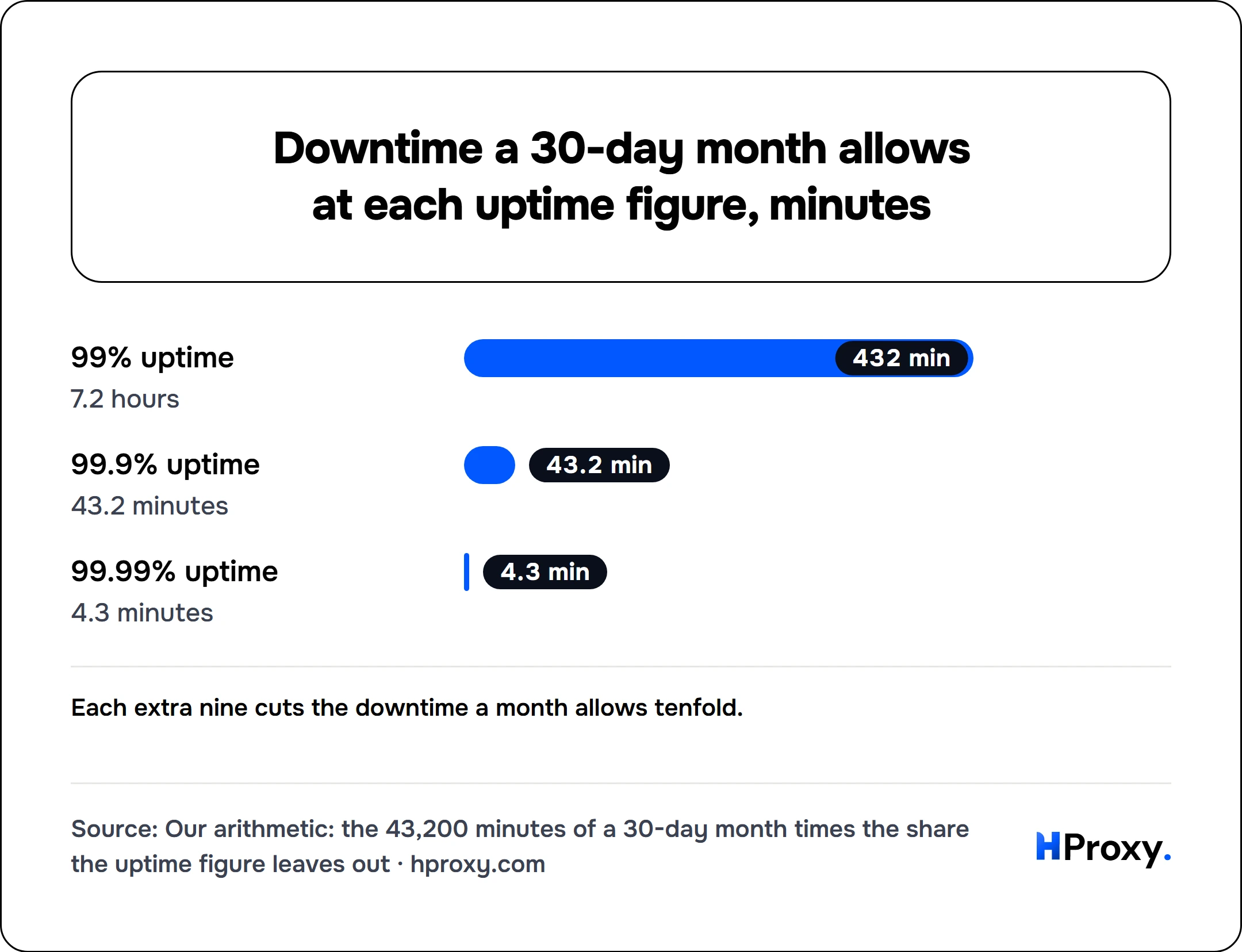
The figures sound close, but the gaps are wide: in a 30-day month, 99 percent uptime allows 7.2 hours of downtime, 99.9 percent allows 43.2 minutes, and 99.99 percent allows 4.3 minutes.
Read three more things in any SLA. First, the definition of downtime: the Google Cloud Secure Web Proxy SLA counts only a 100 percent error rate, and gaps under a minute do not count. Second, the claim process: that SLA wants notice within 30 days and your log files. Third, the scope: the two proxy SLAs measure whether the network or the proxy answers, and one says in writing that its targets do not measure "success rate or acceptance at a specific target". So an uptime promise is not a promise that a site will answer your requests.
4. Where do the residential IPs come from?
Residential IPs belong to home connections, and Google notes that operators "need code running on consumer devices to enroll them into the network". Its Threat Intelligence Group studied IPIDEA, which it believes is one of the largest such networks. It found that ethical-sourcing claims by residential providers "are often incorrect or overstated". It also found that operators "share pools of devices using reseller agreements", and that several brands which looked independent were controlled by the same actors. In one week of January 2026, over 550 tracked threat groups used IPIDEA exit nodes.
The US Justice Department described another service, 911 S5, as a residential proxy built from malware-infected computers. Those computers were tied to more than 19 million IP addresses. US officials estimate that 560,000 fraudulent unemployment claims came from them, with confirmed losses above $5.9 billion. Our write-ups of 911 S5 and of the IPIDEA cluster show how both were built.
So ask four questions, and get the answers in writing:
- Who operates the pool: the provider, or a network it resells?
- How does a device join: which app or SDK, and does its owner see a clear opt-in?
- How does the owner stop sharing, and is the owner paid for sharing?
- What does the provider do when an upstream network fails a check?
The EWDCI, an industry group, commits its members to "sourcing proxies ethically, with informed consent". Six of the seven providers we read claim ethical or consented sourcing, but only one publishes the steps. It names the app or SDK a device owner opts into, what the owner gets in return, and how the owner opts out. A second says owners opt in through its partners and are paid per GB, without naming the apps or the way out. The rest give a sentence or a paragraph. Treat the adjective as a question, and that one page as the measure of a full answer.
5. How does the provider screen its customers?
A rotating pool is shared, so if a provider sells to anyone, your requests leave from the same addresses as everyone else. Google found that devices used as exit nodes can be "flagged as suspicious or blocked" because of the traffic that passes through them. The EWDCI principles call for Know Your Customer checks "especially when high-risk tools like residential IPs are involved".
Ask for two documents: the written identity policy and the acceptable-use policy. The first says when the provider checks who you are. The second says what it refuses to carry.
6. How do you test a provider on your own targets?
A demo on the targets of the provider tells you little. Test on yours, at the concurrency you will run, across your busy hours. Keep the numbers in a scorecard:
| Measure | How to take it |
|---|---|
| Success rate | Share of requests that returned the page you wanted. |
| Speed | Median time and the slowest tenth, per target. |
| Location | Share of exits in the country you asked for. |
| Cost per 1,000 good pages | Spend divided by successful pages, times 1,000. |
| Support | Time to a useful answer on one real ticket. |
| Meter | Your own byte count against the bill. |
Ask how a GB is counted before you compare prices. One provider states that it counts "data in both directions, including partial responses, retries, and interrupted connections", and that "One GB is one billion bytes." A pool that costs half as much per GB but succeeds half as often costs the same per useful page.
For checks on the IPs themselves, such as the network owner and the real location, see how to vet a proxy provider.
7. Do enterprise plans require a commitment?
Business plans differ more in their terms than in their prices. In our sample, one provider requires a minimum budget of $2,000 a month for custom plans. Another starts its Enterprise plan at 1 TB of traffic. A third asks for business verification, a signed agreement and a 12-month commitment on its annual plan, and invoices the fee in advance. The same provider says bank transfer may be available to approved business accounts, and it expires prepaid credits on monthly plans after 60 days.
Ask five questions before the trial ends:
- Is there a minimum spend, a commitment, or a ceiling on self-service?
- Does an unused balance or credit expire, and after how long?
- Can every invoice carry your company name and VAT ID?
- Can you pay by bank transfer, and on what payment terms?
- Can you cap spending per key or per team, and see usage per project?
8. How do you leave?
Choose a provider you can leave: with standard HTTP, HTTPS and SOCKS5 and no client software, a switch is a change of host, port and credentials. Keep your own record of success rate and spend, so the next test starts from numbers. Note how much notice the terms require and what happens to a balance you have not used.
How to know the choice is sound
The choice holds when four things are on file: the scorecard from your own test, the document behind every claim you relied on, the terms your legal team read, and a named contact for incidents. If a claim has no document, record it as unverified, not as met.
Where buyers go wrong
- Choosing on pool size, a number no buyer can check.
- Reading "compliant with" as "certified".
- Taking an uptime figure without the SLA that pays for it.
- Accepting "ethically sourced" without the steps to join and to leave.
- Finding the minimum, the commitment or the credit expiry after the trial.
How HProxy answers these checks
We hold ourselves to the same list, and this is what you can check today:
- Terms: our terms provide the service "as is" and "as available", cap liability at the fees of the preceding twelve months, and apply German law. They cover the pool behind a product for 30 days from purchase. Permitted uses are listed: web scraping, ad verification, SEO research, brand protection, market intelligence, price monitoring and browser automation.
- Identity policy: our compliance page says it plainly: no documents at sign-up, every card payment screened before delivery, documents deleted 90 days after review.
- Spend control: API keys carry scopes and an optional daily spend cap, and an order over the cap is refused before any charge.
- Usage: traffic statistics per Residential Premium plan, with bytes, requests and success rate by target host and country.
- Billing: a numbered invoice for every top-up and a statement for any period, with your company name and VAT ID once they are in your billing details.
- Volume: residential bandwidth gets cheaper on its own as you buy more, with no minimum order. Residential Lite, targeted by country, goes from $0.50 for one GB to $0.44/GB at 2,000 GB+. Residential Premium, with city, state and ISP targeting, goes from $1.49 for one GB to $1.00/GB at 1,000 GB+. One order holds up to 1,000 dedicated IPs or 10,000 GB.
- Exit: standard HTTP, HTTPS and SOCKS5, with no SDK and no client software to install.

What we do not publish today: an uptime SLA, a security certificate or a data processing agreement. If your review needs any of them, write to sales before you buy, and you get a plain answer on what we can sign. The same address handles high volume, dedicated infrastructure and invoicing.
How we read the providers
On 26 September 2026 we read the visible text of the enterprise, business pricing and SLA or support pages of Live Proxies, DoubleData, ProxyWing, Decodo, SOAX, Infatica and Rayobyte. On 27 September we followed the links those pages show to an SLA, a DPA, a certificate, a trust centre or a sourcing policy. We read those documents too, including a certificate. We coded each cell by hand, with the quote behind it, because footer links and use-case words fool a keyword count. "None named" means the pages and documents we read say nothing about it. We did not query IAF CertSearch for each provider. For the eight ranking guides, we counted links to standard bodies, regulators and courts. Terms change, so treat this table as a snapshot of those two days.
Sources
Standards, law and official records, read on 26 September 2026:
- Certification, International Organization for Standardization (undated page, archived copy of 19 September 2026).
- ISO/IEC 27001:2022, Information security management systems, International Organization for Standardization.
- System and Organization Controls: SOC suite of services, AICPA and CIMA.
- Regulation (EU) 2016/679 (GDPR), Article 28, Official Journal of the European Union, 27 April 2016.
- SP 800-161 Revision 1, Cybersecurity Supply Chain Risk Management Practices, NIST, May 2022, updated 1 November 2024.
- Cloud Secure Web Proxy SLA, Google Cloud, last modified 9 September 2025.
- Disrupting the World's Largest Residential Proxy Network, Google Threat Intelligence Group, 28 January 2026.
- 911 S5 Botnet Dismantled and Its Administrator Arrested, US Department of Justice, 29 May 2024.
- Our Principles, Ethical Web Data Collection Initiative, an industry group (not linked).
Provider pages, quoted for what each provider says about itself and not linked, read on 26 and 27 September 2026:
- SOAX: its pricing and billing FAQ, its Service Level Agreement (effective 1 June 2026), its DPA and its trust page.
- Rayobyte: its enterprise page, its Proxy Service Level Agreement and its page on ethical usage and acquisition.
- Infatica: its page for companies, its certifications page, its ISO/IEC 27001 certificate and its DPA.
- Decodo: its enterprise page and its security and sourcing pages.
- DoubleData: its enterprise page and its compliance page.
- ProxyWing: its enterprise page and its DPA.
- Live Proxies: its enterprise page.