We keep a record of what providers in this market charge and what happens to them over time. This page is the part of that record covering Live Socks, written up for somebody deciding today.
The record we hold
The domain is live-socks.net. They are filed here as a free proxy list.
What we do not hold is a current, sourced price for Live Socks. Rather than print a figure we cannot stand behind, this page leaves it out and tells you what to look for when you read their page yourself.
Their pricing page will answer three of the four questions that matter. Send an email for the fourth, which is usually whether blocked requests are billed, and keep the reply.
What is on their front page
As of 9 September 2026 the tab reads "Free SOCKS5 Proxy List: Fresh Servers Four Times a Day". The description they publish for search engines reads: "Free SOCKS5 and SOCKS4 proxy lists published four times a day. Every server is checked for country, port, response and uptime."
What else that page states, without interpretation:
The product lines named on that page are mobile and SOCKS5. They advertise 25 countries or locations. We found no separate pricing page linked from the homepage, which usually means the price arrives by quotation.
That is the vendor speaking, not us. We print it because a claim with a date attached is at least falsifiable.
The domain record
The domain was registered on 22 July 2011, through Dynadot Inc, which makes it about 15 years old. That record was read from the registry on 9 September 2026. The registry shows it renewed to 22 July 2027.
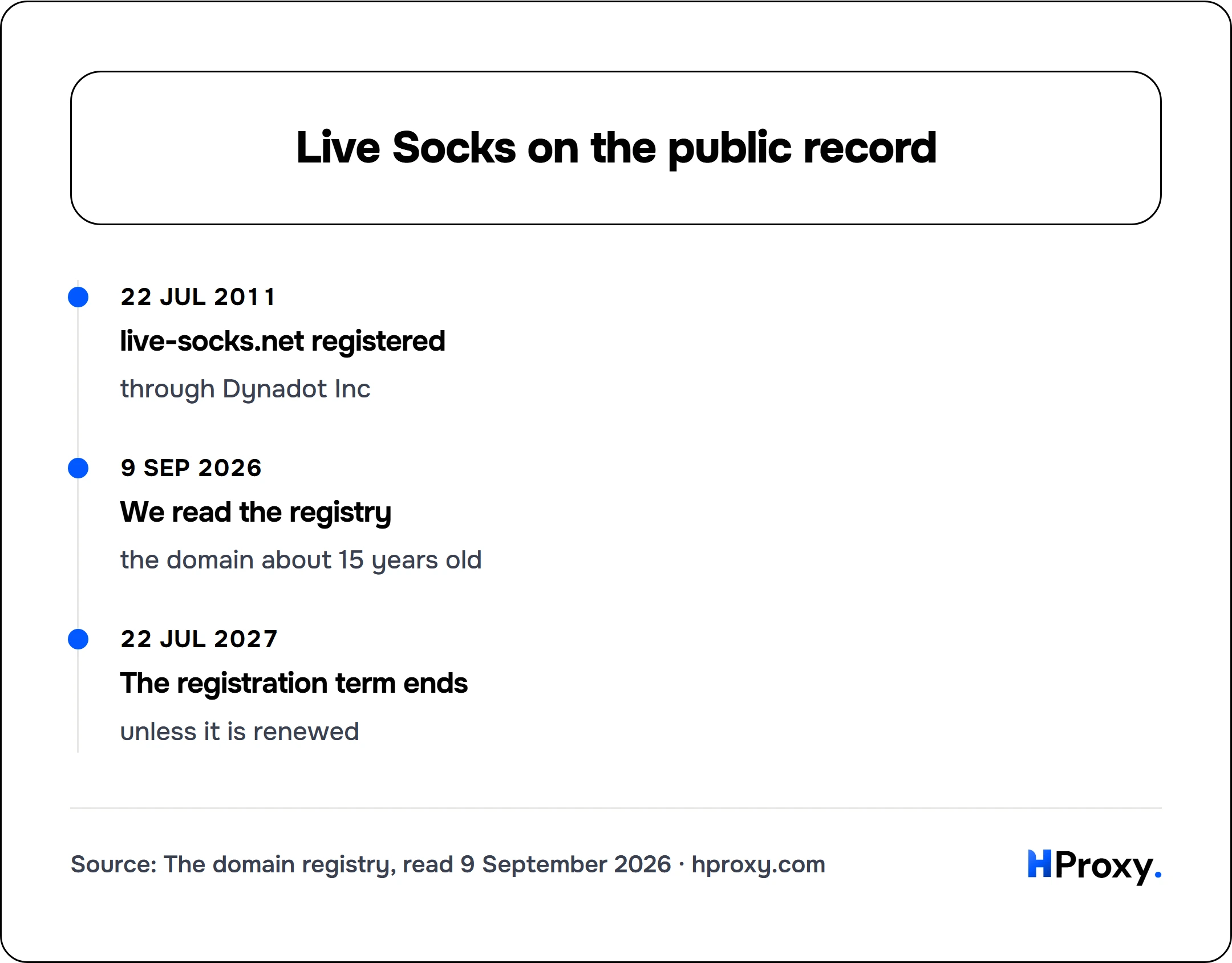
22 Jul 2011
live-socks.net registered
through Dynadot Inc
9 Sep 2026
We read the registry
the domain about 15 years old
22 Jul 2027
The registration term ends
unless it is renewed
Age is not quality. A long registration does not make a network good, and a new one does not make it bad. What it does rule out is the shortest-lived pattern in this market, which is a site that appears, sells, and is gone inside a year.
Whose list this is
We checked this one by hand on 6 September 2026. It is a list, and we record the operator as independent.
As far as we can establish it is run independently rather than by a proxy vendor. That usually means it survives on advertising, which shapes the site rather than the data.
The Internet Archive has it from 23 July 2011 to 1 February 2023, about 13 years of coverage. The domain was registered 22 July 2011 through Dynadot Inc.
Every list in this category has the same underlying problem, which is decay. We measure it on our own network and publish it: 4,023 alive on 2026-08-11, out of 589,918 ever discovered. Those that worked, then stopped, lasted a median 10 days, counting only addresses with fewer than 20 of them, without Amazon's networks or one June evening when our checker failed (measured 2026-09-28). A list is only as good as its last check.
The parts no marketing page answers
What passes through, and what is kept
A service with no stated retention period has one anyway, and it is whatever their hosting provider does by default. Absence of a policy is a policy, and usually not the one you would choose.
A country count is not coverage
Almost every provider claims almost every country. What differs is depth, and depth decides whether a single city or a single carrier is usable. No published figure tells you that.
What happens when it breaks at two in the morning
Support quality is invisible until it is the only thing that matters. A cheap provider that takes three days to answer a routing problem has cost you more than the saving, and no pricing page reveals that.
Side by side, with the blanks left blank
The rows that matter, with our own answers stated plainly:
| Question to ask | Live Socks | HProxy |
|---|---|---|
| Entry price | Not verified by us, read their page | From $0.44/GB, pay as you go |
| Does unused balance expire? | Check the current terms, this one moves | Never |
| Minimum commitment | Read their current terms | None |
| Identity checks | Worth confirming in writing before you commit | Card orders are screened, and verification is sometimes requested |
| Targeting | Not published clearly, ask before paying | Country, city and ISP |
| Free way to evaluate | On their own terms page | Free proxy list and proxy checker |
Two notes on that table. The rows we left for you to check are not evasions: those terms change, and printing a stale figure is exactly the failure this page is trying to avoid. And no table can hold the number that should decide your purchase, which is the success rate on your own target.
The ten minute version of this decision
For a few dollars you can get a verdict specific to your job, which no comparison page can honestly promise you.
- Start with the smallest purchase each vendor allows, so the test costs less than the decision it replaces.
- Use your own scraper and your own target. A benchmark against a neutral site measures nothing you will experience.
- Measure what came back correctly and what it consumed, then divide the spend by the successes.
- Push a sample of exit addresses through an independent checker and confirm the country and connection type are what was advertised.
- Buy the one that won on your target, and diarise a re-test in three months.
The other names that come up
Other providers in the same bracket, priced and dated the same way:
- CheckerProxy alternatives
- clarketm proxy-list (GitHub) alternatives
- DidSoft alternatives
- Fauvet alternatives
- Free Proxy alternatives
Where HProxy sits in that test
Our own lane is easy to state. Residential starts at $0.44 per GB with country targeting, the balance is topped up when you want and does not expire, there is no subscription unless the optional discount suits you, and city and ISP targeting come with Residential Premium from $1.00 per GB. If the test above puts us second on your target, buy the winner.