
Every proxy provider page, ours included, is built from advertised prices and claimed pool sizes. Those two materials cannot tell you what you actually need to know, so this page spends most of its length on what they leave out.
Everything we can stand behind
Jinglingip (精灵代理) trades at jinglingip.cn.
There is no price in this comparison because we do not have one we can date and attribute. What follows instead is the set of questions that decide the cost once you do read their page.
Check the reachable rate, the minimum, the expiry terms and the failure billing, and date your note. A price without those four attached is not a price.
Jinglingip (精灵代理) in its own words
On 9 September 2026 the site introduced itself as "精灵IP, 精灵IP代理,换IP软件首选精灵代理IP【精灵IP官网】". The one-paragraph pitch on their own page: "精灵IP - 精灵IP代理加速器,支持安卓手机/电脑/苹果/虚拟机/模拟器/ROS软路由代理IP,PPTP拨号,静态动态IP代理,IP修改器,换IP软件认准精灵IP官网免费试用「Jinglingip.Cn」"
Also on the page, stated plainly:
We found no separate pricing page linked from the homepage, which usually means the price arrives by quotation.
None of that is verified performance. It is what the vendor chose to publish, recorded with a date so you can see whether it still says the same thing.
How far back the record goes
The Internet Archive holds 20 snapshots of the site, the earliest from April 2021.
None of it predicts success rate. It is here because domain age and archive depth are free to check, and a provider whose public record starts last quarter deserves a smaller first order.
What our crawl found
Our own crawl reached 3.769 of their pages. The mix was 3.734 blog pages.
Site size is a signal about marketing budget rather than network quality, and the two are frequently unrelated. It is useful for a different reason: a provider with many pricing pages is usually segmenting hard, and a provider with none is selling by quotation.
Whether anyone is still working on it
Our crawl of their site found 3,769 pages carrying a date, 3,734 of them articles. The oldest is from December 2020 and the newest from August 2026. 252 of them carry a date inside the last twelve months.
Timestamps are not quality, and a company still publishing is at least a company still trading. That is worth more than it sounds in a market where providers disappear without notice.
The questions behind the numbers
Shared or dedicated changes everything
A shared address arrives with a history you did not create and cannot see. For read-only work it rarely matters. For anything that keeps a session, it is the most common cause of unexplained failure.
Who pays for the requests that fail
Divide the spend by the successful responses, not by the requests sent. That single change reorders most price comparisons in this market, and your accounting will use it eventually anyway.
The limit that stops the job
Bandwidth is rarely the constraint on a real workload. Concurrent connections, requests per second and per-session caps are, and they are frequently buried in the documentation rather than the pricing page.
The comparison, honestly framed
Compare on these rows and ignore the feature lists on both sites:
| Question to ask | Jinglingip (精灵代理) | HProxy |
|---|---|---|
| Entry price | Not verified by us, read their page | From $0.44/GB, pay as you go |
| Does unused balance expire? | Not published clearly, ask before paying | Never |
| Minimum commitment | Check the current terms, this one moves | None |
| Identity checks | Their terms page answers this | Card orders are screened, and verification is sometimes requested |
| Targeting | Worth confirming in writing before you commit | Country, city and ISP |
| Free way to evaluate | Read their current terms | Free proxy list and proxy checker |
A table like this can rank the things that are written down. It cannot rank the thing that matters most, which is how the network behaves against the site you care about.
The test that beats this page
It is a small amount of money for an answer that is actually about your target.
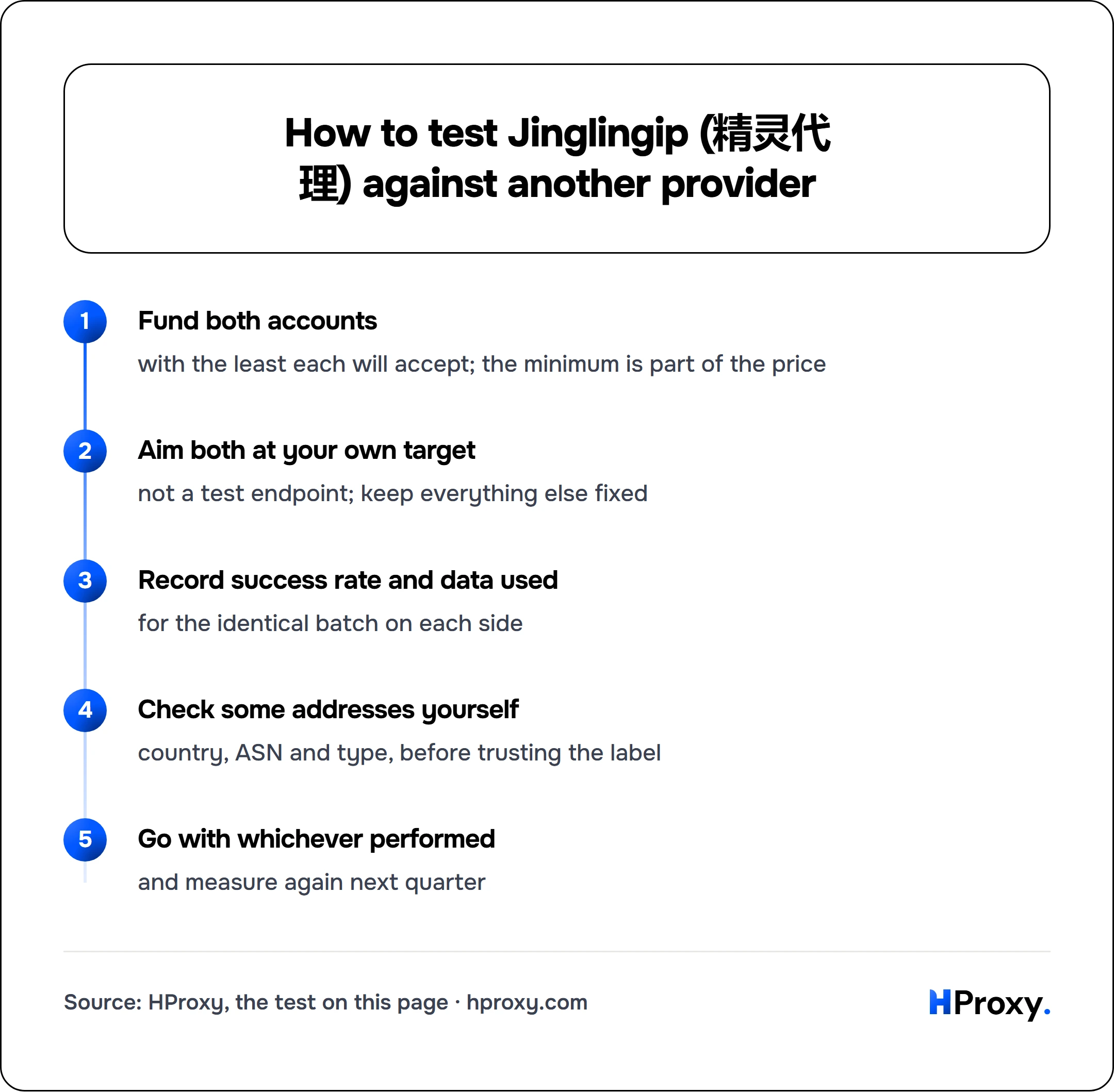
- Fund both accounts with the least money each will accept, and note what that minimum was, because it is part of the comparison.
- Aim both at the page that matters to you rather than a test endpoint, and keep every other variable fixed.
- Record the success rate and the data consumed for the identical batch on each side.
- Check some of the addresses yourself for country, ASN and type before you trust the label on the plan.
- Go with whichever performed, then measure again next quarter. Networks change underneath you.
Fund both accounts
with the least each will accept; the minimum is part of the price
Aim both at your own target
not a test endpoint; keep everything else fixed
Record success rate and data used
for the identical batch on each side
Check some addresses yourself
country, ASN and type, before trusting the label
Go with whichever performed
and measure again next quarter
Where else buyers look
If this one does not fit, these are the nearest comparable providers we have written up, each on the same terms as this page.
- Proxylte alternatives
- Proxyma alternatives
- Proxyman alternatives
- Proxymania alternatives
- Proxymaps alternatives
- ProxyMix alternatives
Where we fit
For completeness: residential from $0.44 per GB with country targeting, city and ISP targeting on Residential Premium from $1.00 per GB, no monthly minimum, and a balance that stays where you left it. We are a good fit for uneven workloads and a poor one for anybody who wants a signed enterprise agreement.