Choosing a proxy provider on price alone is the most common and most expensive mistake in this market, because a cheap request that fails costs more than a dearer one that works. That framing runs through the whole page.
What is on file for Illusory
Illusory trades at illusory.io.
We price the providers we can source and date, and Illusory is not currently one of them. The rest of this page is about what to check when you read their pricing yourself.
Check the reachable rate, the minimum, the expiry terms and the failure billing, and date your note. A price without those four attached is not a price.
Illusory in its own words
The title tag on 9 September 2026 was "Illusory, Modern proxies for data-led operations". The one-paragraph pitch on their own page: "Illusory makes it easier to scrape online data and perform automated tasks without getting blocked or detected. Train AI language models, conduct market research, or run mission-critical operations with our powerful, bare metal mobile proxies."
Taken from the same page, on the same day:
The product lines named on that page are mobile, SOCKS5 and IPv6. Their pricing page is titled "Pricing, Illusory".
Treat all of it as advertising, because it is. Its value is that it is dated and quotable, which is more than most comparison pages offer.
Age, and why it matters here
The domain was registered on 27 August 2019, through NameCheap, Inc, which makes it about 7 years old. We pulled that from the registry on 23 April 2026. The current registration term ends 27 August 2026.
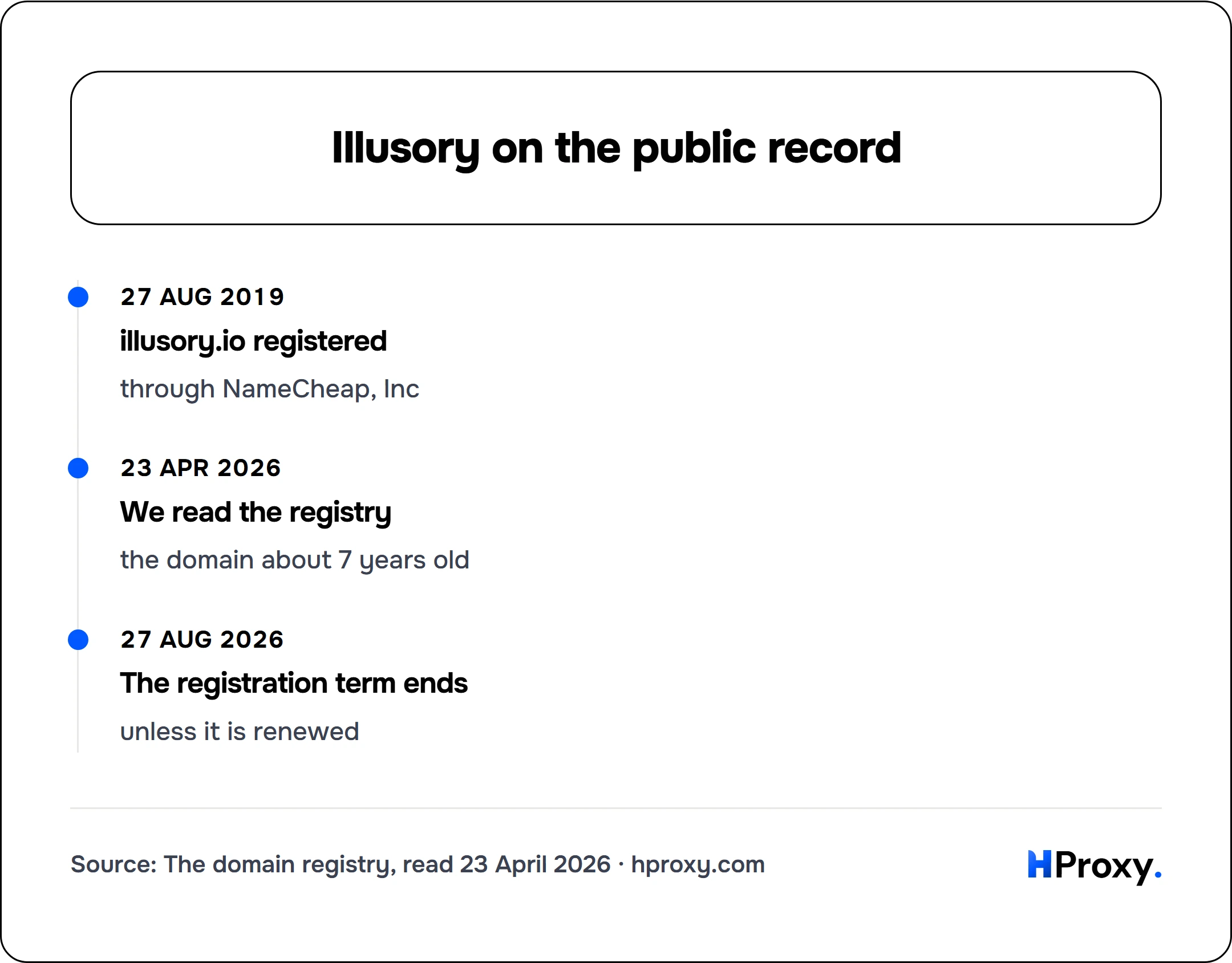
27 Aug 2019
illusory.io registered
through NameCheap, Inc
23 Apr 2026
We read the registry
the domain about 7 years old
27 Aug 2026
The registration term ends
unless it is renewed
This proves nothing about the product. It is a cheap check against the one failure mode that costs buyers real money in this market, which is paying a provider that will not exist in six months.
What Illusory publishes
We crawled 27 pages of their site and found 21 blog pages and 1 pricing page.
The number is not a compliment or a criticism. It describes how much of their effort goes into being found, which is worth knowing when you are weighing a marketing claim against a measurement.
What you still do not know after reading their site
The comparison that is not a comparison
Half this market prices bandwidth and half prices addresses. A per-address plan is cheap for heavy traffic through few exits and ruinous for light traffic through many, and the reverse holds for per-gigabyte plans.
Who else is using your address
Ask how many accounts can sit on one address at once. Where the answer is unlimited or unspecified, price the plan as shared regardless of what the product is called.
Ask whether failed requests are billed
Divide the spend by the successful responses, not by the requests sent. That single change reorders most price comparisons in this market, and your accounting will use it eventually anyway.
The two of us, on the questions that matter
Set the two side by side on the questions that decide the outcome, rather than on feature counts:
| Question to ask | Illusory | HProxy |
|---|---|---|
| Entry price | Not verified by us, read their page | From $0.44/GB, pay as you go |
| Does unused balance expire? | Read their current terms | Never |
| Minimum commitment | Check the current terms, this one moves | None |
| Identity checks | Their terms page answers this | Card orders are screened, and verification is sometimes requested |
| Targeting | Check the current terms, this one moves | Country, city and ISP |
| Free way to evaluate | Their terms page answers this | Free proxy list and proxy checker |
The useful part of that table is the left column. Take those six questions to any provider in this market and the answers will sort them faster than any review.
The measurement that outranks every review
This costs less than a coffee and produces the only evidence that applies to your workload.
- Take the smallest paid unit each provider will sell you. A free trial works for a first pass, though trials sometimes ride better pools than paid plans do.
- Fire the same batch through both on one afternoon. Different days are different conditions, and that ruins the comparison.
- Track the success rate and the bandwidth. A cheap gigabyte that fails half the time is not cheap.
- Run a sample of the addresses through an independent lookup, because advertised geography and actual geography differ more often than the market admits.
- Go with whichever performed, then measure again next quarter. Networks change underneath you.
Where else buyers look
If this one does not fit, these are the nearest comparable providers we have written up, each on the same terms as this page.
- Leastslow alternatives
- LegionProxy alternatives
- Lemonclub alternatives
- LightningProxies alternatives
What we sell, stated plainly
Our position is narrow. Residential from $0.44 per GB, no subscription, no expiry on the balance, and a public record of what our free network actually does. A provider unwilling to be measured is telling you something, and so is one that asks to be.