LightningProxies (lightningproxies.net) sells residential, mobile, ISP, datacenter and IPv6 proxies, and launched its website in January 2023. On 14 October 2026 its residential traffic cost $4.50 for 1 GB, falling to $2.20 a GB in a 100 GB plan, under a banner promising "27% OFF on all Residential Proxies Plans". In January the same traffic started at $3.50 a GB. Its terms name no company and choose the laws of Romania, and its refund rules exclude most cases. Our comparison with DataImpulse, Proxy-Cheap and Webshare, priced the same day, is below.
What LightningProxies sells
The product menu lists six lines, each sold "Pay as you go": residential traffic by the gigabyte, unlimited residential plans by throughput, ISP proxies by the IP, datacenter and IPv6 proxies by the day, and mobile traffic by the gigabyte. The residential pool is advertised as 20M+ real IPs in 195 countries, with targeting by country, state, city and network. The unlimited plans draw on "5M+ Residential IPs" at speeds from 100 Mbps to 1000 Mbps, for one day, one week or 30 days. The mobile pool is given as 500k+ IPs. ISP proxies come "with unlimited bandwidth", and you pay per IP for the length of the subscription.
Its menu gives IP counts by country, among them 1,530,310 in the United States, 1,350,429 in Brazil and 1,130,344 in China. The site also offers free tools, a proxy checker and a WHOIS lookup among them, and setup pages for a dozen antidetect browsers.
It sells to other proxy shops as well. Its reseller page offers a "White Label Reselling Program", so that anyone can start "their proxy business with minimal investments and zero risk", with a "30 Day Free Trial" for resellers. A proxy bought under another brand name may therefore run on LightningProxies' network, and the reseller page names none of the brands that do.
What it costs, and how prices moved this year
| product | January 2026 | October 2026 |
|---|---|---|
| residential | from $3.50 a GB | from $4.50 a GB |
| unlimited residential | from $260 a day | from $155 a day |
| datacenter | from $10 a day | from $2 a day |
| ISP | from $4 an IP | from $4 an IP |
| IPv6 | from $10 a day | from $10 a day |
| mobile | from $5 a GB | from $5 a GB |
The January figures come from the archive's copy of its homepage of 19 January 2026; the October ones from its live pages. Residential traffic became dearer, while unlimited plans and datacenter proxies became much cheaper.
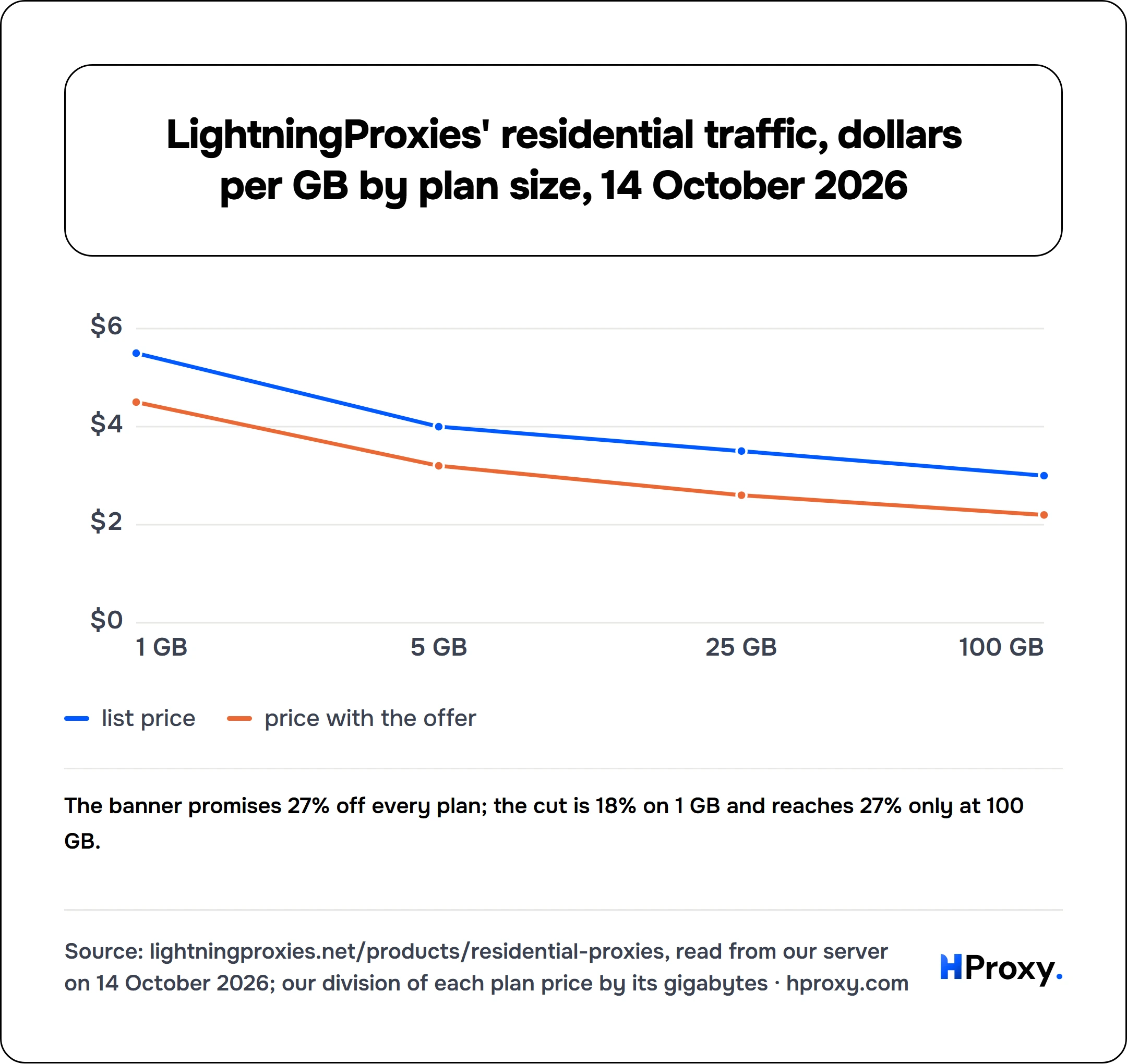
- list price
- price with the offer
The plans cost $5.50 for 1 GB, $20 for 5 GB, $87.50 for 25 GB and $300 for 100 GB before the offer, and $4.50, $16, $65 and $220 with it. Each is marked "/ one-time".
The fine print
Refunds in few cases. Residential, mobile and IPv6 proxies can be refunded only when "Less than 100MB of data has been used" and the customer can "demonstrate that the service is not usable". Even then, "If the service is functioning as intended", there is no refund. Datacenter, unlimited residential and ISP proxies "are non-refundable and cannot be exchanged for credits". A technical fault longer than 48 hours brings a full refund only inside the first 48 hours after purchase, and a partial one later.
A trial that closes the door on refunds. The FAQ offers a free trial through the live chat, with "Certain conditions apply". The refund policy then says that a customer who "received a trial and then purchased the service" gets no refund for that purchase "under any circumstances".
Romanian law, a shop's template. The terms are governed by "the laws of Romania". Much of their wording comes from an online store's template: they speak of products "subject to return or exchange only according to our Return Policy" and of orders that use "the same billing and/or shipping address", for a service that ships nothing.
Payment. The FAQ lists cards, PayPal and a range of cryptocurrencies.
Who runs LightningProxies
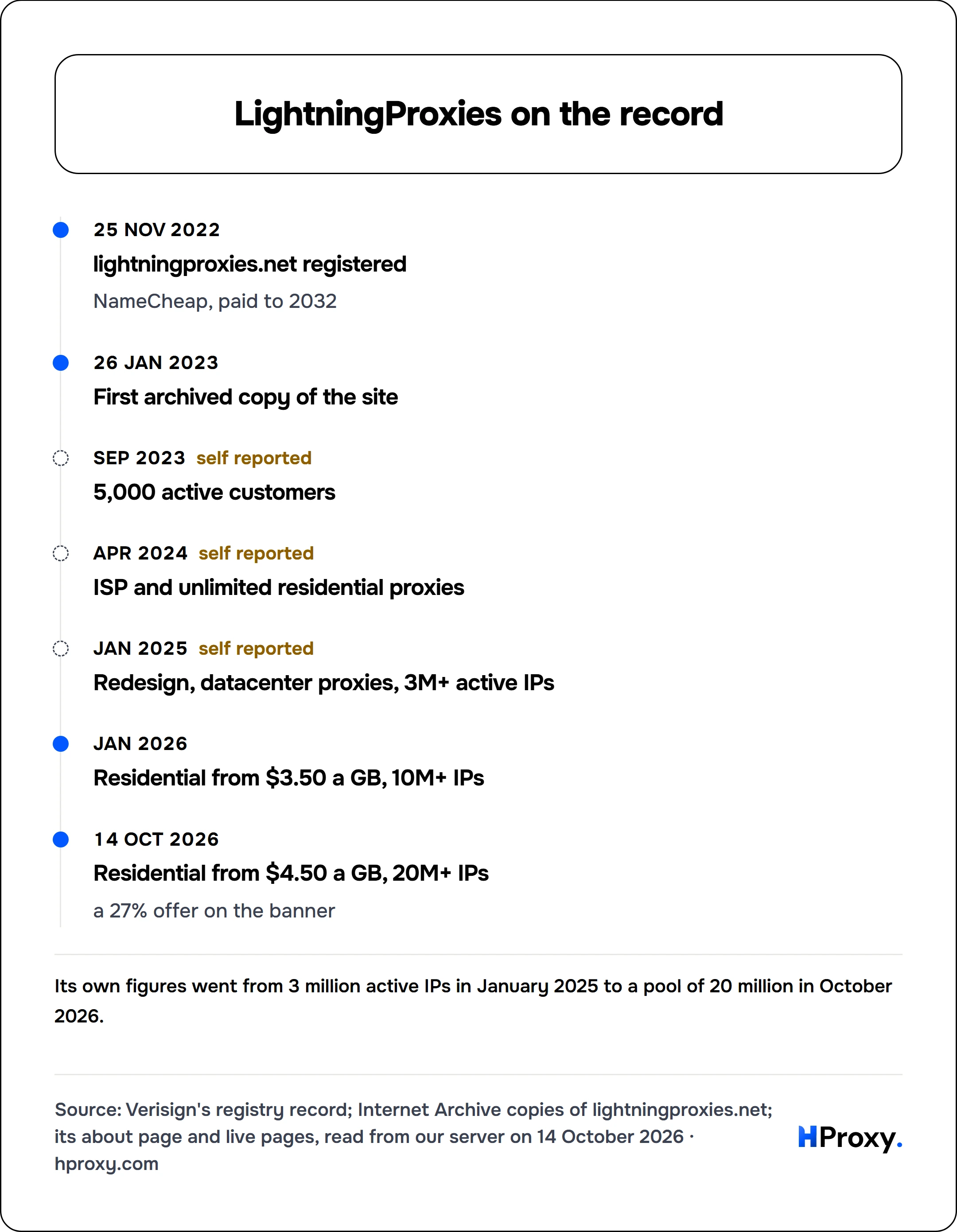
No page we read names a company. The terms begin: "This website is operated by LightningProxies." The contact section gives an e-mail address and a Telegram account, @lightningproxies, and no postal address. The domain was registered on 25 November 2022 through NameCheap and is paid up to 25 November 2032.
The about page tells the story in the company's own words. The website opened in January 2023, and the archive's first copy is from 26 January 2023. It claims 5,000 active customers by September 2023, the launch of ISP and unlimited residential proxies in April 2024, and a redesign with new datacenter proxies in January 2025, when "Residential Proxies reach 3Mil+ active IPs". The homepage of January 2026 offered "10M+ residential proxies"; in October the figure was "20M+".
25 Nov 2022
lightningproxies.net registered
NameCheap, paid to 2032
26 Jan 2023
First archived copy of the site
Sep 2023self reported
5,000 active customers
Apr 2024self reported
ISP and unlimited residential proxies
Jan 2025self reported
Redesign, datacenter proxies, 3M+ active IPs
Jan 2026
Residential from $3.50 a GB, 10M+ IPs
14 Oct 2026
Residential from $4.50 a GB, 20M+ IPs
a 27% offer on the banner
How it compares
At the smallest order, residential traffic at LightningProxies costs more per gigabyte than at the three sellers below, whose prices were read from our server the same morning.
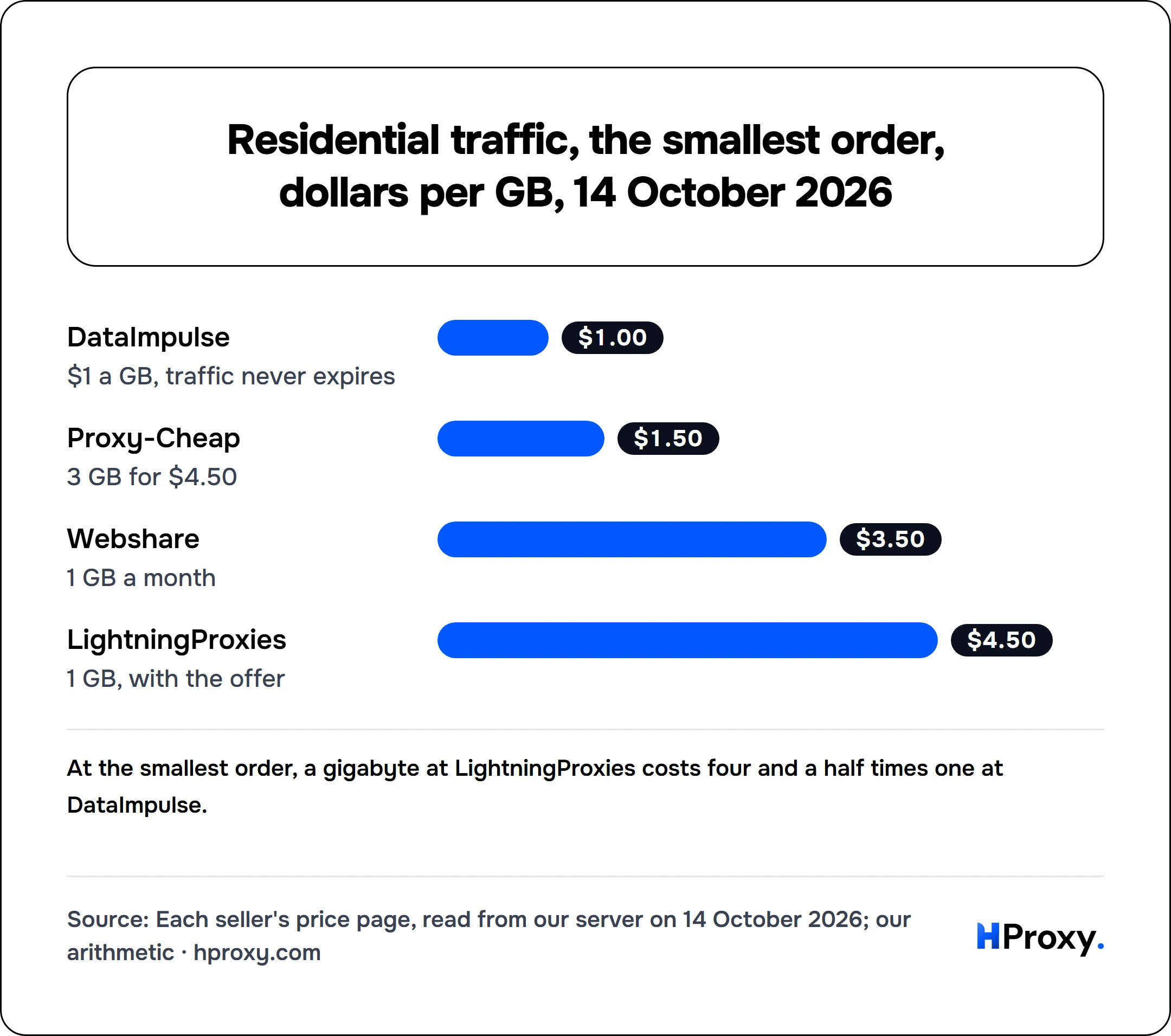
DataImpulse charges $1 a GB and says its "Traffic Never Expires". Proxy-Cheap sells 3 GB for $4.50. Webshare sells 1 GB for $3.50 a month. In large plans the gap narrows: LightningProxies' 100 GB plan comes to $2.20 a GB.
Where HProxy fits
We sell residential traffic too, $0.50 per GB, from a balance that never expires, so gigabytes you do not use this month stay yours. Our terms name the company behind us, Obsidian UG (haftungsbeschränkt), under German law. Before you buy from anyone, our free proxy checker shows whether the proxies you get answer.
Which one to pick
- LightningProxies for unlimited residential plans by the day, now from $155, or for ISP proxies with unlimited bandwidth from $4 an IP.
- DataImpulse for the lowest price per gigabyte, with traffic that never expires.
- Proxy-Cheap for a small first order, 3 GB for $4.50.
- Webshare for a monthly plan from 1 GB.
What we could not find out
We do not know who runs LightningProxies: its pages name no company, and its terms give Romanian law without a Romanian company. We found no rule on whether residential gigabytes expire. The tier prices of the other product lines are drawn by script, so we give only their starting prices. We bought nothing and tested no proxy, so speed and success rates remain the seller's claims. We will read these pages again by 14 January 2027.
Sources
- lightningproxies.net: home, about, the six price pages, the residential, ISP and unlimited product pages, terms of service, privacy policy, FAQs and reseller page, its robots file and sitemap, read from our server on 14 October 2026.
- The Internet Archive's copies of lightningproxies.net, January 2023 to January 2026, and its capture index.
- Verisign's registry record of lightningproxies.net, 14 October 2026.
- The price pages of DataImpulse, Proxy-Cheap and Webshare, read from our server on 14 October 2026.
- HProxy's residential price, from our live price table.