
TorGuard is trading at torguard.net, but its site answered our server with a security check, so this page reads its archived copies. It is a VPN company first. It also sells a proxy plan: $14.99 a month for proxy servers in 22+ countries. Its terms name no company, only TorGuard.net, under Florida law. The like-for-like prices are in the alternatives table.
Is TorGuard legit? The record in one table
| what we read on 27 September 2026 | |
|---|---|
| website | torguard.net answers our server with a Cloudflare check; archived copies run to 3 September 2026 |
| company | none named: "TorGuard.net or its subsidiaries", under Florida law |
| domain | registered 5 March 2012 |
| products | VPN, an anonymous proxy plan, email and cloud servers |
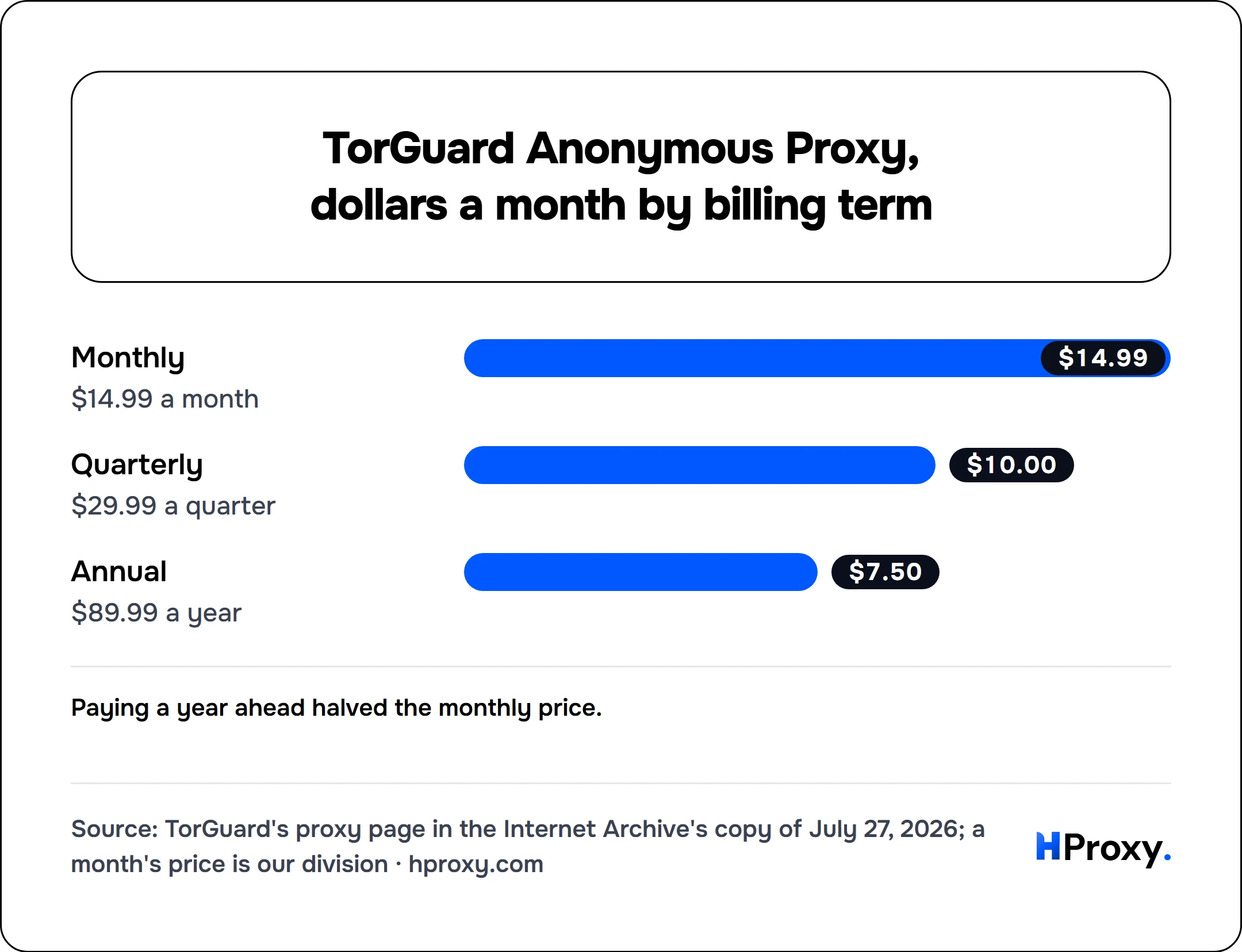
| proxy plan | $14.99 a month, $29.99 a quarter, $89.99 a year |
| refunds | within 7 days, for new buyers; crypto payments excluded |
| Trustpilot | 4.2 from 3,731 reviews, in a copy archived on 12 March 2026 |
It is one of the older names in this market, on the same domain since 2012. The Trustpilot score covers the whole brand, not the proxy plan alone.
What the TorGuard proxy costs, and what it includes
The proxy plan buys access to its proxy network, not a price per address. These are the plans in the copy of its proxy page archived on 27 July 2026:
| plan | price | per month |
|---|---|---|
| monthly | $14.99 a month | $14.99 |
| quarterly | $29.99 a quarter | $10.00 |
| annual | $89.99 a year | $7.50 |
Every plan promises no cap on speed or traffic, 300+ servers and no logs. It connects over SOCKS5, HTTP/SSL and SSH tunnels. For networks that block proxies, it adds V2Ray (VMess, VLESS and Trojan) and Shadowsocks. Up to 15 devices can connect at once over SOCKS5, HTTP/SSL and SSH, and 6 over V2Ray and Shadowsocks.
The page calls the service "Torrent & P2P Friendly". Its residential IP is a separate VPN product, the Residential IP VPN, at $19.99 a month.
The fine print that decides the cost
Plans renew on their own. Every plan renews each month, quarter or year until you cancel it before the renewal date.
A refund window of 7 days, once. New buyers can ask for their money back within seven days. Crypto payments, gift card payments and dedicated IPs are never refunded.
Two numbers for connections. The proxy page promises 15 connections at once, while the terms say "Proxy clients are limited to eight simultaneous connections."
The trial is written for the VPN. The free 7-day trial needs no card, and it lists the VPN features. The proxy page links to the same trial.
No company on the page. The terms name "TorGuard.net or its subsidiaries" and send disputes to arbitration in Orange County, Florida.
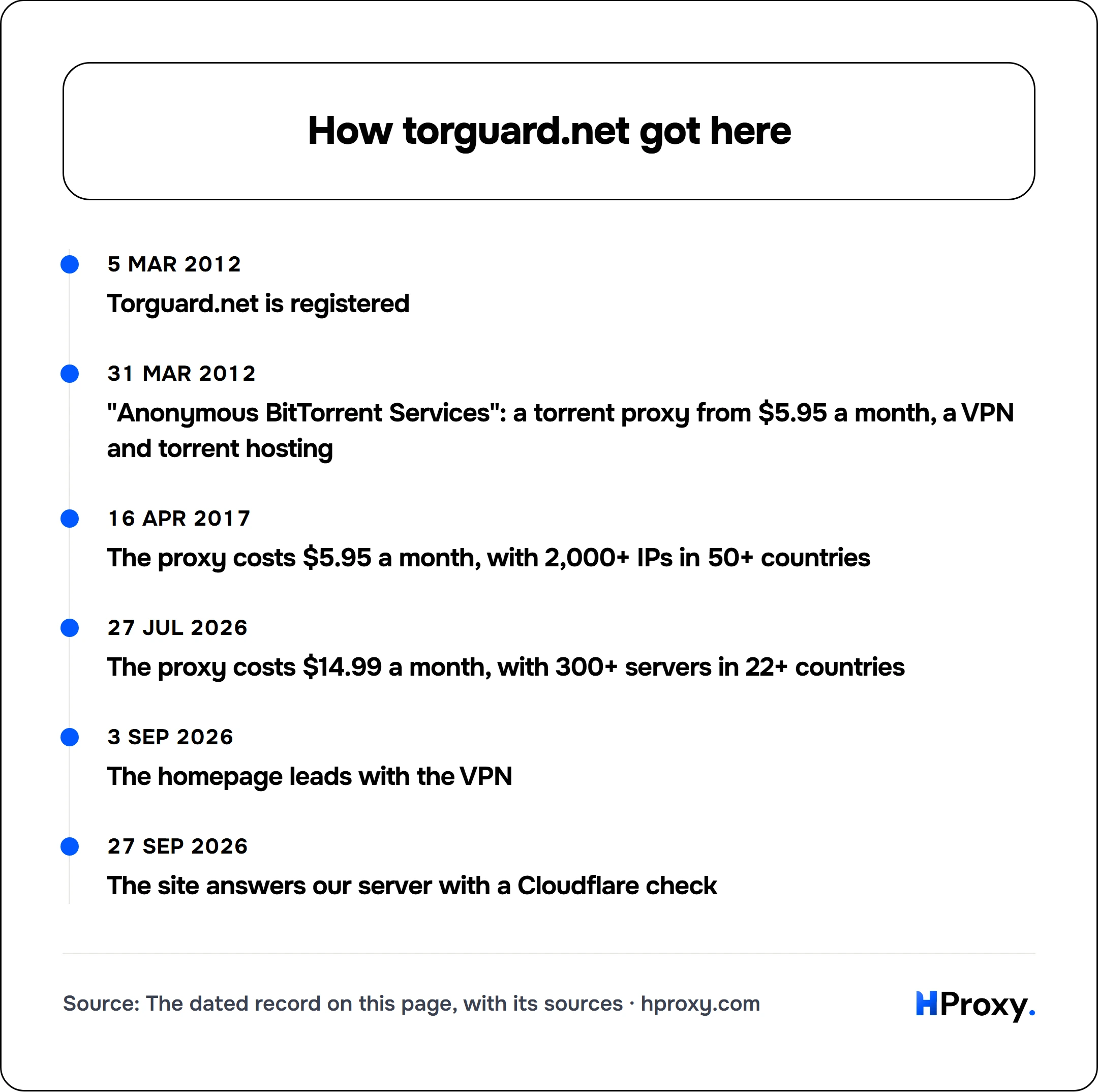
How torguard.net got here
| date | what the record shows |
|---|---|
| 5 March 2012 | torguard.net is registered |
| 31 March 2012 | "Anonymous BitTorrent Services": a torrent proxy from $5.95 a month, a VPN and torrent hosting |
| 16 April 2017 | the proxy costs $5.95 a month, with 2,000+ IPs in 50+ countries |
| 27 July 2026 | the proxy costs $14.99 a month, with 300+ servers in 22+ countries |
| 3 September 2026 | the homepage leads with the VPN |
| 27 September 2026 | the site answers our server with a Cloudflare check |
5 Mar 2012
Torguard.net is registered
31 Mar 2012
"Anonymous BitTorrent Services": a torrent proxy from $5.95 a month, a VPN and torrent hosting
16 Apr 2017
The proxy costs $5.95 a month, with 2,000+ IPs in 50+ countries
27 Jul 2026
The proxy costs $14.99 a month, with 300+ servers in 22+ countries
3 Sep 2026
The homepage leads with the VPN
27 Sep 2026
The site answers our server with a Cloudflare check
Sources: the domain registry and Internet Archive copies of its pages, read 27 September 2026.
TorGuard alternatives for a proxy subscription
Other vendors rent addresses rather than access to a server network. The fair test is what a month buys and how the traffic is metered. TorGuard comes from its archived copy of 27 July 2026, the others from pricing pages read on 26 September 2026.
| provider | what a month buys | price a month | traffic |
|---|---|---|---|
| TorGuard Anonymous Proxy | access to 300+ servers in 22+ countries | $14.99, or $7.50 on the annual plan | unlimited, by its page |
| Webshare, shared datacenter | 100 proxies | $2.99 | 250 GB to unlimited, by plan |
| Webshare, dedicated datacenter | 20 proxies | $26.60 | 250 GB to unlimited, by plan |
| Bright Data, datacenter | addresses, priced one by one | from $0.90 an IP | not stated on its menu |
| HProxy IPv4 datacenter | one dedicated address, for a week or a month | $1.58/IP | unlimited |
| HProxy static ISP | one dedicated address, for a week or a month | $2.70/IP | unlimited |
For sites that block datacenter ranges, residential traffic is the other route. Our Residential Lite costs $0.50 per GB for a first gigabyte with country targeting, down to $0.44/GB at 2,000 GB+. Premium adds state, city and ISP targeting at $1.49 per GB, down to $1.00/GB at 1,000 GB+. Both are on our residential price table.
Where TorGuard is the better buy
A flat fee for heavy traffic. One plan covers all the traffic you send, which suits large files better than traffic billed by the gigabyte.
Ways past blocked networks. V2Ray, Shadowsocks and SSH tunnels help where plain proxies are filtered. Our residential proxies speak HTTP and SOCKS5.
Many places in one plan. A single plan covers servers in 22+ countries.
A refund on a first purchase. New buyers can get their money back within 7 days, unless they paid in crypto.
A long record. The brand has traded on the same domain since 2012.
Where HProxy is the better fit
An address of your own. Our IPv4 datacenter and static ISP proxies are one dedicated address each, rented from one address for a week or a month. TorGuard sells access to its server network, and its dedicated IPs are VPN products.
Residential addresses as proxies. Our residential pools are sold as proxies, by the gigabyte. TorGuard sells its residential IP only as a VPN.
Refunds that include crypto. Our refund policy returns unspent balance to the original payment method, card or crypto, within 14 days. TorGuard refunds no crypto payment.
Before you commit
If your job is torrents or private browsing on a filtered network, a flat plan like this one may be the better tool. For scraping, accounts or a fixed address, buy one of our IPv4 or static ISP addresses for a week and test it on your target. Check the exits in our proxy checker first. The checker and our free proxy list need no account.
The limits of this record
The TorGuard site answered our server with a Cloudflare check. Every TorGuard fact here comes from Internet Archive copies, dated where used: the proxy page of 27 July 2026, the terms of 16 May 2026 and the homepage of 3 September 2026. Prices may have moved since.
We did not test the proxy network. The server count, the speeds and the no-logs promise are its own claims. This page is due for a check by 27 December 2026.
Other providers we cover
Pages on other proxy brands: ixBrowser.com, Jiguangdaili.com, Jinglingip.cn, Juliangip.com and JustProxy.biz.
Sources
Every TorGuard source below was read on 27 September 2026 as an Internet Archive copy. The pricing pages of the alternatives were read on 26 September 2026.
- TorGuard: the proxy page (27 July 2026), terms (16 May 2026), homepage (3 September 2026), free trial page (16 May 2026) and residential IP page (3 June 2026); the proxy page of 16 April 2017 and the homepage of 31 March 2012.
- Verisign, the registry record for torguard.net.
- Trustpilot, the page for torguard.net, from an Internet Archive copy of 12 March 2026.
- Webshare and Bright Data, pricing pages.
- HProxy, our own product catalog, price table and refund policy.