
We keep a record of what providers in this market charge and what happens to them over time. This page is the part of that record covering HTTPTunnel, written up for somebody deciding today.
What we can and cannot tell you about HTTPTunnel
The company behind the name sits at httptunnel.ge.
A price is missing here on purpose. We have not captured a sourced rate for HTTPTunnel recently enough to publish one, and a stale number in this market is a wrong number.
Note the price, the unit it is quoted in, the minimum, and the expiry. Unit and expiry are where most comparisons in this market quietly go wrong.
What HTTPTunnel says about itself today
As of 9 September 2026 the tab reads "HTTPTunnel — anonymous proxy servers, tested.". Their own summary of the product runs: "Free, tested anonymous proxies. Bulk-check connectivity, anonymity, and speed. Bypass restrictions, keep your IP private."
Reading the same page for the things buyers actually ask about:
They advertise 195 countries or locations. We found no separate pricing page linked from the homepage, which usually means the price arrives by quotation.
Treat all of it as advertising, because it is. Its value is that it is dated and quotable, which is more than most comparison pages offer.
What the timestamps show
Our crawl of their site found 8 pages carrying a date. The oldest is from May 2026 and the newest from May 2026. 8 of them carry a date inside the last twelve months.
Recent dates prove somebody is still at the keyboard. They prove nothing about the network, which is what the test at the end of this page is for.
Where published figures stop being useful
The country total, and the country you use
Ask for the pool size in your country rather than in total, and expect the answer to be vague. Where it is not published, the ten minute test at the end of this page settles it for a few dollars.
Match the units before anything else
Half this market prices bandwidth and half prices addresses. A per-address plan is cheap for heavy traffic through few exits and ruinous for light traffic through many, and the reverse holds for per-gigabyte plans.
What happens when it breaks at two in the morning
Support quality is invisible until it is the only thing that matters. A cheap provider that takes three days to answer a routing problem has cost you more than the saving, and no pricing page reveals that.
A comparison that admits what it cannot say
The rows that matter, with our own answers stated plainly:
| Question to ask | HTTPTunnel | HProxy |
|---|---|---|
| Entry price | Not verified by us, read their page | From $0.44/GB, pay as you go |
| Does unused balance expire? | Worth confirming in writing before you commit | Never |
| Minimum commitment | Not published clearly, ask before paying | None |
| Identity checks | On their own terms page | Card orders are screened, and verification is sometimes requested |
| Targeting | Their terms page answers this | Country, city and ISP |
| Free way to evaluate | Check the current terms, this one moves | Free proxy list and proxy checker |
Two notes on that table. The rows we left for you to check are not evasions: those terms change, and printing a stale figure is exactly the failure this page is trying to avoid. And no table can hold the number that should decide your purchase, which is the success rate on your own target.
How to settle it yourself in ten minutes
Run this before you commit any volume. It replaces every opinion on this page, including ours.
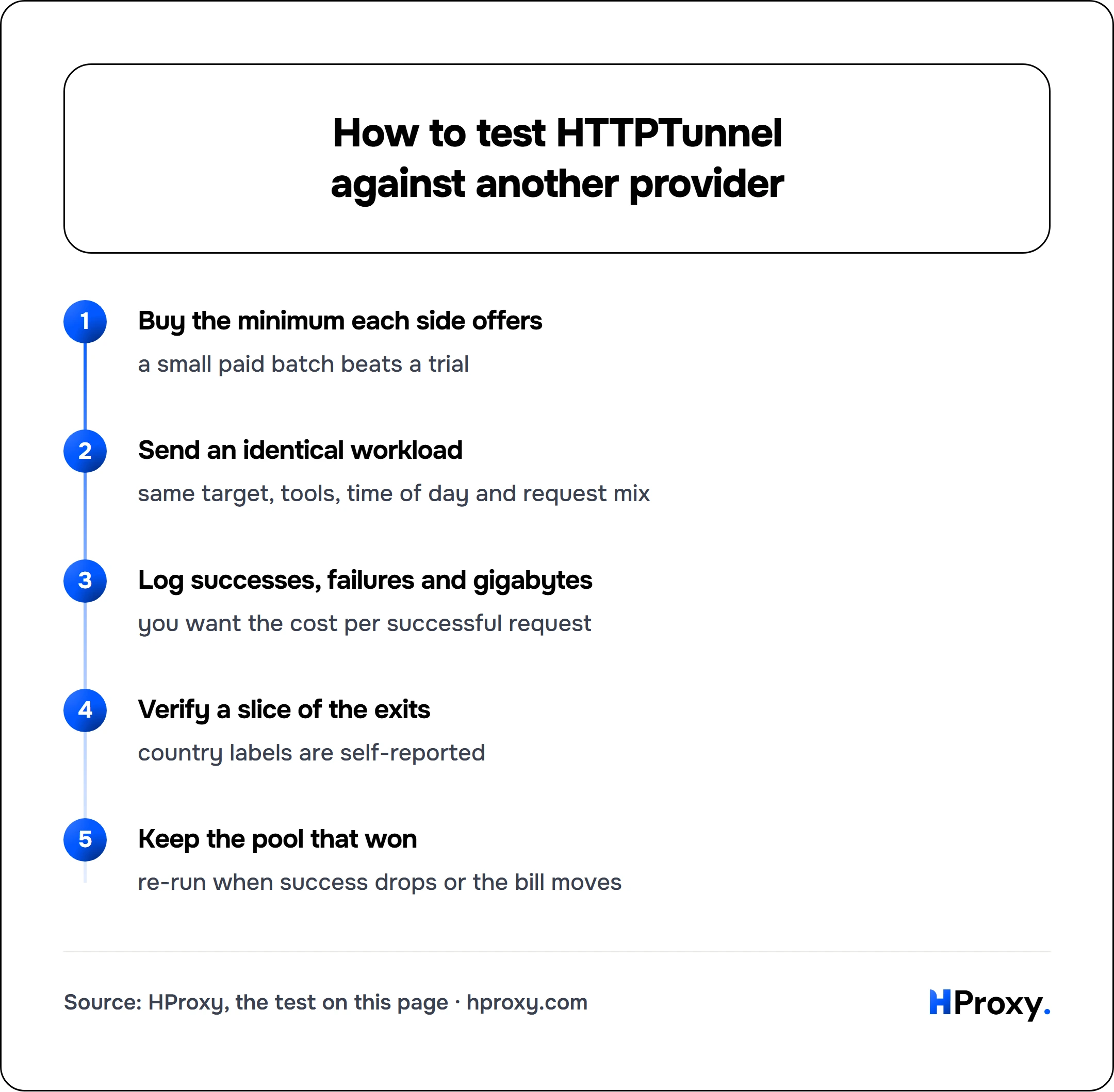
- Buy the minimum each side offers. Prefer a small paid batch over a trial, because trial traffic does not always ride the same pool.
- Send an identical workload through each: same target, same tooling, same time of day, same request mix.
- Log successes, failures and gigabytes used. Cost per successful request is the figure you are after.
- Verify a slice of the exits independently. Country labels in this market are self-reported and are not always right.
- Keep whichever pool won on your job. Re-run this whenever success rate drops or the bill moves.
Buy the minimum each side offers
a small paid batch beats a trial
Send an identical workload
same target, tools, time of day and request mix
Log successes, failures and gigabytes
you want the cost per successful request
Verify a slice of the exits
country labels are self-reported
Keep the pool that won
re-run when success drops or the bill moves
The other names that come up
Other providers in the same bracket, priced and dated the same way:
- IPCloud alternatives
- Ipcola alternatives
- IPCook alternatives
- IPDeep alternatives
- IPFighter alternatives
- Ipfoxy alternatives
The competing offer, for completeness
Our own lane is easy to state. Residential starts at $0.44 per GB with country targeting, the balance is topped up when you want and does not expire, there is no subscription unless the optional discount suits you, and city and ISP targeting come with Residential Premium from $1.00 per GB. If the test above puts us second on your target, buy the winner.