
We keep a record of what providers in this market charge and what happens to them over time. This page is the part of that record covering fastCRW, written up for somebody deciding today.
What we can and cannot tell you about fastCRW
The company behind the name sits at fastcrw.com.
fastCRW is not in our priced record, so nothing about their rate appears below. That gap is stated rather than filled, which is the only honest option available.
Copy down the entry rate, the commitment attached to the cheapest rate, the minimum top-up and the expiry rule. Those four turn a marketing figure into something you can compare.
What fastCRW says about itself today
On 9 September 2026 their homepage carried the title "Web Scraping and Search API for AI Agents, fastCRW". The description they publish for search engines reads: "Open source Firecrawl + Tavily alternative. Search, scrape, crawl, map, and extract the web for AI agents. Self-hostable Rust binary, free tier."
Also on the page, stated plainly:
Payment methods mentioned: cards and Wise or Payoneer. The page offers some form of free trial. Their pricing page is titled "Pricing, fastCRW".
Those are claims, and claims are free. They earn their place here only because the date makes them checkable later.
What the registration record shows
The domain was registered on 5 March 2026, through Spaceship, Inc, which makes it about 0 years old. Those dates come from a registry query on 9 September 2026. Their registration is booked through 5 March 2027.
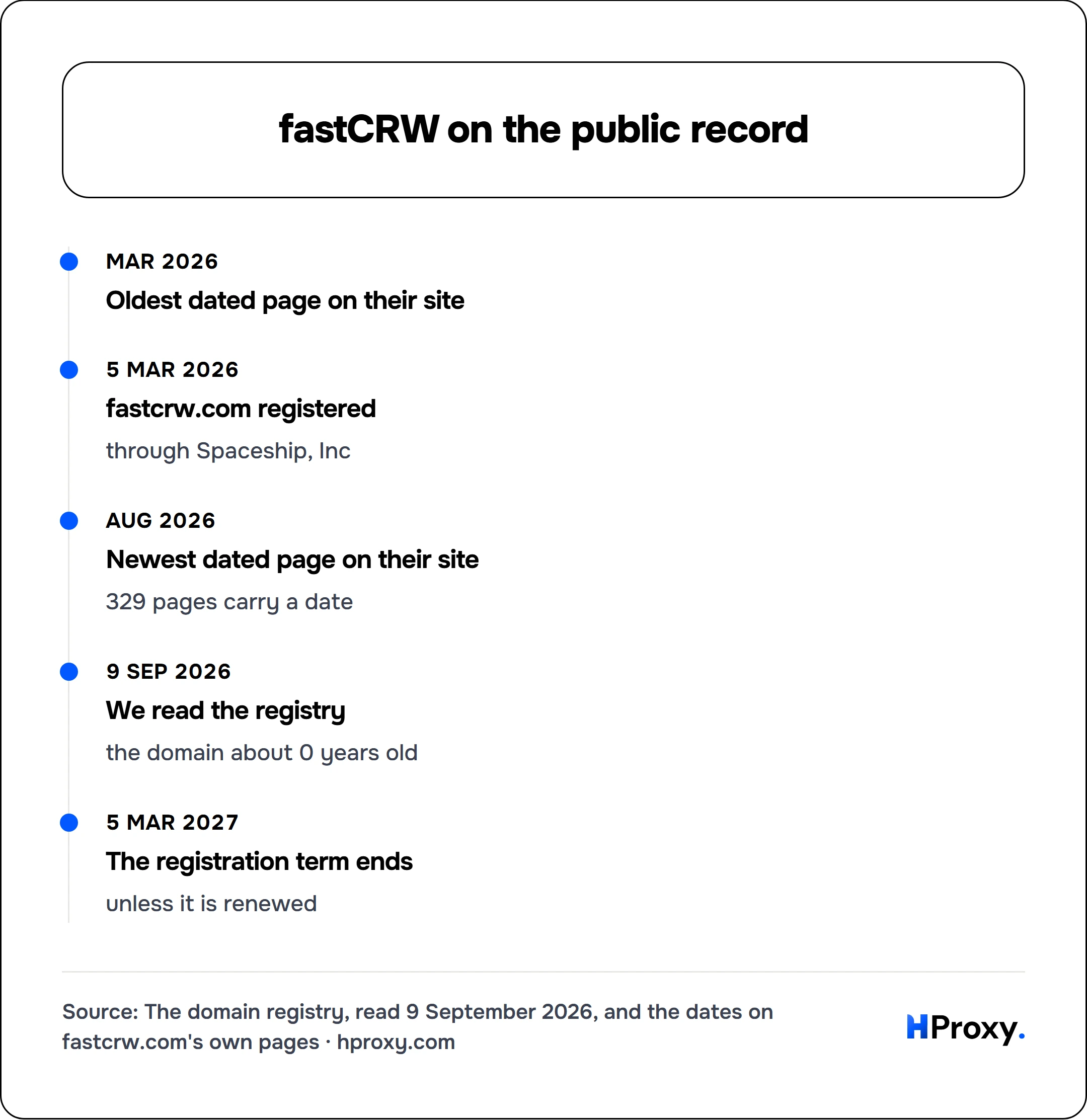
Mar 2026
Oldest dated page on their site
5 Mar 2026
fastcrw.com registered
through Spaceship, Inc
Aug 2026
Newest dated page on their site
329 pages carry a date
9 Sep 2026
We read the registry
the domain about 0 years old
5 Mar 2027
The registration term ends
unless it is renewed
Age is not quality. A long registration does not make a network good, and a new one does not make it bad. What it does rule out is the shortest-lived pattern in this market, which is a site that appears, sells, and is gone inside a year.
What they have built around the product
Our own crawl reached 341 of their pages, last run 19 June 2026. The mix was 232 blog pages, 1 pricing page, 21 use-case pages and 27 integration pages.
Read it as a map of what they emphasise. It is our count, from our crawler, on the date shown, and it is the only figure on this page that neither of us can dispute.
Signs of life
Our crawl of their site found 329 pages carrying a date, 230 of them articles. The oldest is from March 2026 and the newest from August 2026. 329 of them carry a date inside the last twelve months.
Recent dates prove somebody is still at the keyboard. They prove nothing about the network, which is what the test at the end of this page is for.
What the advertised numbers cannot tell you
The country total, and the country you use
Almost every provider claims almost every country. What differs is depth, and depth decides whether a single city or a single carrier is usable. No published figure tells you that.
Shared or dedicated changes everything
An address you share carries the reputation of everyone else on it. That is acceptable for some work and fatal for anything involving a login. The price difference between shared and dedicated usually reflects exactly this.
What a blocked response costs you
Some vendors bill every request, some bill only successful ones, and the difference is the whole comparison once a target starts blocking. A cheap rate with a fifty percent success rate is twice its advertised price.
What separates them, in a table
The rows that matter, with our own answers stated plainly:
| Question to ask | fastCRW | HProxy |
|---|---|---|
| Entry price | Not verified by us, read their page | From $0.44/GB, pay as you go |
| Does unused balance expire? | On their own terms page | Never |
| Minimum commitment | Their terms page answers this | None |
| Identity checks | Check the current terms, this one moves | Card orders are screened, and verification is sometimes requested |
| Targeting | Read their current terms | Country, city and ISP |
| Free way to evaluate | Worth confirming in writing before you commit | Free proxy list and proxy checker |
Two notes on that table. The rows we left for you to check are not evasions: those terms change, and printing a stale figure is exactly the failure this page is trying to avoid. And no table can hold the number that should decide your purchase, which is the success rate on your own target.
The ten minute version of this decision
For a few dollars you can get a verdict specific to your job, which no comparison page can honestly promise you.
- Buy the minimum each side offers. Prefer a small paid batch over a trial, because trial traffic does not always ride the same pool.
- Send an identical workload through each: same target, same tooling, same time of day, same request mix.
- Log successes, failures and gigabytes used. Cost per successful request is the figure you are after.
- Verify a slice of the exits independently. Country labels in this market are self-reported and are not always right.
- Keep whichever pool won on your job. Re-run this whenever success rate drops or the bill moves.
The other names that come up
Other providers in the same bracket, priced and dated the same way:
- TMProxy alternatives
- Tnd alternatives
- Toolip alternatives
- Topfreeproxy alternatives
- ToProxy.ru alternatives
- Toproxylab alternatives
Our side of it
HProxy is pay as you go from $0.44 per GB on residential, with ISP, mobile and datacenter under one balance and no commitment attached to any of them. Run the test. If we lose on your target, we lose, and you have your answer.