Comparison

Leaving Toproxylab: the numbers side by side

A Toproxylab alternative, judged by a competitor who says so up front: the record we hold, the gaps in it, and the test that outranks this page.

HProxy Team··5 min read
HProxy.Comparison

Free proxies won't hold up here.

Shared datacenter IPs get flagged and dropped fast. When it has to hold, gaming, streaming, accounts, you need mobile and residential IPs that read as a real device, from $0.44/GB, pay as you go.

Residential proxies

Most pages titled "Toproxylab alternative" are affiliate lists with the payout order baked in. This one is written by a rival, which is a different bias and an easier one to correct for, because you can check every number we print.

What we can and cannot tell you about Toproxylab

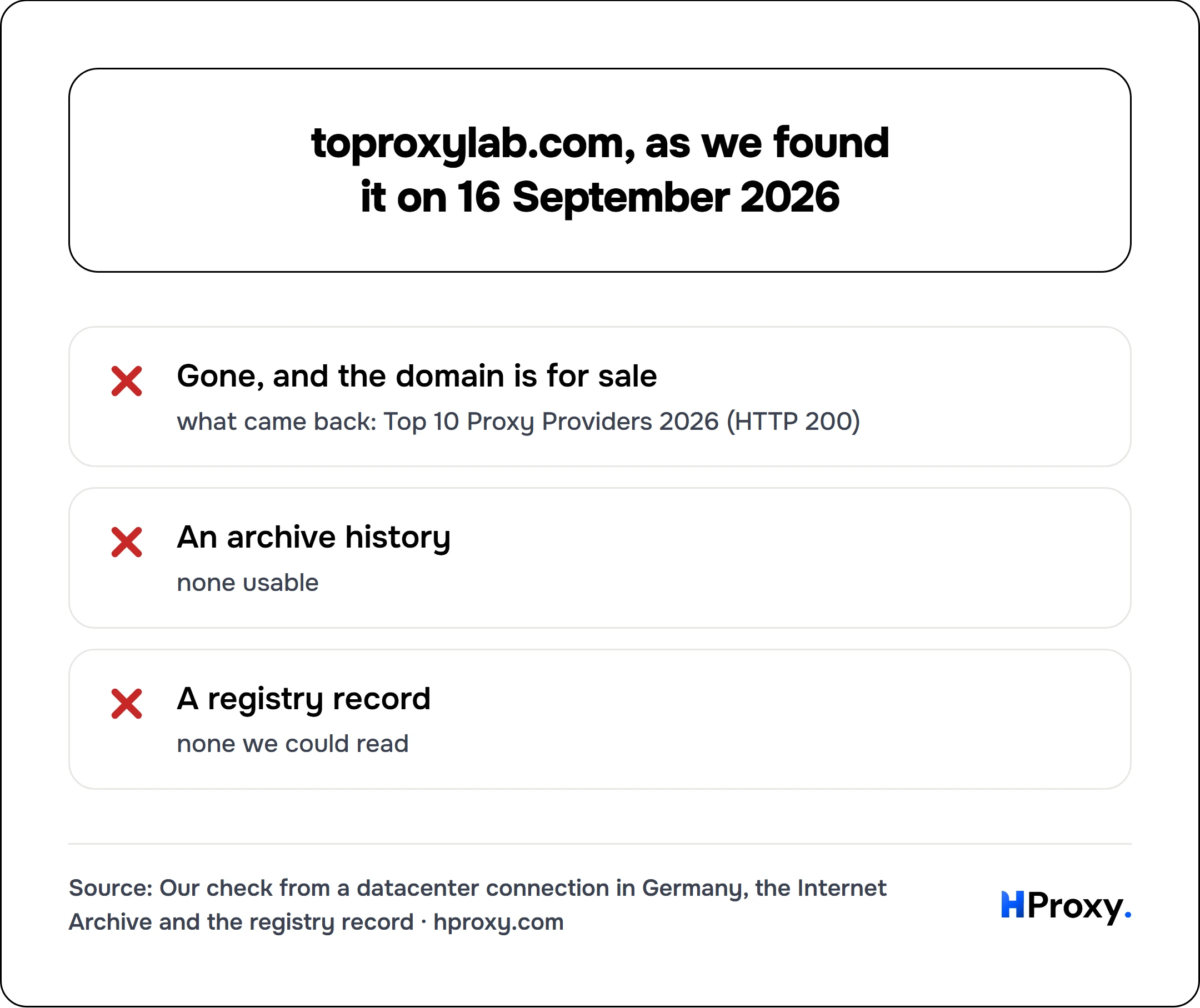
The domain is toproxylab.com.

Toproxylab is not in our priced record, so nothing about their rate appears below. That gap is stated rather than filled, which is the only honest option available.

Note the price, the unit it is quoted in, the minimum, and the expiry. Unit and expiry are where most comparisons in this market quietly go wrong.

How Toproxylab presents itself

As of 9 September 2026 the tab reads "Top 10 Proxy Providers 2026: 14 Services Tested". Written for search engines, their description says: "Independent tests of 14 proxy providers: fraud scores, 400-IP pool runs, leak checks and real prices. Residential, ISP, mobile and datacenter."

What else that page states, without interpretation:

The product lines named on that page are residential, datacenter, ISP or static residential, mobile, SOCKS5 and IPv6. They advertise 195 countries or locations. Payment methods mentioned: PayPal, crypto, Alipay, cards and Wise or Payoneer. The page offers some form of free trial. Support is advertised as around the clock. A refund or money-back term is mentioned. We found no separate pricing page linked from the homepage, which usually means the price arrives by quotation.

Nothing there has been tested. It is a record of what the page said on the day, which is the honest limit of what a page like this can offer without a measurement.

Longevity, on the public record

The domain was registered on 10 August 2025, through NameCheap, Inc, which makes it about 1 year old. Registry data as of 9 September 2026. It is paid up until 10 August 2027.

Age is not quality. A long registration does not make a network good, and a new one does not make it bad. What it does rule out is the shortest-lived pattern in this market, which is a site that appears, sells, and is gone inside a year.

How much site there is

Our own crawl reached 91 of their pages, last run 19 June 2026. The mix was 9 blog pages.

Read it as a map of what they emphasise. It is our count, from our crawler, on the date shown, and it is the only figure on this page that neither of us can dispute.

What the timestamps show

Our crawl of their site found 88 pages carrying a date. The oldest is from September 2025 and the newest from August 2026. 88 of them carry a date inside the last twelve months.

Recent dates prove somebody is still at the keyboard. They prove nothing about the network, which is what the test at the end of this page is for.

What the advertised numbers cannot tell you

Ten million addresses, and none of them yours

Nobody audits pool totals in this market, and the counting rules differ between vendors. Even an accurate figure describes addresses that exist, not addresses you will be routed through. Treat it as a marketing unit rather than a capability.

The entry price is not the effective price

A starting rate is a marketing number. What you pay depends on the tier your volume lands in, the minimum purchase, and what happens to traffic you bought and did not use. An expiring balance quietly raises the price of every unit you did consume.

Threads, not gigabytes, are often the ceiling

Bandwidth is rarely the constraint on a real workload. Concurrent connections, requests per second and per-session caps are, and they are frequently buried in the documentation rather than the pricing page.

What separates them, in a table

The table answers what we can answer and marks what we cannot:

Question to askToproxylabHProxy
Entry priceNot verified by us, read their pageFrom $0.44/GB, pay as you go
Does unused balance expire?Worth confirming in writing before you commitNever
Minimum commitmentNot published clearly, ask before payingNone
Identity checksOn their own terms pageCard orders are screened, and verification is sometimes requested
TargetingNot published clearly, ask before payingCountry, city and ISP
Free way to evaluateOn their own terms pageFree proxy list and proxy checker

We would rather show an incomplete table than a confident wrong one. Anything we could not source is left for you to read at the source, with the date you read it.

The ten minute version of this decision

For a few dollars you can get a verdict specific to your job, which no comparison page can honestly promise you.

  1. Open an account on each and add the smallest amount they take. Skip the trial if a paid unit is cheap enough to buy outright.
  2. Point both at your real target, through your real tool, on the same day, with the same mix of requests.
  3. Count how many requests returned what you wanted, and how much bandwidth each side spent doing it.
  4. Spot-check the exits. Confirm they are in the country you paid for and the connection type you were sold.
  5. Buy the one that won on your target, and diarise a re-test in three months.

Who else is in this bracket

The same treatment, applied to the providers most often weighed against this one:

The competing offer, for completeness

HProxy suits buyers who want to add funds, send traffic and stop thinking about it. Residential from $0.44 per GB, no commitment, nothing expiring. Buyers who need procurement paperwork and a named account manager are better served elsewhere, and we would rather say so here than waste your afternoon.

Frequently asked questions

Why look for a Toproxylab alternative at all?
The usual reasons any buyer compares two providers: the pricing model stopped fitting the usage pattern, a target started blocking, a specific country underperformed, a balance expired, or support went quiet. None of those is visible from a marketing page, which is why a small paid test on your own target settles it faster than any review.
How is HProxy different?
The models differ more than the products do. HProxy is pay as you go from a balance you top up when you want, the balance does not expire, there is no subscription unless the optional discount suits you, and residential starts at $0.44 per GB with city and ISP targeting included. Whether that beats a tiered plan depends on your usage pattern, which a short test settles.
Do I have to talk to sales or sign a contract to switch?
Not with us. You can sign up, add funds and send traffic without a call, a minimum or a subscription. Whether another provider requires any of those is on their own pricing page and is worth reading, because a required commitment is part of the price even when it is not part of the rate.
How often should I re-test a provider?
Quarterly is a reasonable rhythm for most workloads, and immediately after a noticeable drop in success rate. Pools are rebuilt, suppliers change and detection improves, so a benchmark from last year describes a network that no longer exists.
Does a bigger pool mean better results?
No. Your job meets only the exits it draws, in the countries it needs, against one target's defences. Freshness and rotation policy move the outcome far more than the headline total, and pool totals across this market are counted generously and rarely audited.

Proxies that don't die mid-job

Residential, ISP, datacenter and mobile, verified by the same engine that runs tens of millions of checks. They read as a real device and hold up under load. Pay as you go, and your balance never expires. $0.44/GB is the 2,000 GB+ rate; a single gigabyte is $0.50/GB, with no minimum order.

129M+ proxy checks run · 100+ countries · HTTP / HTTPS / SOCKS · re-checked every few minutes · no signup