If you are comparing TopFreeProxy against anything else, the first thing to fix is units. A per-gigabyte rate against a per-address rate is not a comparison, and half the proxy provider market prices in a different unit to the other half.
What is on file for TopFreeProxy
Their site is topfreeproxy.com.
We price the providers we can source and date, and TopFreeProxy is not currently one of them. The rest of this page is about what to check when you read their pricing yourself.
Take down four numbers and a date: reachable rate, minimum purchase, commitment for the floor rate, and expiry period. Anything less and you cannot compare them to anyone.
TopFreeProxy in its own words
The title tag on 9 September 2026 was "Free Proxy List 2026 , HTTP, HTTPS, SOCKS4, SOCKS5, TopFreeProxy". Their own summary of the product runs: "Free, fast and reliable proxy list updated in real-time. Browse thousands of HTTP, HTTPS, SOCKS4 and SOCKS5 proxies verified automatically every 60 seconds."
Also on the page, stated plainly:
The product lines named on that page are SOCKS5. We found no separate pricing page linked from the homepage, which usually means the price arrives by quotation.
Treat all of it as advertising, because it is. Its value is that it is dated and quotable, which is more than most comparison pages offer.
How far back the record goes
The domain was registered on 14 March 2026, through Epik LLC, which makes it about 0 years old. Checked against the registry on 9 September 2026. The registration currently runs to 14 March 2027.
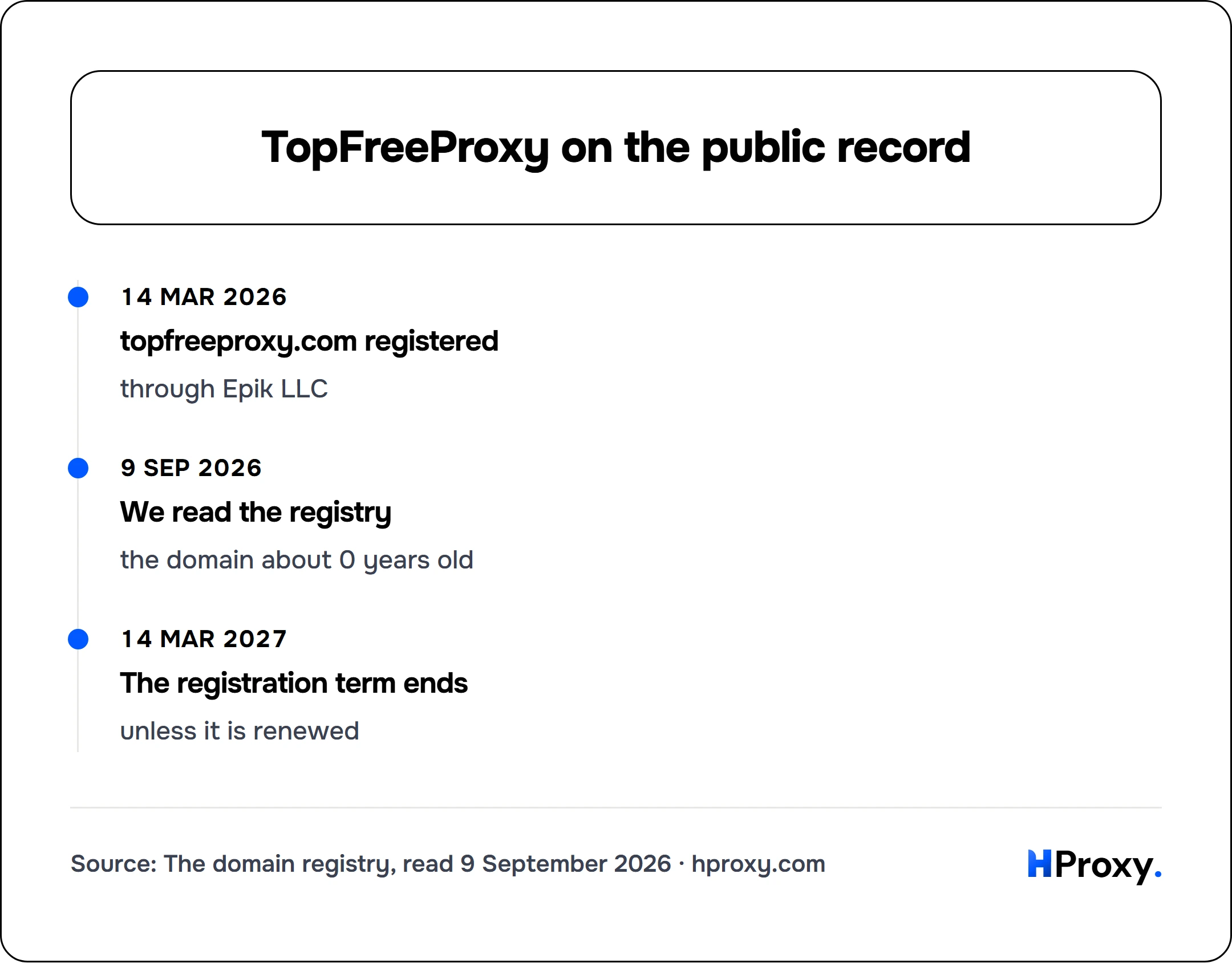
14 Mar 2026
topfreeproxy.com registered
through Epik LLC
9 Sep 2026
We read the registry
the domain about 0 years old
14 Mar 2027
The registration term ends
unless it is renewed
None of it predicts success rate. It is here because domain age and archive depth are free to check, and a provider whose public record starts last quarter deserves a smaller first order.
What a pricing page leaves out
A commitment is part of the price
The lowest published rate in this market usually sits behind a monthly commitment measured in thousands. Quoting it beside a pay as you go rate is not a comparison. Compare the rate you can reach today.
The reputation you inherit
A shared address arrives with a history you did not create and cannot see. For read-only work it rarely matters. For anything that keeps a session, it is the most common cause of unexplained failure.
The line item hidden in the success rate
Divide the spend by the successful responses, not by the requests sent. That single change reorders most price comparisons in this market, and your accounting will use it eventually anyway.
The rows that decide it
Here are the comparisons that survive contact with a real workload:
| Question to ask | TopFreeProxy | HProxy |
|---|---|---|
| Entry price | Not verified by us, read their page | From $0.44/GB, pay as you go |
| Does unused balance expire? | Not published clearly, ask before paying | Never |
| Minimum commitment | Check the current terms, this one moves | None |
| Identity checks | Their terms page answers this | Card orders are screened, and verification is sometimes requested |
| Targeting | Check the current terms, this one moves | Country, city and ISP |
| Free way to evaluate | Their terms page answers this | Free proxy list and proxy checker |
A table like this can rank the things that are written down. It cannot rank the thing that matters most, which is how the network behaves against the site you care about.
The measurement that outranks every review
This costs less than a coffee and produces the only evidence that applies to your workload.
- Fund both accounts with the least money each will accept, and note what that minimum was, because it is part of the comparison.
- Aim both at the page that matters to you rather than a test endpoint, and keep every other variable fixed.
- Record the success rate and the data consumed for the identical batch on each side.
- Check some of the addresses yourself for country, ASN and type before you trust the label on the plan.
- Keep the winner, and repeat the whole thing quarterly, because pools age.
Comparable providers
We hold the same record for these, and the same honest limits apply to each:
Our own position
Our end of it is a wallet, four proxy types and no contract. Residential begins at $0.44 per GB and the balance does not expire. The free proxy list and checker are open to anyone, and they are the fastest way to see how we treat measurement before you spend anything.