Data5u sits in a market where the advertised number and the number you pay are frequently different, because tiers, minimums and expiry all sit between them. Untangling that is most of the work here.
What we can and cannot tell you about Data5u
The company behind the name sits at data5u.com.
Data5u is not in our priced record, so nothing about their rate appears below. That gap is stated rather than filled, which is the only honest option available.
Copy down the entry rate, the commitment attached to the cheapest rate, the minimum top-up and the expiry rule. Those four turn a marketing figure into something you can compare.
What Data5u says about itself today
Read 9 September 2026, the homepage titles itself "HTTP代理IP服务平台_无忧代理IP( DATA5U官网 )". The description they publish for search engines reads: "DATA5U(无忧代理IP)是专业的企业级代理IP服务平台,提供高可用HTTP/HTTPS动态代理IP,支持数据采集、舆情监测等场景,每日100万IP定制服务,免费测试6小时,是您发展爬虫、大数据事业的可靠伙伴。"
Also on the page, stated plainly:
The product lines named on that page are SOCKS5. Their pricing page is titled "购买爬虫动态代理IP_无忧代理IP".
Nothing there has been tested. It is a record of what the page said on the day, which is the honest limit of what a page like this can offer without a measurement.
What the registration record shows
The domain was registered on 5 April 2016, through Alibaba Cloud Computing (Beijing) Co., Ltd, which makes it about 10 years old. Registry data as of 23 April 2026. It is paid up until 5 April 2027.
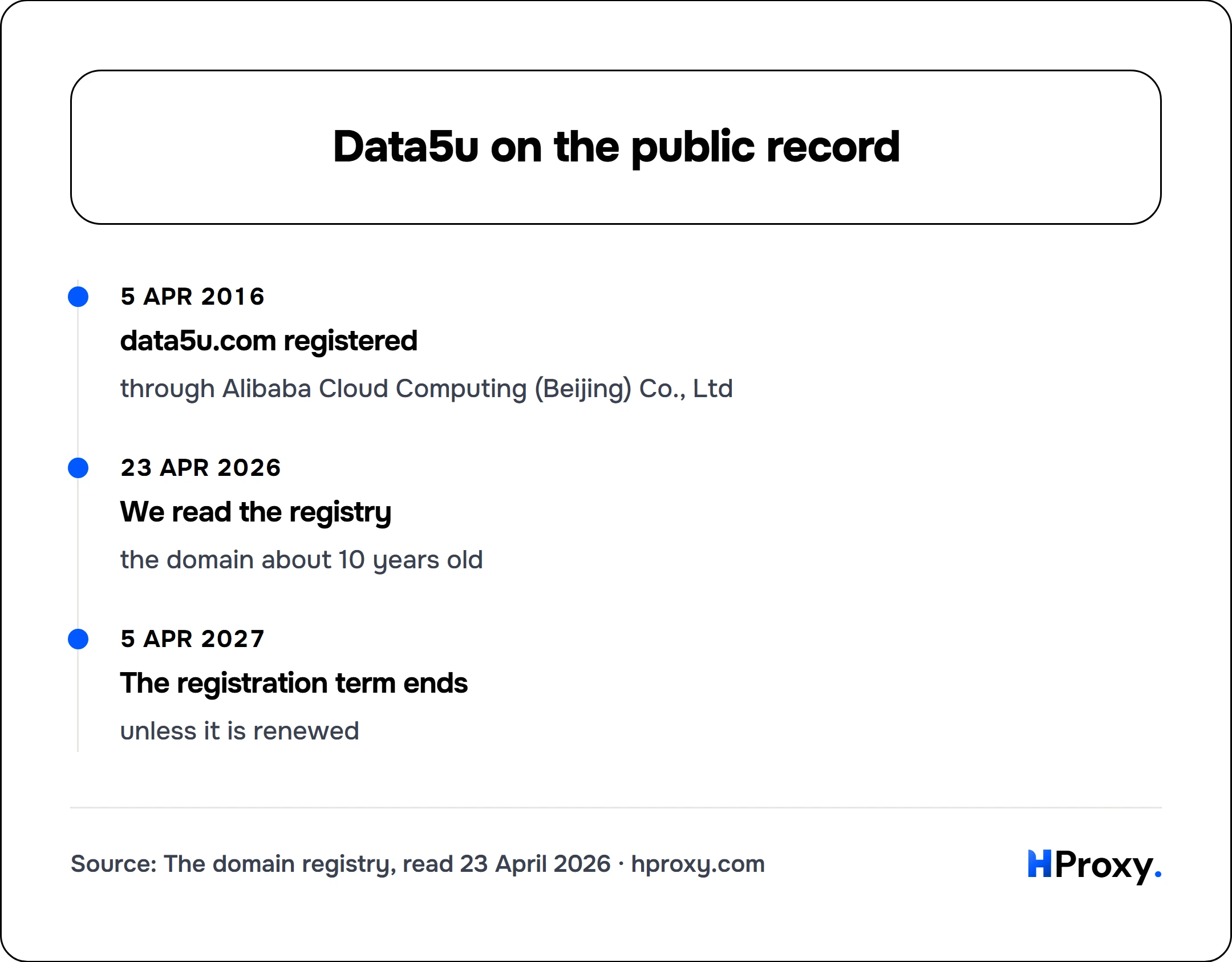
5 Apr 2016
data5u.com registered
through Alibaba Cloud Computing (Beijing) Co., Ltd
23 Apr 2026
We read the registry
the domain about 10 years old
5 Apr 2027
The registration term ends
unless it is renewed
Age is not quality. A long registration does not make a network good, and a new one does not make it bad. What it does rule out is the shortest-lived pattern in this market, which is a site that appears, sells, and is gone inside a year.
What the advertised numbers cannot tell you
Ten million addresses, and none of them yours
Nobody audits pool totals in this market, and the counting rules differ between vendors. Even an accurate figure describes addresses that exist, not addresses you will be routed through. Treat it as a marketing unit rather than a capability.
The entry price is not the effective price
A starting rate is a marketing number. What you pay depends on the tier your volume lands in, the minimum purchase, and what happens to traffic you bought and did not use. An expiring balance quietly raises the price of every unit you did consume.
A verdict has a shelf life
Pools are rebuilt, suppliers change and detection improves. A provider that beat the field last spring may be mid-table now. Nothing in this market stays true long enough to buy once and stop measuring.
What separates them, in a table
The rows that matter, with our own answers stated plainly:
| Question to ask | Data5u | HProxy |
|---|---|---|
| Entry price | Not verified by us, read their page | From $0.44/GB, pay as you go |
| Does unused balance expire? | Worth confirming in writing before you commit | Never |
| Minimum commitment | Not published clearly, ask before paying | None |
| Identity checks | On their own terms page | Card orders are screened, and verification is sometimes requested |
| Targeting | Their terms page answers this | Country, city and ISP |
| Free way to evaluate | Check the current terms, this one moves | Free proxy list and proxy checker |
Every unfilled cell above is a question to put to them directly, in writing, before money changes hands. Vendors answer those questions readily; comparison sites guess at them.
A test worth more than this comparison
Do this once and you will never need a comparison page for this decision again.
- Open an account on each and add the smallest amount they take. Skip the trial if a paid unit is cheap enough to buy outright.
- Point both at your real target, through your real tool, on the same day, with the same mix of requests.
- Count how many requests returned what you wanted, and how much bandwidth each side spent doing it.
- Spot-check the exits. Confirm they are in the country you paid for and the connection type you were sold.
- Take the winner and set a reminder to run this again, since a result has a shelf life of about a quarter.
Who else is in this bracket
The same treatment, applied to the providers most often weighed against this one:
- Proxydancu alternatives
- Proxydeals alternatives
- Proxydime alternatives
- Proxydiscount alternatives
- Proxydocker alternatives
- ProxyEmpire alternatives
Our side of it
HProxy is pay as you go from $0.44 per GB on residential, with ISP, mobile and datacenter under one balance and no commitment attached to any of them. Run the test. If we lose on your target, we lose, and you have your answer.