The answer to "what should I use instead of BrowserScan" depends entirely on why you are leaving. Price, a commitment, a country, a support experience and a blocked target all point at different replacements.
Everything we can stand behind
You will find them at browserscan.net. In our own records they sit in the proxy provider category.
We have no verified current rate for BrowserScan on file. Printing a guess would make this page worse than useless, so the price row below is empty and the reading list is not.
When you do read it, note four things: the rate you actually qualify for today, the minimum purchase, whether unused balance expires, and whether failed requests are billed. Those four decide the real cost more than the headline does.
Their own description, read this week
On 9 September 2026 the site introduced itself as "Best BrowserScan Fingerprint Detection Tool - Improve your online privacy security, BrowserScan". Their own summary of the product runs: "Enhance your online privacy security with the best BrowserScan fingerprint checking tool. Protect your privacy from leaking with our advanced technology.support dns leak test,2fa live,check ip,browser checker,port scanner,speed test,user agent parse,proxy server detection,webrtc leak test, etc."
What else that page states, without interpretation:
We found no separate pricing page linked from the homepage, which usually means the price arrives by quotation.
None of that is verified performance. It is what the vendor chose to publish, recorded with a date so you can see whether it still says the same thing.
How long BrowserScan has been trading
The domain was registered on 3 February 2023, through GoDaddy.com, LLC, which makes it about 3 years old. We pulled that from the registry on 9 September 2026. The current registration term ends 3 February 2028.
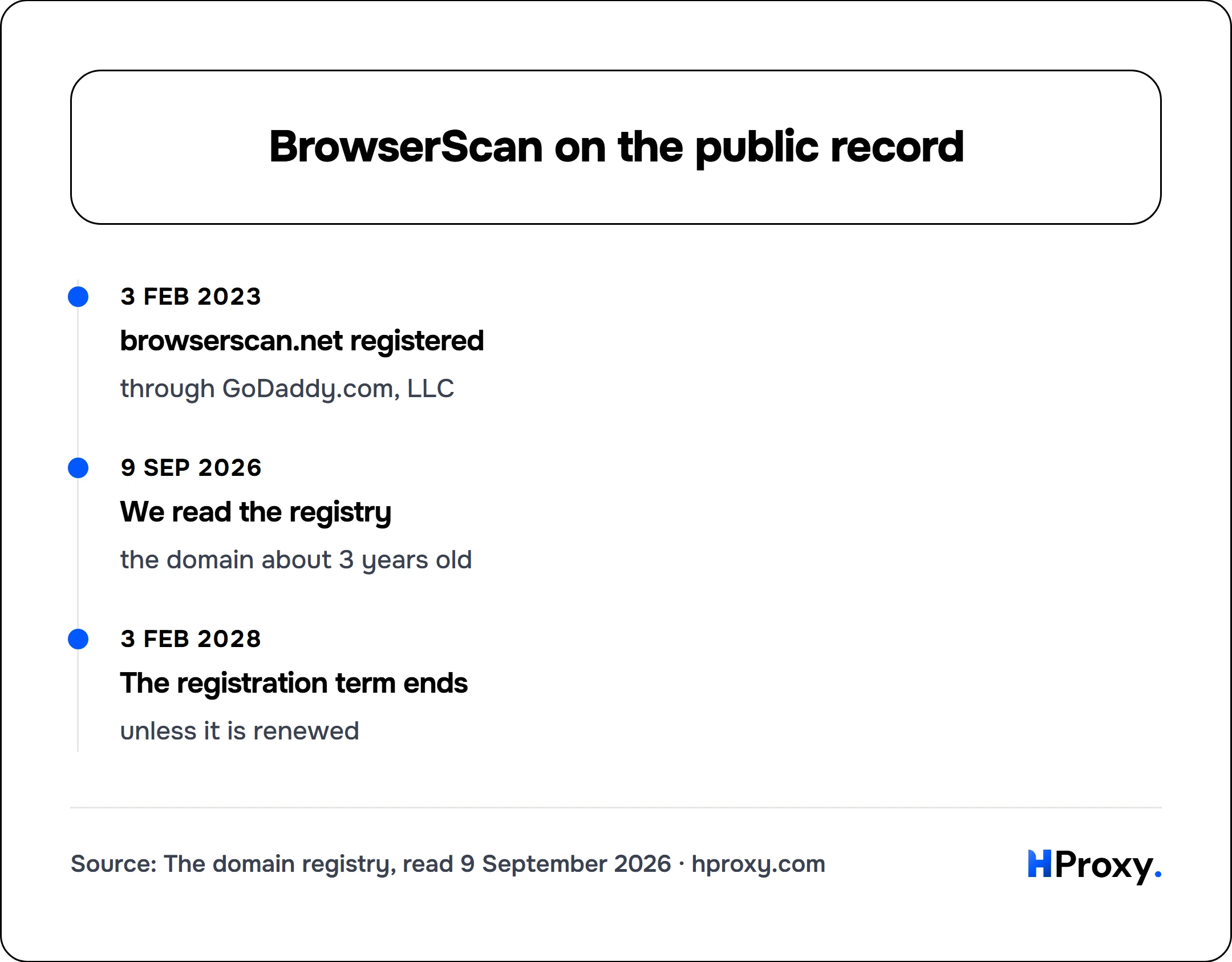
3 Feb 2023
browserscan.net registered
through GoDaddy.com, LLC
9 Sep 2026
We read the registry
the domain about 3 years old
3 Feb 2028
The registration term ends
unless it is renewed
None of it predicts success rate. It is here because domain age and archive depth are free to check, and a provider whose public record starts last quarter deserves a smaller first order.
What you still do not know after reading their site
The entry price is not the effective price
Rates in this market are quoted from the bottom of the table. The relevant question is which row you land on at your volume, and whether reaching a cheaper row costs more in commitment than it saves per unit.
What happens at the end of the month
This single term separates cheap providers from providers that look cheap. If a plan resets at month end, your effective rate is the plan price divided by what you actually used. Ours does not expire, which is easy to say and easy to verify in the terms.
What the lowest rate actually costs
Treat a required call with a salesperson as a cost. It delays the work, it usually arrives with an annual term attached, and it exists because the published price is negotiable in one direction only.
The two of us, on the questions that matter
Here are the comparisons that survive contact with a real workload:
| Question to ask | BrowserScan | HProxy |
|---|---|---|
| Entry price | Not verified by us, read their page | From $0.44/GB, pay as you go |
| Does unused balance expire? | Not published clearly, ask before paying | Never |
| Minimum commitment | Check the current terms, this one moves | None |
| Identity checks | Their terms page answers this | Card orders are screened, and verification is sometimes requested |
| Targeting | Check the current terms, this one moves | Country, city and ISP |
| Free way to evaluate | Their terms page answers this | Free proxy list and proxy checker |
Where a cell points you at their terms, that is because the answer moves and a stale quotation would be worse than none. The missing row, in every table of this kind, is the one only your own measurement can fill.
The measurement that outranks every review
This costs less than a coffee and produces the only evidence that applies to your workload.
- Fund both accounts with the least money each will accept, and note what that minimum was, because it is part of the comparison.
- Aim both at the page that matters to you rather than a test endpoint, and keep every other variable fixed.
- Record the success rate and the data consumed for the identical batch on each side.
- Check some of the addresses yourself for country, ASN and type before you trust the label on the plan.
- Keep the winner, and repeat the whole thing quarterly, because pools age.
The rest of the shortlist
Buyers comparing this name usually have two or three of these open in other tabs:
- IPCloud alternatives
- Ipcola alternatives
- IPCook alternatives
- IPDeep alternatives
- IPFighter alternatives
Where we fit
For completeness: residential from $0.44 per GB with country targeting, city and ISP targeting on Residential Premium from $1.00 per GB, no monthly minimum, and a balance that stays where you left it. We are a good fit for uneven workloads and a poor one for anybody who wants a signed enterprise agreement.