If you are comparing BirdProxies against anything else, the first thing to fix is units. A per-gigabyte rate against a per-address rate is not a comparison, and half the proxy provider market prices in a different unit to the other half.
What is on file for BirdProxies
BirdProxies trades at birdproxies.com.
There is no price in this comparison because we do not have one we can date and attribute. What follows instead is the set of questions that decide the cost once you do read their page.
When you do read it, note four things: the rate you actually qualify for today, the minimum purchase, whether unused balance expires, and whether failed requests are billed. Those four decide the real cost more than the headline does.
BirdProxies in its own words
The title tag on 9 September 2026 was "BirdProxies - Premium ISP and Residential Proxies, Fast and Reliable". Their meta description, the sentence Google shows under the link, says: "BirdProxies offers high-quality ISP and residential proxies with 99.9% uptime. Buy proxies starting at €0.69/IP. 50+ countries, instant setup, 24/7 support."
Reading the same page for the things buyers actually ask about:
The product lines named on that page are residential, datacenter and ISP or static residential. Payment methods mentioned: crypto. Support is advertised as around the clock. We found no separate pricing page linked from the homepage, which usually means the price arrives by quotation.
Those are claims, and claims are free. They earn their place here only because the date makes them checkable later.
How far back the record goes
The domain was registered on 26 April 2024, through NameCheap, Inc, which makes it about 2 years old. Checked against the registry on 23 April 2026. The registration currently runs to 26 April 2027.
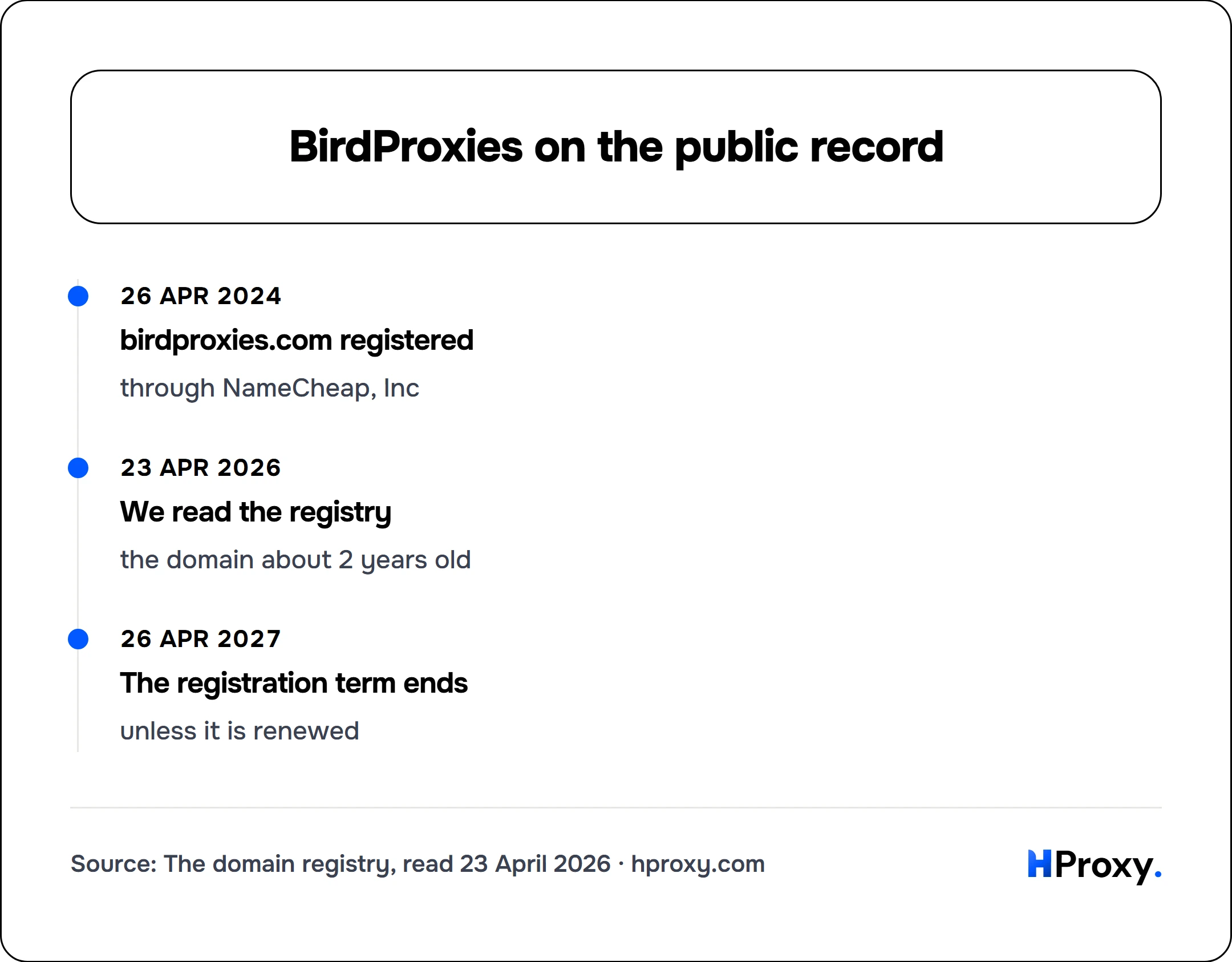
26 Apr 2024
birdproxies.com registered
through NameCheap, Inc
23 Apr 2026
We read the registry
the domain about 2 years old
26 Apr 2027
The registration term ends
unless it is renewed
None of it predicts success rate. It is here because domain age and archive depth are free to check, and a provider whose public record starts last quarter deserves a smaller first order.
What BirdProxies publishes
Our own crawl reached 1.449 of their pages. The mix was 477 blog pages, 9 pricing pages and 90 use-case pages.
Site size is a signal about marketing budget rather than network quality, and the two are frequently unrelated. It is useful for a different reason: a provider with many pricing pages is usually segmenting hard, and a provider with none is selling by quotation.
The questions behind the numbers
Ask what happens to unused balance
This single term separates cheap providers from providers that look cheap. If a plan resets at month end, your effective rate is the plan price divided by what you actually used. Ours does not expire, which is easy to say and easy to verify in the terms.
The rate behind the sales call
A commitment converts a variable cost into a fixed one. That is a good trade at steady volume and a poor one otherwise, and the decision belongs to you rather than to whichever tier looks cheapest per unit.
The limit that stops the job
Bandwidth is rarely the constraint on a real workload. Concurrent connections, requests per second and per-session caps are, and they are frequently buried in the documentation rather than the pricing page.
The comparison, honestly framed
Here are the comparisons that survive contact with a real workload:
| Question to ask | BirdProxies | HProxy |
|---|---|---|
| Entry price | Not verified by us, read their page | From $0.44/GB, pay as you go |
| Does unused balance expire? | Read their current terms | Never |
| Minimum commitment | On their own terms page | None |
| Identity checks | Not published clearly, ask before paying | Card orders are screened, and verification is sometimes requested |
| Targeting | On their own terms page | Country, city and ISP |
| Free way to evaluate | Not published clearly, ask before paying | Free proxy list and proxy checker |
A table like this can rank the things that are written down. It cannot rank the thing that matters most, which is how the network behaves against the site you care about.
The test that beats this page
It is a small amount of money for an answer that is actually about your target.
- Put a few dollars on each account. Trials are fine for a first look, but paid traffic is what you will actually be buying.
- Run them against the site you actually care about, using the code you actually run, within the same hour.
- Track the success rate and the bandwidth. A cheap gigabyte that fails half the time is not cheap.
- Run a sample of the addresses through an independent lookup, because advertised geography and actual geography differ more often than the market admits.
- Choose on the measurement, not the marketing, and expect the answer to change within a year.
The rest of the shortlist
Buyers comparing this name usually have two or three of these open in other tabs:
- Glorycloud alternatives
- Gologin alternatives
- GonzoProxy alternatives
- Gotoproxy alternatives
- Goubanjia alternatives
What we sell, stated plainly
If you want our side of it: $0.44 per GB for residential, pay as you go, nothing expires, and the free tools stay free. We would rather you measured than believed us, which is why the test comes before this paragraph rather than after it.