
Goubanjia is gone. Until 2021, goubanjia.com ran 全网代理IP, a Chinese site with a free proxy list and paid HTTP proxies. The last working copy in the Internet Archive is from 20 April 2021. On 27 September 2026 the address served no page at all: our server got an empty reply, and later no answer. The alternatives are in the table below.
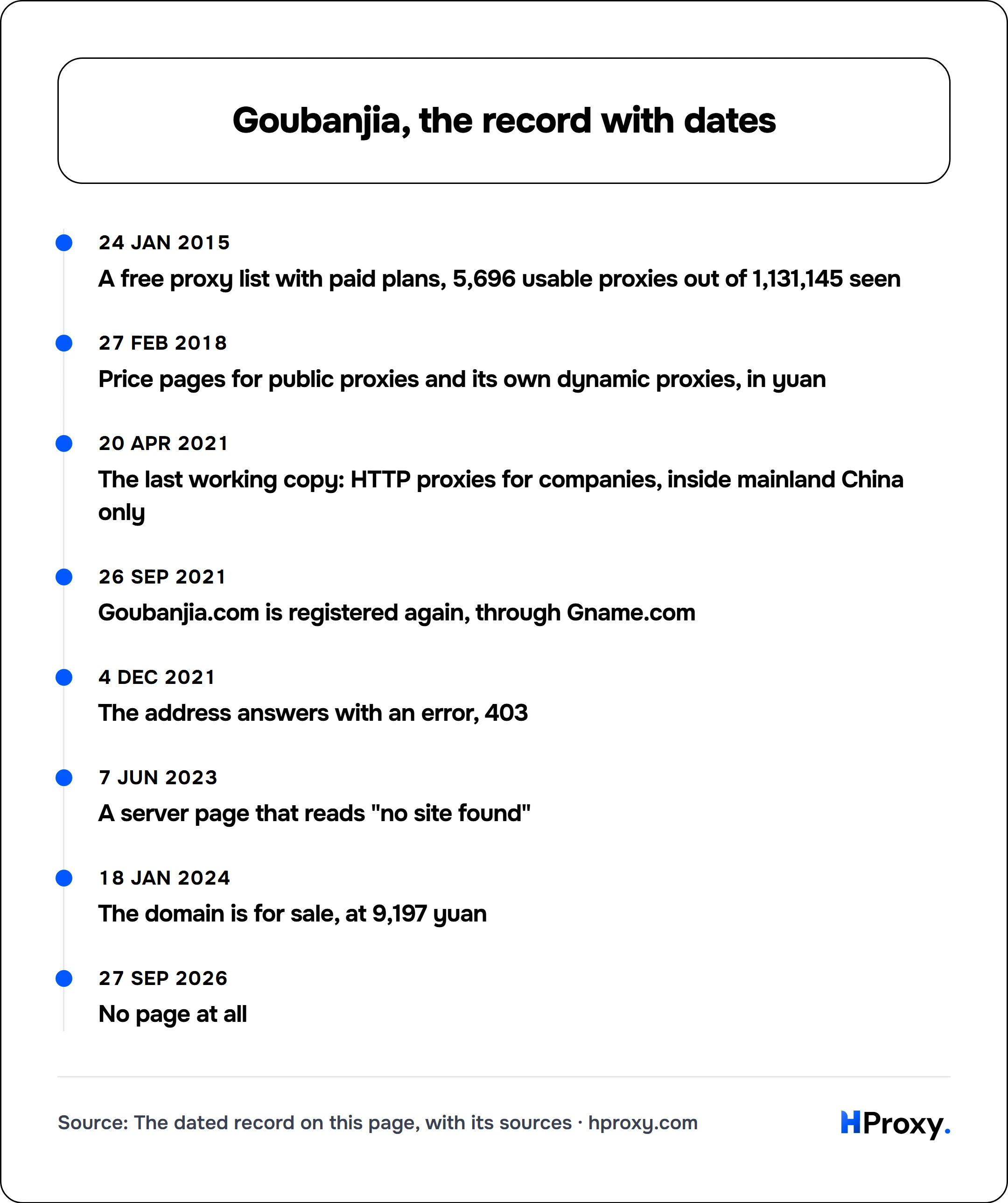
The record, with dates
| date | what the record shows |
|---|---|
| 24 January 2015 | a free proxy list with paid plans, 5,696 usable proxies out of 1,131,145 seen |
| 27 February 2018 | price pages for public proxies and its own dynamic proxies, in yuan |
| 20 April 2021 | the last working copy: HTTP proxies for companies, inside mainland China only |
| 26 September 2021 | goubanjia.com is registered again, through Gname.com |
| 4 December 2021 | the address answers with an error, 403 |
| 7 June 2023 | a server page that reads "no site found" |
| 18 January 2024 | the domain is for sale, at 9,197 yuan |
| 27 September 2026 | no page at all |
24 Jan 2015
A free proxy list with paid plans, 5,696 usable proxies out of 1,131,145 seen
27 Feb 2018
Price pages for public proxies and its own dynamic proxies, in yuan
20 Apr 2021
The last working copy: HTTP proxies for companies, inside mainland China only
26 Sep 2021
Goubanjia.com is registered again, through Gname.com
4 Dec 2021
The address answers with an error, 403
7 Jun 2023
A server page that reads "no site found"
18 Jan 2024
The domain is for sale, at 9,197 yuan
27 Sep 2026
No page at all
Sources: the domain registry, the Internet Archive and our own checks of 27 September 2026.
What it offered
In 2015 the homepage showed the newest 100 free HTTP proxies. It said its scanners had seen 1,131,145 proxies, of which 5,696 were usable, and that the list changed every 10 minutes.
By 2018 there were two paid products. Access to public proxies, found by scanning the internet and "about 30%" usable, cost 9 yuan a day, 35 a week and 93 a month. Its own dynamic proxies, all inside mainland China, cost 4 yuan for a 4-hour test and 10 yuan a day. The page said no product could be refunded after purchase.
By April 2021 the site sold HTTP proxies to companies for data collection, with invoices. It offered no addresses outside mainland China, and it said it kept request logs and would report illegal use.
What we could not check
- Why it stopped. No page gives a reason.
- Who ran it. No company is named; the 2021 site carried a Beijing website filing number, 京ICP备16045418号.
- What happened to paid accounts and balances.
Goubanjia alternatives for free and paid proxies
On 9 September 2026 we took a random sample from eleven free lists and opened every address in it. The rows below come from our test of eleven free lists.
| list | addresses listed | share that relayed our sample, 9 September |
|---|---|---|
| Goubanjia | none since 2021 | gone |
| free-proxy-list.net | 300 | 34.2% |
| ProxyScrape | 624 to 671 | 26.7% |
| Spys.me | 400 | 25.0% |
| TheSpeedX (GitHub) | 3,024 | 7.5% |
| Proxifly (GitHub) | 2,385 | 2.5% |
A longer list did not relay more that day. TheSpeedX published 3,024 addresses and relayed 7.5 percent, while free-proxy-list.net published 300 and relayed 34.2 percent. Our own free proxy list comes from an engine that has run 129M checks across 110 sources, as measured on 2026-08-11.
When free proxies are not enough, paid traffic removes the guesswork. Our Residential Lite costs $0.50 per GB for a first gigabyte, with country targeting. Premium costs $1.49 per GB and adds state, city and ISP targeting. Both are on our price table.
Where HProxy is different
Still running, with a name on it. HProxy is run by Obsidian UG in Herford, Germany, with its register number in our imprint.
A checker for large lists. Our free proxy checker tests up to 100,000 proxies without an account.
A balance that keeps. Our paid proxies run on a balance that never expires, so nothing is lost if a job pauses.
Before you pick one
Pull a sample from any free list and run it through our proxy checker before you rely on it. Send nothing private through a public proxy, and if most addresses fail, test a gigabyte of paid traffic next.
The limits of this record
Everything about Goubanjia comes from archived copies and from our own checks of the dead address. We cannot say on which day the service stopped: the archive shows the site on 20 April 2021 and an error on 4 December 2021. This page is due for a check by 27 December 2026.
Other providers we cover
Pages on other proxy brands: Enode.vn and Evomi.com.
Sources
- Goubanjia: archived copies of goubanjia.com from 24 January 2015 to 18 January 2024, including its price pages of 27 February 2018.
- Verisign, the registry record for goubanjia.com.
- HProxy, our checks of goubanjia.com from our server, 27 September 2026.
- HProxy, our test of eleven free proxy lists, 9 September 2026.
- HProxy, our free proxy engine figures, product catalog, price table and imprint.