The useful question is never whether GoToProxy is good. It is whether it fits the job you are about to run, on your target, this month. A proxy provider that suits one workload is wrong for the next one.
What we know about GoToProxy, and what we do not
Their site is gotoproxy.com.
There is no price in this comparison because we do not have one we can date and attribute. What follows instead is the set of questions that decide the cost once you do read their page.
Take down four numbers and a date: reachable rate, minimum purchase, commitment for the floor rate, and expiry period. Anything less and you cannot compare them to anyone.
The site, as it reads today
Their homepage title, read on 9 September 2026: "Home - GoToProxy - Expert Proxy Service Reviews and Privacy Tools". Written for search engines, their description says: "Recent Articles"
Also on the page, stated plainly:
The product lines named on that page are residential, datacenter, ISP or static residential and mobile. We found no separate pricing page linked from the homepage, which usually means the price arrives by quotation.
Nothing there has been tested. It is a record of what the page said on the day, which is the honest limit of what a page like this can offer without a measurement.
Age, and why it matters here
The domain was registered on 27 March 2023, through Dynadot Inc, which makes it about 3 years old. The lookup behind those dates ran on 9 September 2026. As things stand the domain is held to 27 March 2028.
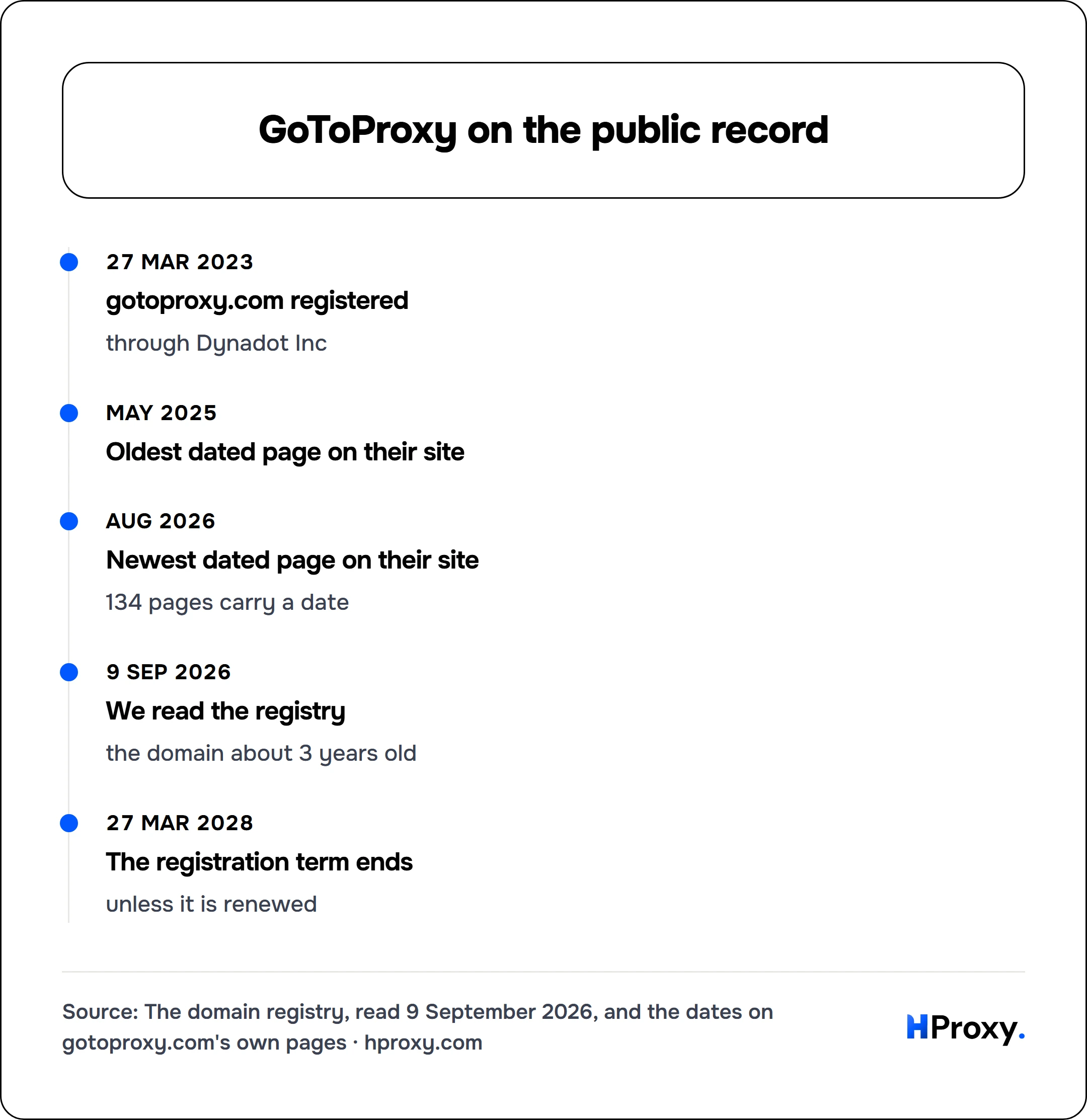
27 Mar 2023
gotoproxy.com registered
through Dynadot Inc
May 2025
Oldest dated page on their site
Aug 2026
Newest dated page on their site
134 pages carry a date
9 Sep 2026
We read the registry
the domain about 3 years old
27 Mar 2028
The registration term ends
unless it is renewed
None of it predicts success rate. It is here because domain age and archive depth are free to check, and a provider whose public record starts last quarter deserves a smaller first order.
What GoToProxy publishes
Our own crawl reached 134 of their pages. The mix was 1 blog page.
Site size is a signal about marketing budget rather than network quality, and the two are frequently unrelated. It is useful for a different reason: a provider with many pricing pages is usually segmenting hard, and a provider with none is selling by quotation.
Whether anyone is still working on it
Our crawl of their site found 134 pages carrying a date. The oldest is from May 2025 and the newest from August 2026. 95 of them carry a date inside the last twelve months.
Timestamps are not quality, and a company still publishing is at least a company still trading. That is worth more than it sounds in a market where providers disappear without notice.
The questions behind the numbers
Support is a product feature
Support quality is invisible until it is the only thing that matters. A cheap provider that takes three days to answer a routing problem has cost you more than the saving, and no pricing page reveals that.
Nothing here stays true for long
Supply changes hands quietly in this industry. The network behind a brand can be replaced with no announcement, which is why a benchmark is a perishable good and a re-test is cheap insurance.
The limit that stops the job
Bandwidth is rarely the constraint on a real workload. Concurrent connections, requests per second and per-session caps are, and they are frequently buried in the documentation rather than the pricing page.
The comparison, honestly framed
Compare on these rows and ignore the feature lists on both sites:
| Question to ask | GoToProxy | HProxy |
|---|---|---|
| Entry price | Not verified by us, read their page | From $0.44/GB, pay as you go |
| Does unused balance expire? | Their terms page answers this | Never |
| Minimum commitment | Worth confirming in writing before you commit | None |
| Identity checks | Read their current terms | Card orders are screened, and verification is sometimes requested |
| Targeting | On their own terms page | Country, city and ISP |
| Free way to evaluate | Not published clearly, ask before paying | Free proxy list and proxy checker |
Treat the right-hand column as a claim by an interested party, because it is one. Every line in it is checkable on our own pages and in our own terms.
The measurement that outranks every review
This costs less than a coffee and produces the only evidence that applies to your workload.
- Take the smallest paid unit each provider will sell you. A free trial works for a first pass, though trials sometimes ride better pools than paid plans do.
- Fire the same batch through both on one afternoon. Different days are different conditions, and that ruins the comparison.
- Write down two numbers per provider: the share of requests that succeeded, and the traffic it cost.
- Take a handful of the addresses you were given and verify their country and type against a checker you do not control.
- Go with whichever performed, then measure again next quarter. Networks change underneath you.
Comparable providers
We hold the same record for these, and the same honest limits apply to each:
- Eclipseproxy alternatives
- Elfproxy alternatives
- Elite Proxy alternatives
- EliteProxies alternatives
- Enigmaproxy alternatives
Where we fit
For completeness: residential from $0.44 per GB with country targeting, city and ISP targeting on Residential Premium from $1.00 per GB, no monthly minimum, and a balance that stays where you left it. We are a good fit for uneven workloads and a poor one for anybody who wants a signed enterprise agreement.