Two things decide whether a proxy provider works for you, and neither appears on a pricing page: how the pool behaves against your specific target, and what happens to money you have paid but not spent.
What we know about BestProxyReviews, and what we do not
Their site is bestproxyreviews.com.
We have no verified current rate for BestProxyReviews on file. Printing a guess would make this page worse than useless, so the price row below is empty and the reading list is not.
Find the rate available with no commitment, then find the cheapest rate and what it costs to reach. The distance between those two tells you what kind of vendor you are dealing with.
BestProxyReviews in its own words
On 9 September 2026 the site introduced itself as "The Best Proxy Services Of 2026 - Best Proxy Review". Their own summary of the product runs: "Making the best choice for a proxy provider is not an easy task. Fortunately, we have made it easy by combing the market and presenting to you the best proxy"
Reading the same page for the things buyers actually ask about:
The product lines named on that page are residential, datacenter, ISP or static residential, mobile, SOCKS5, IPv6 and a scraping or SERP API. They advertise 30 countries or locations. Payment methods mentioned: Wise or Payoneer. The page offers some form of free trial. Support is advertised as around the clock. A refund or money-back term is mentioned. We found no separate pricing page linked from the homepage, which usually means the price arrives by quotation.
Treat all of it as advertising, because it is. Its value is that it is dated and quotable, which is more than most comparison pages offer.
How far back the record goes
The domain was registered on 1 December 2010, through Dynadot Inc, which makes it about 15 years old. We pulled that from the registry on 23 April 2026. The Internet Archive holds 20 snapshots of the site, the earliest from December 2010. The current registration term ends 1 December 2026.
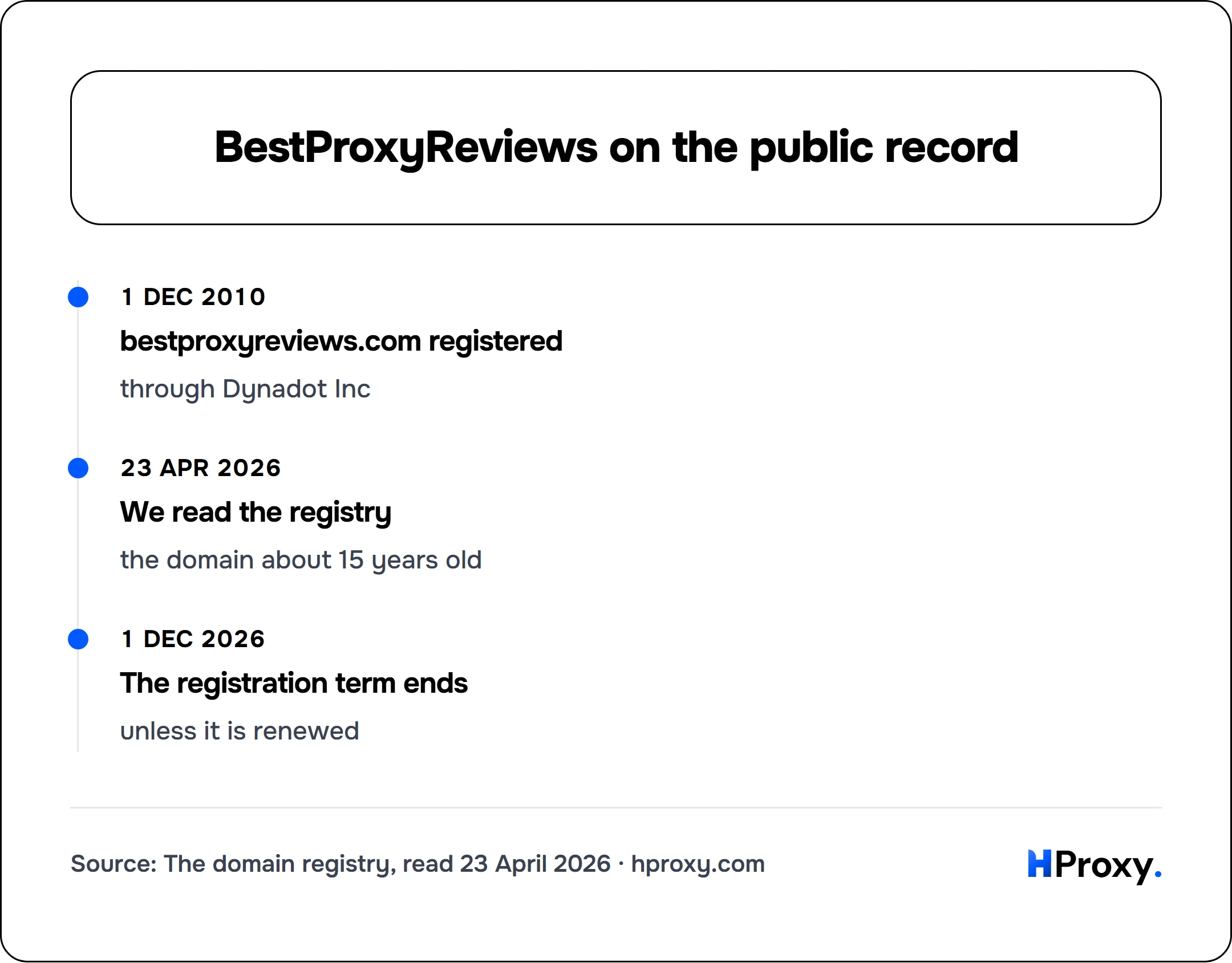
1 Dec 2010
bestproxyreviews.com registered
through Dynadot Inc
23 Apr 2026
We read the registry
the domain about 15 years old
1 Dec 2026
The registration term ends
unless it is renewed
None of it predicts success rate. It is here because domain age and archive depth are free to check, and a provider whose public record starts last quarter deserves a smaller first order.
What you still do not know after reading their site
Networks age, so re-test quarterly
Supply changes hands quietly in this industry. The network behind a brand can be replaced with no announcement, which is why a benchmark is a perishable good and a re-test is cheap insurance.
The reputation you inherit
An address you share carries the reputation of everyone else on it. That is acceptable for some work and fatal for anything involving a login. The price difference between shared and dedicated usually reflects exactly this.
The line item hidden in the success rate
On a hard target, failures are the majority of your traffic. Whether those failures are billed decides the real cost, and the clause covering it is rarely on the pricing page.
The two of us, on the questions that matter
Compare on these rows and ignore the feature lists on both sites:
| Question to ask | BestProxyReviews | HProxy |
|---|---|---|
| Entry price | Not verified by us, read their page | From $0.44/GB, pay as you go |
| Does unused balance expire? | Not published clearly, ask before paying | Never |
| Minimum commitment | Check the current terms, this one moves | None |
| Identity checks | Their terms page answers this | Card orders are screened, and verification is sometimes requested |
| Targeting | Worth confirming in writing before you commit | Country, city and ISP |
| Free way to evaluate | Read their current terms | Free proxy list and proxy checker |
Where a cell points you at their terms, that is because the answer moves and a stale quotation would be worse than none. The missing row, in every table of this kind, is the one only your own measurement can fill.
The measurement that outranks every review
This costs less than a coffee and produces the only evidence that applies to your workload.
- Fund both accounts with the least money each will accept, and note what that minimum was, because it is part of the comparison.
- Aim both at the page that matters to you rather than a test endpoint, and keep every other variable fixed.
- Record the success rate and the data consumed for the identical batch on each side.
- Check some of the addresses yourself for country, ASN and type before you trust the label on the plan.
- Go with whichever performed, then measure again next quarter. Networks change underneath you.
Where else buyers look
If this one does not fit, these are the nearest comparable providers we have written up, each on the same terms as this page.
- FlamingoProxies alternatives
- FleetProxy alternatives
- FlexyProxies alternatives
- Floppydata alternatives
- FlowProxies alternatives
- Floxy alternatives
Our own position
Our end of it is a wallet, four proxy types and no contract. Residential begins at $0.44 per GB and the balance does not expire. The free proxy list and checker are open to anyone, and they are the fastest way to see how we treat measurement before you spend anything.