The shortest useful answer about FlowProxies: find out what their current published rate is, find out whether your balance expires, then measure success rate on your own target. Everything below expands those three steps.
FlowProxies on the record
The domain is flow-proxies.com.
A price is missing here on purpose. We have not captured a sourced rate for FlowProxies recently enough to publish one, and a stale number in this market is a wrong number.
Their pricing page will answer three of the four questions that matter. Send an email for the fourth, which is usually whether blocked requests are billed, and keep the reply.
Where published figures stop being useful
Ten million addresses, and none of them yours
The number that matters is how many usable exits you can reach in the one country your job needs, this week. A pool total averages that away, which is why two providers with similar totals produce opposite results on the same site.
The entry price is not the effective price
Divide what you spent in a month by what you actually used, and you have the only rate worth quoting. It usually sits well above the figure on the homepage, because tiers, minimums and unused allocation all sit between the two.
The expiry question
Expiry is the quietest price increase in this market. A plan sized for a busy month is expensive in a slow one, and the difference never appears in any comparison table, including ones written by vendors who benefit from it.
A comparison that admits what it cannot say
The table answers what we can answer and marks what we cannot:
| Question to ask | FlowProxies | HProxy |
|---|---|---|
| Entry price | Not verified by us, read their page | From $0.44/GB, pay as you go |
| Does unused balance expire? | Check the current terms, this one moves | Never |
| Minimum commitment | Read their current terms | None |
| Identity checks | Worth confirming in writing before you commit | Card orders are screened, and verification is sometimes requested |
| Targeting | Read their current terms | Country, city and ISP |
| Free way to evaluate | Worth confirming in writing before you commit | Free proxy list and proxy checker |
Every unfilled cell above is a question to put to them directly, in writing, before money changes hands. Vendors answer those questions readily; comparison sites guess at them.
How to settle it yourself in ten minutes
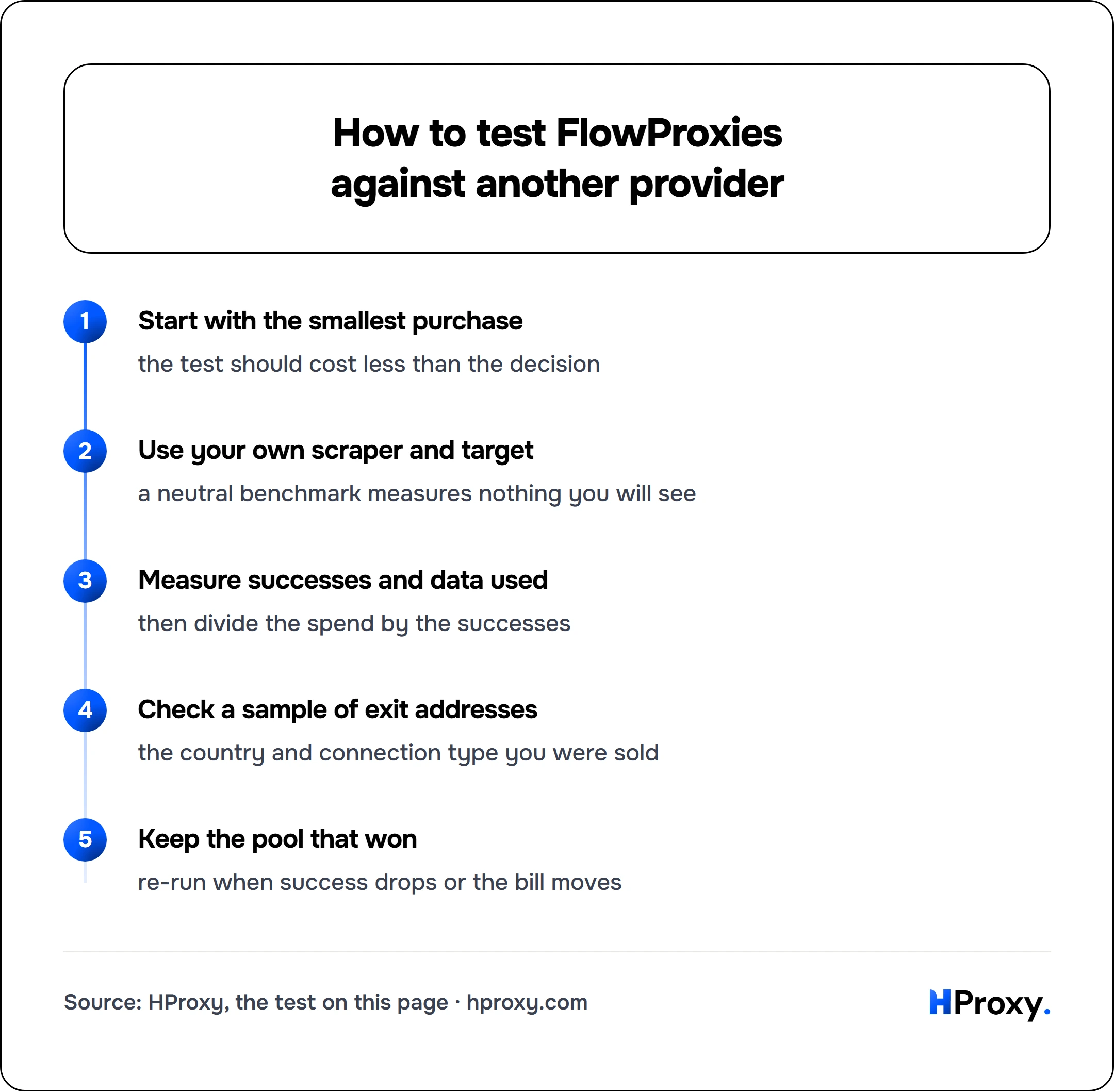
Run this before you commit any volume. It replaces every opinion on this page, including ours.
- Start with the smallest purchase each vendor allows, so the test costs less than the decision it replaces.
- Use your own scraper and your own target. A benchmark against a neutral site measures nothing you will experience.
- Measure what came back correctly and what it consumed, then divide the spend by the successes.
- Push a sample of exit addresses through an independent checker and confirm the country and connection type are what was advertised.
- Keep whichever pool won on your job. Re-run this whenever success rate drops or the bill moves.
Start with the smallest purchase
the test should cost less than the decision
Use your own scraper and target
a neutral benchmark measures nothing you will see
Measure successes and data used
then divide the spend by the successes
Check a sample of exit addresses
the country and connection type you were sold
Keep the pool that won
re-run when success drops or the bill moves
Others in this market
Nearest alternatives by product shape rather than by who pays us, since nobody does:
- YiLu Proxy alternatives
- You Proxy alternatives
- Youproxy alternatives
- YourPrivateProxy alternatives
- Zdaye alternatives
Where HProxy sits in that test
Our own lane is easy to state. Residential starts at $0.44 per GB with country targeting, the balance is topped up when you want and does not expire, there is no subscription unless the optional discount suits you, and city and ISP targeting come with Residential Premium from $1.00 per GB. If the test above puts us second on your target, buy the winner.