This page exists because the search you ran has almost no honest results. Nearly every page ranking for "FleetProxy alternative" earns a commission on the answer it gives you. We earn money if you pick us, which we are stating in the first paragraph rather than the footer.
FleetProxy on the record
FleetProxy operates from fleetproxy.io.
What we do not hold is a current, sourced price for FleetProxy. Rather than print a figure we cannot stand behind, this page leaves it out and tells you what to look for when you read their page yourself.
Read their page for the reachable rate rather than the headline, the minimum spend, the expiry clause and the billing treatment of blocked requests. Write down the date, because all four move.
What is on their front page
On 9 September 2026 their homepage carried the title "FleetProxy, Affordable Residential, Mobile and Datacenter Proxy Provider". The description they publish for search engines reads: "FleetProxy: affordable rotating residential, static ISP, datacenter, mobile LTE, and SOCKS5 proxies in 195 countries. Pay-as-you-go from $2.65/GB."
What else that page states, without interpretation:
The product lines named on that page are residential, datacenter, ISP or static residential, mobile, SOCKS5 and IPv6. They advertise 170 countries or locations. Payment methods mentioned: crypto. The page offers some form of free trial. Support is advertised as around the clock. Their pricing page is titled "FleetProxy Pricing Plans, Transparent Proxy Pricing From $2.65/GB".
Those are claims, and claims are free. They earn their place here only because the date makes them checkable later.
Longevity, on the public record
The domain was registered on 24 July 2024, through NameCheap, Inc, which makes it about 2 years old. Registry data as of 23 April 2026. The Internet Archive holds 12 snapshots of the site, the earliest from February 2025. It is paid up until 24 July 2026.
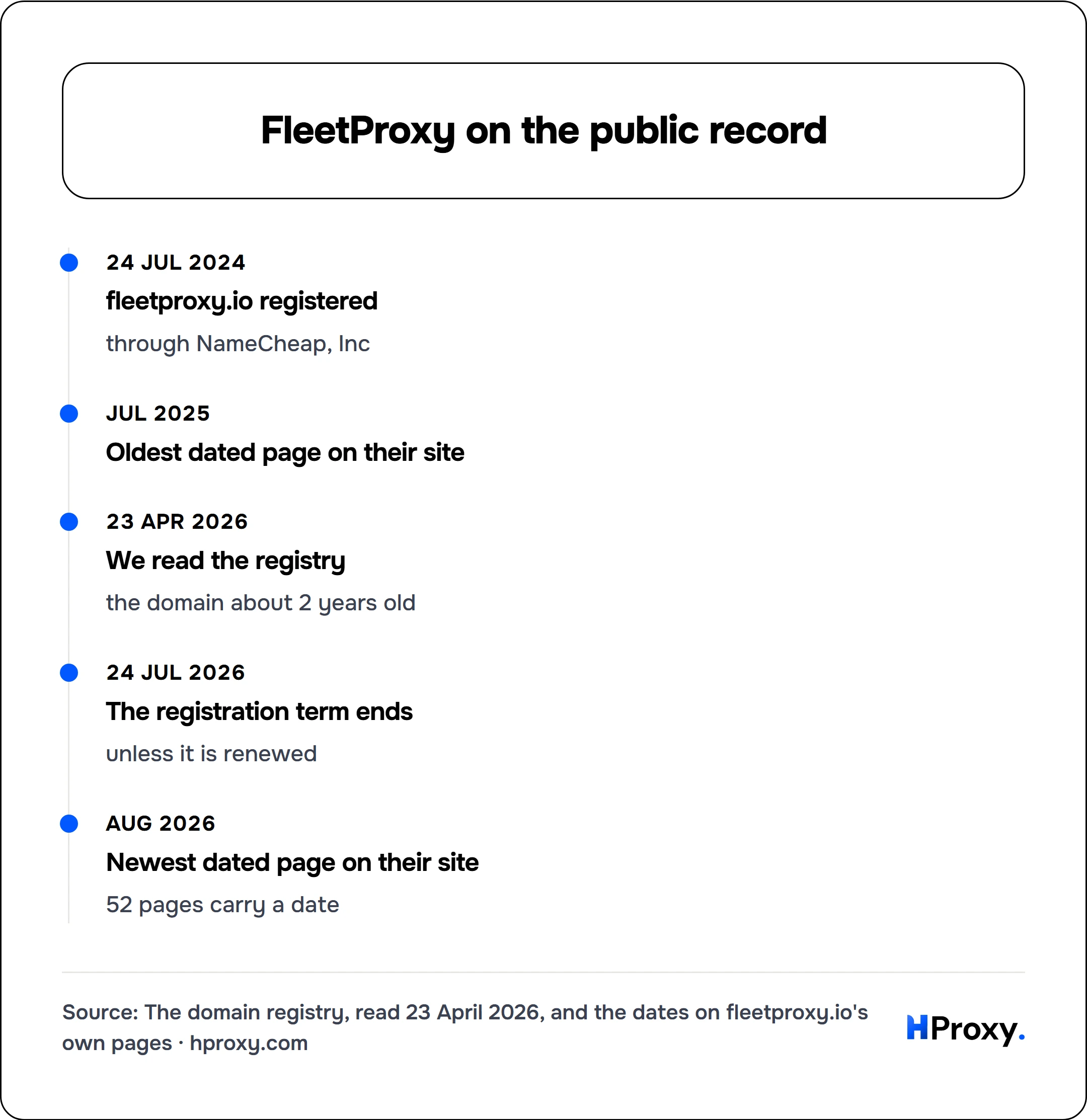
24 Jul 2024
fleetproxy.io registered
through NameCheap, Inc
Jul 2025
Oldest dated page on their site
23 Apr 2026
We read the registry
the domain about 2 years old
24 Jul 2026
The registration term ends
unless it is renewed
Aug 2026
Newest dated page on their site
52 pages carry a date
Read that as a floor rather than a recommendation. Longevity says somebody has kept paying the registrar, and in a market with this much churn that is worth ten seconds of your attention.
The shape of their site
A crawl of 124 pages returned 40 blog pages, 1 pricing page, 1 location page, 6 use-case pages and 4 integration pages.
That mix tells you how the company sells. Heavy location pages mean a geography-led pitch, heavy blog means a search-led one, and a single pricing page usually means one simple offer or one sales call.
The activity record
Our crawl of their site found 52 pages carrying a date, 40 of them articles. The oldest is from July 2025 and the newest from August 2026. 43 of them carry a date inside the last twelve months.
An actively maintained site is table stakes rather than a recommendation. It does rule out the failure that costs buyers the most here, which is prepaying a company that has quietly stopped.
Where published figures stop being useful
The expiry question
Find out whether unspent traffic rolls over, expires, or expires only on some plans. The answer changes the effective rate by more than most of the price differences buyers spend their time arguing about.
Why a cheap address is often a used one
A shared address arrives with a history you did not create and cannot see. For read-only work it rarely matters. For anything that keeps a session, it is the most common cause of unexplained failure.
Who pays for the requests that fail
Some vendors bill every request, some bill only successful ones, and the difference is the whole comparison once a target starts blocking. A cheap rate with a fifty percent success rate is twice its advertised price.
A comparison that admits what it cannot say
The rows below are the ones that change what you pay and whether the job runs:
| Question to ask | FleetProxy | HProxy |
|---|---|---|
| Entry price | Not verified by us, read their page | From $0.44/GB, pay as you go |
| Does unused balance expire? | Check the current terms, this one moves | Never |
| Minimum commitment | Not published clearly, ask before paying | None |
| Identity checks | On their own terms page | Card orders are screened, and verification is sometimes requested |
| Targeting | Not published clearly, ask before paying | Country, city and ISP |
| Free way to evaluate | On their own terms page | Free proxy list and proxy checker |
Blanks in that table are deliberate. We print what we read and date it, and leave the rest empty rather than repeating something we cannot stand behind.
The ten minute version of this decision
For a few dollars you can get a verdict specific to your job, which no comparison page can honestly promise you.
- Open an account on each and add the smallest amount they take. Skip the trial if a paid unit is cheap enough to buy outright.
- Point both at your real target, through your real tool, on the same day, with the same mix of requests.
- Log successes, failures and gigabytes used. Cost per successful request is the figure you are after.
- Verify a slice of the exits independently. Country labels in this market are self-reported and are not always right.
- Buy the one that won on your target, and diarise a re-test in three months.
Who else is in this bracket
The same treatment, applied to the providers most often weighed against this one:
- W3Lookup alternatives
- Wandouip (豌豆代理) alternatives
- Wealthproxies alternatives
- Webscrapingapi alternatives
- Webshare alternatives
Where HProxy sits in that test
We sell residential proxies from $0.44 per GB with no subscription and a balance that does not expire, plus ISP, mobile and datacenter in the same account. That is the pitch, and the test above is a better judge of it than this paragraph.