The shortest useful answer about Floxy: find out what their current published rate is, find out whether your balance expires, then measure success rate on your own target. Everything below expands those three steps.
Floxy on the record
The domain is floxy.io.
Floxy is not in our priced record, so nothing about their rate appears below. That gap is stated rather than filled, which is the only honest option available.
Their pricing page will answer three of the four questions that matter. Send an email for the fourth, which is usually whether blocked requests are billed, and keep the reply.
How Floxy presents itself
As of 9 September 2026 the tab reads "Floxy - Reliable Proxy Infrastructure for Data Gathering". The description they publish for search engines reads: "Floxy is a reliable proxy provider, offering clean, dedicated, rotating proxies with over 30M+ IP's. Extract public data at scale today!"
The rest of what the page puts in writing:
The product lines named on that page are residential, datacenter, ISP or static residential, mobile, SOCKS5 and a scraping or SERP API. They advertise 200 countries or locations. Payment methods mentioned: crypto. Their pricing page is titled "Pricing - Floxy".
None of that is verified performance. It is what the vendor chose to publish, recorded with a date so you can see whether it still says the same thing.
Longevity, on the public record
The domain was registered on 6 January 2021, through NameCheap, Inc, which makes it about 5 years old. That record was read from the registry on 23 April 2026. The registry shows it renewed to 6 January 2027.
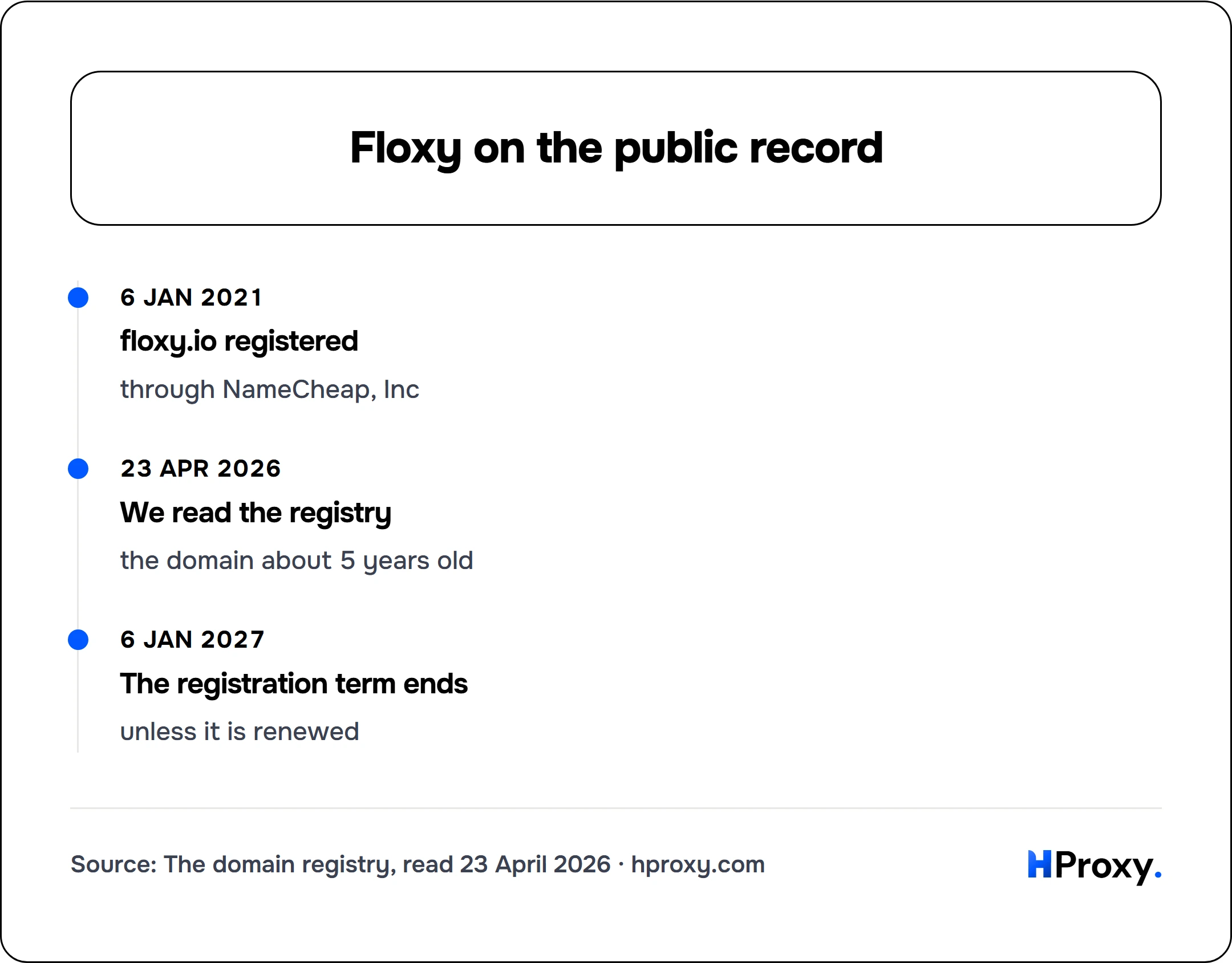
6 Jan 2021
floxy.io registered
through NameCheap, Inc
23 Apr 2026
We read the registry
the domain about 5 years old
6 Jan 2027
The registration term ends
unless it is renewed
Age is not quality. A long registration does not make a network good, and a new one does not make it bad. What it does rule out is the shortest-lived pattern in this market, which is a site that appears, sells, and is gone inside a year.
How much site there is
We crawled 125 pages of their site and found 15 blog pages, 1 pricing page, 60 location pages and 33 use-case pages.
Read it as a map of what they emphasise. It is our count, from our crawler, on the date shown, and it is the only figure on this page that neither of us can dispute.
What the advertised numbers cannot tell you
The reputation you inherit
A shared address arrives with a history you did not create and cannot see. For read-only work it rarely matters. For anything that keeps a session, it is the most common cause of unexplained failure.
Ask whether failed requests are billed
Some vendors bill every request, some bill only successful ones, and the difference is the whole comparison once a target starts blocking. A cheap rate with a fifty percent success rate is twice its advertised price.
Threads, not gigabytes, are often the ceiling
Bandwidth is rarely the constraint on a real workload. Concurrent connections, requests per second and per-session caps are, and they are frequently buried in the documentation rather than the pricing page.
What separates them, in a table
The table answers what we can answer and marks what we cannot:
| Question to ask | Floxy | HProxy |
|---|---|---|
| Entry price | Not verified by us, read their page | From $0.44/GB, pay as you go |
| Does unused balance expire? | On their own terms page | Never |
| Minimum commitment | Their terms page answers this | None |
| Identity checks | Check the current terms, this one moves | Card orders are screened, and verification is sometimes requested |
| Targeting | Their terms page answers this | Country, city and ISP |
| Free way to evaluate | Check the current terms, this one moves | Free proxy list and proxy checker |
Every unfilled cell above is a question to put to them directly, in writing, before money changes hands. Vendors answer those questions readily; comparison sites guess at them.
A test worth more than this comparison
Do this once and you will never need a comparison page for this decision again.
- Buy the minimum each side offers. Prefer a small paid batch over a trial, because trial traffic does not always ride the same pool.
- Send an identical workload through each: same target, same tooling, same time of day, same request mix.
- Log successes, failures and gigabytes used. Cost per successful request is the figure you are after.
- Verify a slice of the exits independently. Country labels in this market are self-reported and are not always right.
- Take the winner and set a reminder to run this again, since a result has a shelf life of about a quarter.
Others in this market
Nearest alternatives by product shape rather than by who pays us, since nobody does:
- Zenproxy alternatives
- Zeus Proxy alternatives
- Zingproxy alternatives
- Ziny alternatives
- 1024Proxy alternatives
- 1Abc alternatives
The competing offer, for completeness
HProxy suits buyers who want to add funds, send traffic and stop thinking about it. Residential from $0.44 per GB, no commitment, nothing expiring. Buyers who need procurement paperwork and a named account manager are better served elsewhere, and we would rather say so here than waste your afternoon.