On 7 September 2026, ProxyVero ran its benchmark against our residential pool. It published 89.4 percent success across six scenarios, 1439 ms average latency, and a 7.1 percent block rate. Five of the six scenarios landed between 86.7 and 100 percent. The sixth was Google search, at 60.0 percent, with a third of the requests blocked.
We asked for that test and did not see it before it went live. This article gives the low number the same room as the high ones. Then it does the thing a provider is not supposed to do with an independent result. It checks it.
Who ran the test and what we gave them
ProxyVero is an independent proxy benchmark site. It asked us for test traffic in order to run its own measurements, we funded a balance on 7 September 2026, and it published a provider profile, a review and a benchmark page. It states on its methodology page that it does not sell rankings and that affiliate calls to action are disclosed where they appear. We saw the pages when everybody else did. Its review declined to give us an overall score at all, on the grounds that it did not yet hold enough benchmark history for one.
What the benchmark measured
Six scenarios, all on residential exits, all with the same script and the same roughly 10 second timeout. Success on the generic endpoint means an HTTP 200 with a body. On the search scenario, success means an HTTP 200 without block-like content. A captcha page counts as a block, not a pass.
Our six scenario results, 7 September 2026
| Scenario | Success % | Avg latency ms | Block rate % | Requests |
|---|---|---|---|---|
| Nike product page | 100.0 | 1537 | 0.0 | 15 |
| TikTok profile | 100.0 | 757 | 0.0 | 15 |
| Generic HTTPS (ipify) | 100.0 | 695 | 0.0 | 10 |
| Instagram profile | 93.3 | 1325 | 0.0 | 15 |
| Amazon product page | 86.7 | 3354 | 6.7 | 15 |
| Google SERP | 60.0 | 648 | 33.3 | 15 |
Two things in that table deserve more attention than the headline. Amazon was the slowest scenario at 3354 ms, roughly four times the fastest. And Google was the fastest, at 648 ms, because a block page arrives quickly.
Is 60 percent on Google actually bad
The single row cannot answer that. A success rate means nothing without the distribution it sits in. No provider publishes the distribution of its competitors.
ProxyVero does. Its August 2026 report ships as a downloadable JSON and CSV file. That file covers 50 residential providers, 6 scenarios and 49,873 requests, with a cutoff of 31 August 2026. We downloaded it on 8 September 2026. Then we re-computed the per-scenario distribution ourselves, from the 299 provider-by-scenario rows in it.
The scenarios do not sit anywhere near each other.
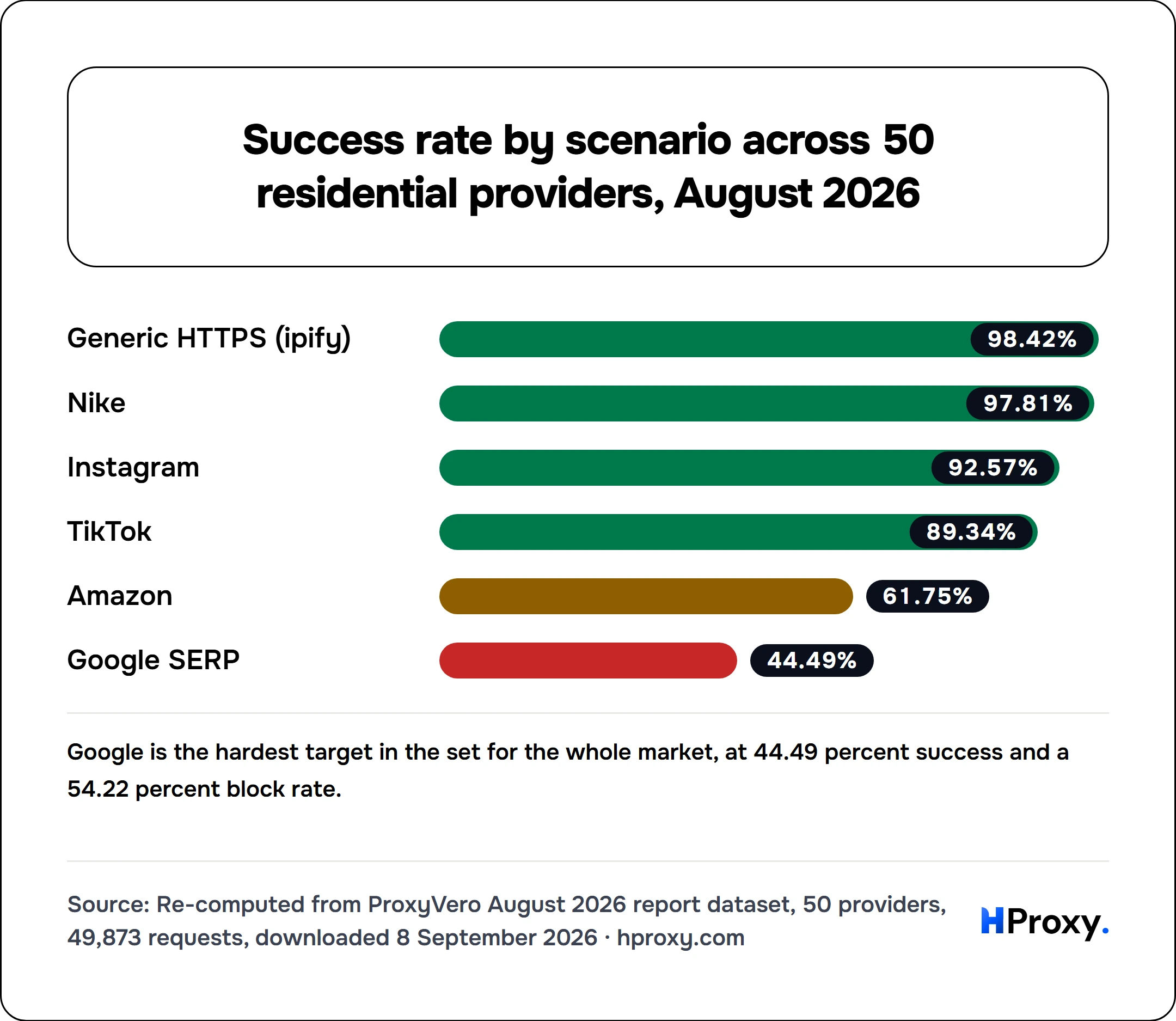
The market average on the Google scenario is 44.49 percent. The median provider scored 50.67 percent. Two of the fifty scored zero. Five cleared 90 percent.
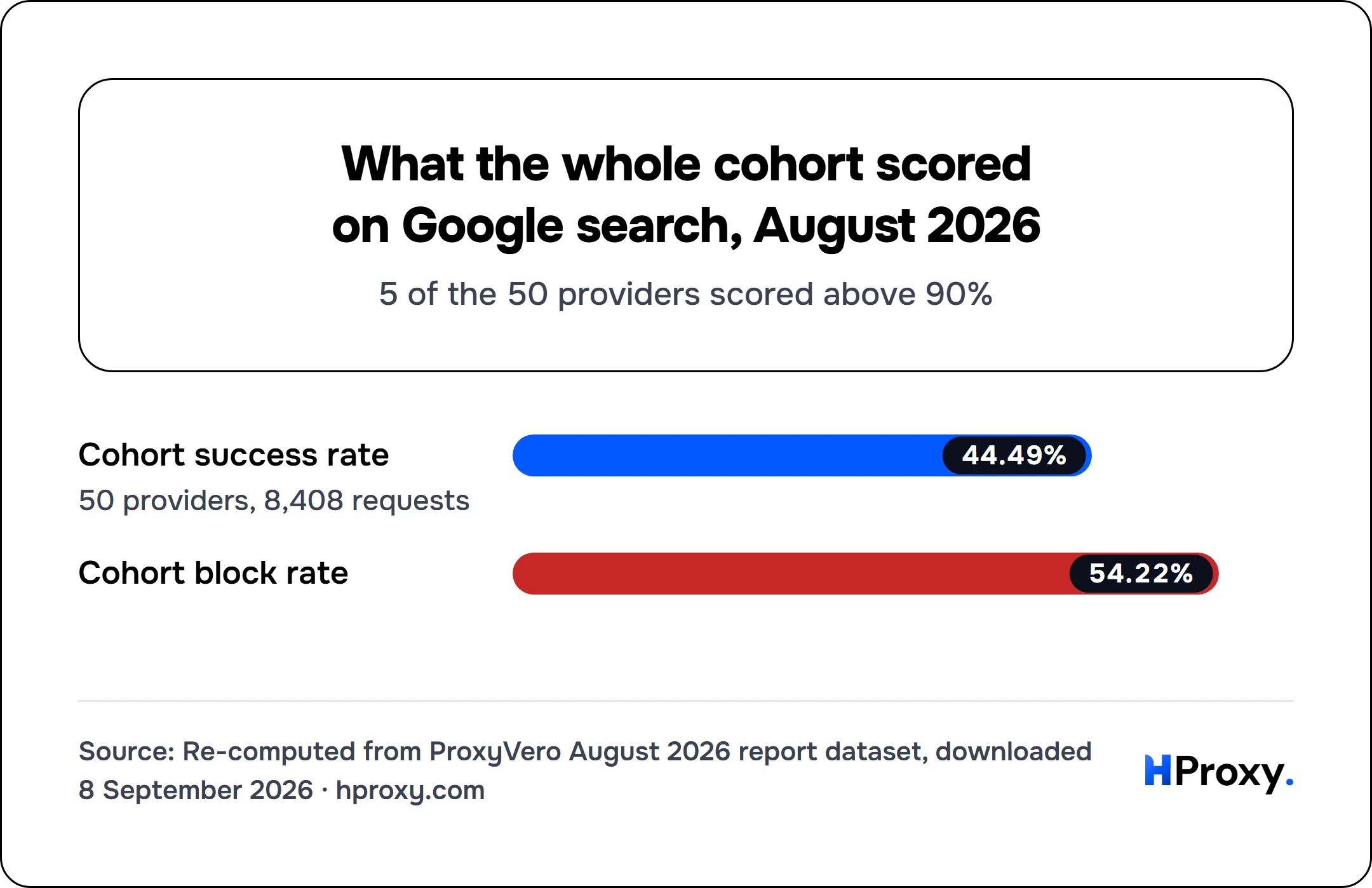
Set our 60.0 percent against that and it stops looking like a defect. It sits above the cohort median. It is ahead of 68 percent of the fifty providers in the file.
Where we actually place, scenario by scenario
The honest way to read one benchmark row is to place it in the cohort. Grading it against 100 tells you about the target, not the provider. Our September figures against the August distribution look like this.
Our result against the 50-provider cohort
| Scenario | Ours % | Cohort median % | We finish ahead of % of the 50 |
|---|---|---|---|
| Amazon | 86.7 | 65.35 | 84 |
| Google SERP | 60.0 | 50.67 | 68 |
| TikTok | 100.0 | 99.09 | 58 |
| Nike | 100.0 | 99.72 | 52 |
| Generic HTTPS | 100.0 | 100.0 | 41 |
| 93.3 | 99.51 | 28 |
Read that table top to bottom and the story inverts. Our two strongest placements are the two scenarios where we scored lowest in absolute terms. Amazon at 86.7 percent puts us ahead of 84 percent of the market. The market averages 61.75 percent there, with a block rate above a third. Google at 60 percent puts us ahead of 68 percent.
Our weakest placement is Instagram. We scored 93.3 percent and the cohort median is 99.51 percent. We finish ahead of 28 percent of the fifty. A number in the nineties reads as fine on its own, and it is our worst result in the set.
That is the finding we did not expect. We would not have found it without the raw file. The scenario that looks alarming is the market being hard. The scenario that looks fine is us being behind.
Why Google blocks proxies, from Google
The Google column is low for everyone because Google asks for it to be. Its robots.txt, live on 8 September 2026, disallows /search for every agent:
User-agent: *
Disallow: /search
Allow: /search/about
When traffic from an address looks automated, Google returns a page saying it has detected unusual traffic. Its own help page describes what happens next: "The message most likely shows a reCAPTCHA. To confirm that you are a person and not a robot, solve the reCAPTCHA." The same page explains why shared addresses fare badly. Some VPNs and tunnel services, it says, "cause all traffic to be blocked because they make it impossible for Google to tell the difference between abusive and non-abusive traffic."
A residential proxy exit is a shared address. The person whose connection you are borrowing is on it, and so is everybody else who routed through it that hour. No pool of residential addresses solves that by being larger. The 54.22 percent cohort block rate is the shape of that problem across fifty networks at once.
If your workload is Google search results at volume, the number that decides your bill is not the price per gigabyte. It is how many attempts a successful result costs you. That is why a captcha solving service sits in most serious SERP pipelines, next to the proxies rather than instead of them.
What the benchmark cannot tell you, including about us
Our result rests on 85 requests over one day. That is thin. One bad exit moves the Google figure by seven points, and a rerun tomorrow will not produce the same number.
The cohort has the same problem in a different shape. In the August file, per-provider samples on the Google scenario ran from 5 requests to 375, with a median of 120. ProxyVero sets its own bar for the monthly top ten at 200 requests. Three of the first ten ranked rows in that report carry the flag saying they are below it. The provider ranked first scored 100 percent on 25 requests. The provider ranked fifth scored 92.73 percent on 385.
We would rather buy from the second one, and the leaderboard reads the other way round.
How to read any proxy leaderboard
Check the sample size before the score, because a perfect run over 25 requests is not a result. Read the per-scenario table rather than the headline average, because one average blends targets whose difficulty differs by 50 points. Check whether the site publishes its raw data, since a ranking you cannot re-compute is a ranking you have to take on faith. Then ignore all of it for your own targets and run your own test, because six scenarios from one vantage point are not your workload.
The pricing point the review made
The review raised one criticism of us that is not about performance. It noted that our advertised $0.44 per gigabyte is the 2,000 GB volume rate, and that one gigabyte costs $0.50.
That is correct. It is also the same criticism we made of other providers in our own residential proxy price study, so we will not argue with it. What we will say is where the qualifier lives.
Our pricing page prints the qualifier three separate times: "$0.44/GB is the 2,000 GB+ rate. One GB is $0.50, and there is no minimum order." The full ladder is on the same page. It runs $0.50 at one gigabyte, $0.48 at 100, $0.46 at 500, $0.45 at 1,000 and $0.44 at 2,000.
A headline that needs a condition is only defensible while the condition is on the same page. Ours is. The reviewer found it, quoted it accurately, and we would rather be held to that standard than praised without it.
What we are doing with the result
Three things, in order of how much they matter.
Instagram is the work. 93.3 percent against a cohort median of 99.51 percent is a routing problem, not a market condition. It is the only scenario in the set where the field is clearly ahead of us. It goes to the top of the pool quality queue, above the Google number that looks worse.
Amazon latency needs a look. 3354 ms average against 695 ms on a plain HTTPS endpoint is a real gap. The success rate on that scenario still beat 84 percent of the market.
Google gets honesty rather than a fix. We will not promise a search scraping success rate. Google's own robots file asks clients not to take that path, and its defences move without notice. What we will say is that 60 percent beat the median of fifty networks. Anybody building a SERP pipeline should budget for retries and a solver, not for a provider that has quietly beaten the problem.
You do not have to take our word for any of this. ProxyVero publishes its testing methodology, our provider profile, the full review and the live benchmark. The August dataset behind every cohort figure here is a public JSON file. Re-running our arithmetic on it takes about ten lines of code.
The better test is still your own. Residential traffic here is $0.50/GB for the first gigabyte, with no plan and no minimum order, and the balance does not expire. One gigabyte against your real targets will tell you more than any leaderboard, including the one that flatters us.
Sources
- ProxyVero, "How we test proxy providers (Methodology & Benchmark Process)", last updated 8 September 2026.
- ProxyVero, "HProxy Benchmark", test window 7 September 2026, page updated 7 September 2026 18:00 UTC.
- ProxyVero, "HProxy Review", September 2026.
- ProxyVero, "August 2026 Proxy Benchmark Report", published 4 September 2026, data cutoff 31 August 2026 23:59 UTC, machine-readable dataset at /reports/2026-08/data.json.
- Google, robots.txt for www.google.com, retrieved 8 September 2026.
- Google Search Help, "Resolve Google Search's 'Unusual traffic from your computer network' message", read 8 September 2026.
- HProxy pricing page, read 8 September 2026.