Baker Proxies sits in a market where the advertised number and the number you pay are frequently different, because tiers, minimums and expiry all sit between them. Untangling that is most of the work here.
The record we hold
The domain is bakerproxies.com.
A price is missing here on purpose. We have not captured a sourced rate for Baker Proxies recently enough to publish one, and a stale number in this market is a wrong number.
Their pricing page will answer three of the four questions that matter. Send an email for the fourth, which is usually whether blocked requests are billed, and keep the reply.
Longevity, on the public record
The domain was registered on 3 May 2020, through NameCheap, Inc, which makes it about 6 years old. That record was read from the registry on 23 April 2026. The registry shows it renewed to 3 May 2027.
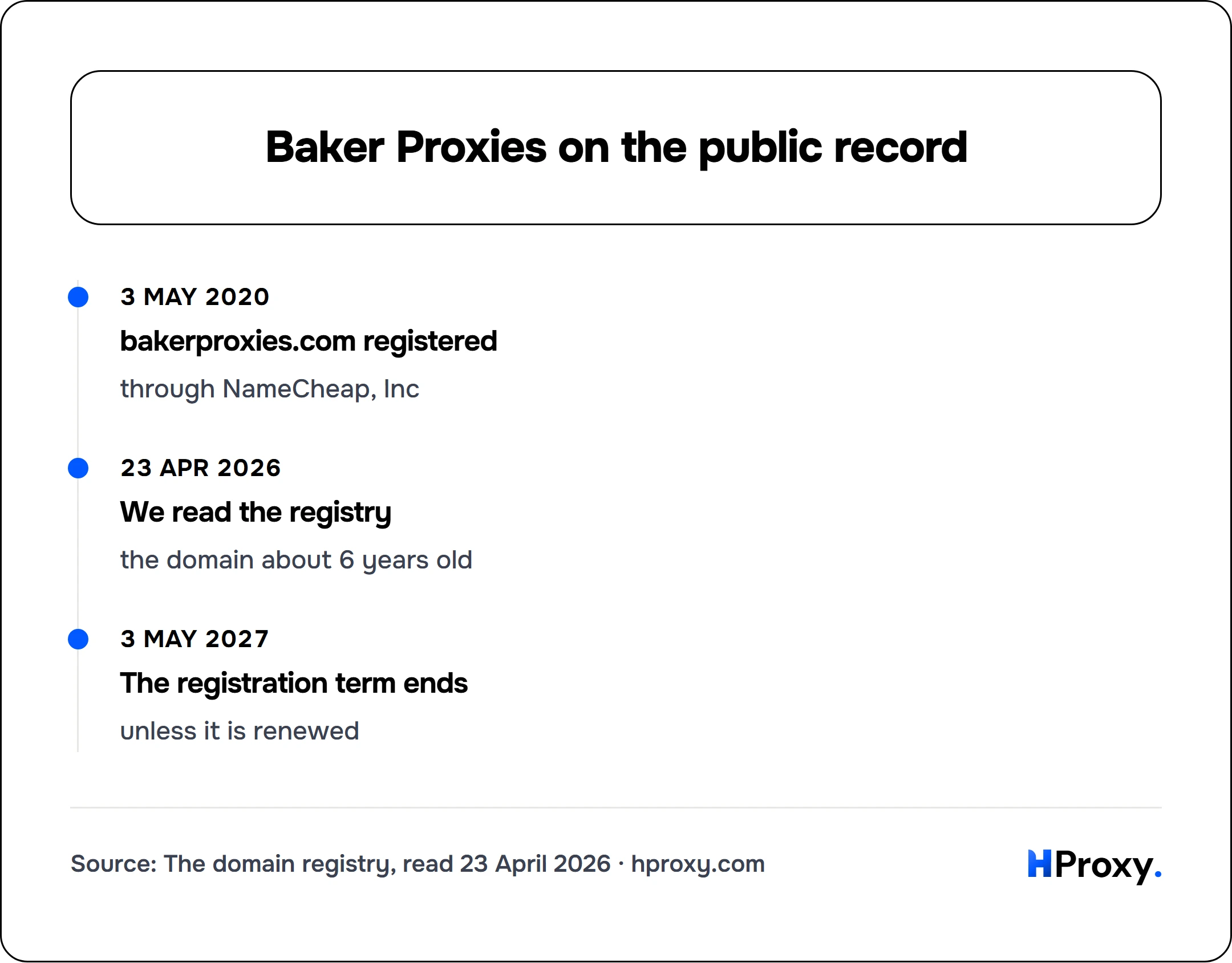
3 May 2020
bakerproxies.com registered
through NameCheap, Inc
23 Apr 2026
We read the registry
the domain about 6 years old
3 May 2027
The registration term ends
unless it is renewed
Age is not quality. A long registration does not make a network good, and a new one does not make it bad. What it does rule out is the shortest-lived pattern in this market, which is a site that appears, sells, and is gone inside a year.
The parts no marketing page answers
The reputation you inherit
An address you share carries the reputation of everyone else on it. That is acceptable for some work and fatal for anything involving a login. The price difference between shared and dedicated usually reflects exactly this.
Ask whether failed requests are billed
On a hard target, failures are the majority of your traffic. Whether those failures are billed decides the real cost, and the clause covering it is rarely on the pricing page.
Threads, not gigabytes, are often the ceiling
Rate limits are often enforced per account rather than per plan, which means buying more traffic does not raise them. Confirm how yours scales before you assume a bigger plan runs faster.
A comparison that admits what it cannot say
The rows that matter, with our own answers stated plainly:
| Question to ask | Baker Proxies | HProxy |
|---|---|---|
| Entry price | Not verified by us, read their page | From $0.44/GB, pay as you go |
| Does unused balance expire? | Worth confirming in writing before you commit | Never |
| Minimum commitment | Not published clearly, ask before paying | None |
| Identity checks | On their own terms page | Card orders are screened, and verification is sometimes requested |
| Targeting | Their terms page answers this | Country, city and ISP |
| Free way to evaluate | Check the current terms, this one moves | Free proxy list and proxy checker |
Every unfilled cell above is a question to put to them directly, in writing, before money changes hands. Vendors answer those questions readily; comparison sites guess at them.
A test worth more than this comparison
Do this once and you will never need a comparison page for this decision again.
- Start with the smallest purchase each vendor allows, so the test costs less than the decision it replaces.
- Use your own scraper and your own target. A benchmark against a neutral site measures nothing you will experience.
- Measure what came back correctly and what it consumed, then divide the spend by the successes.
- Push a sample of exit addresses through an independent checker and confirm the country and connection type are what was advertised.
- Buy the one that won on your target, and diarise a re-test in three months.
Others in this market
Nearest alternatives by product shape rather than by who pays us, since nobody does:
Where HProxy sits in that test
Our own lane is easy to state. Residential starts at $0.44 per GB with country targeting, the balance is topped up when you want and does not expire, there is no subscription unless the optional discount suits you, and city and ISP targeting come with Residential Premium from $1.00 per GB. If the test above puts us second on your target, buy the winner.