Choosing a proxy provider on price alone is the most common and most expensive mistake in this market, because a cheap request that fails costs more than a dearer one that works. That framing runs through the whole page.
Everything we can stand behind
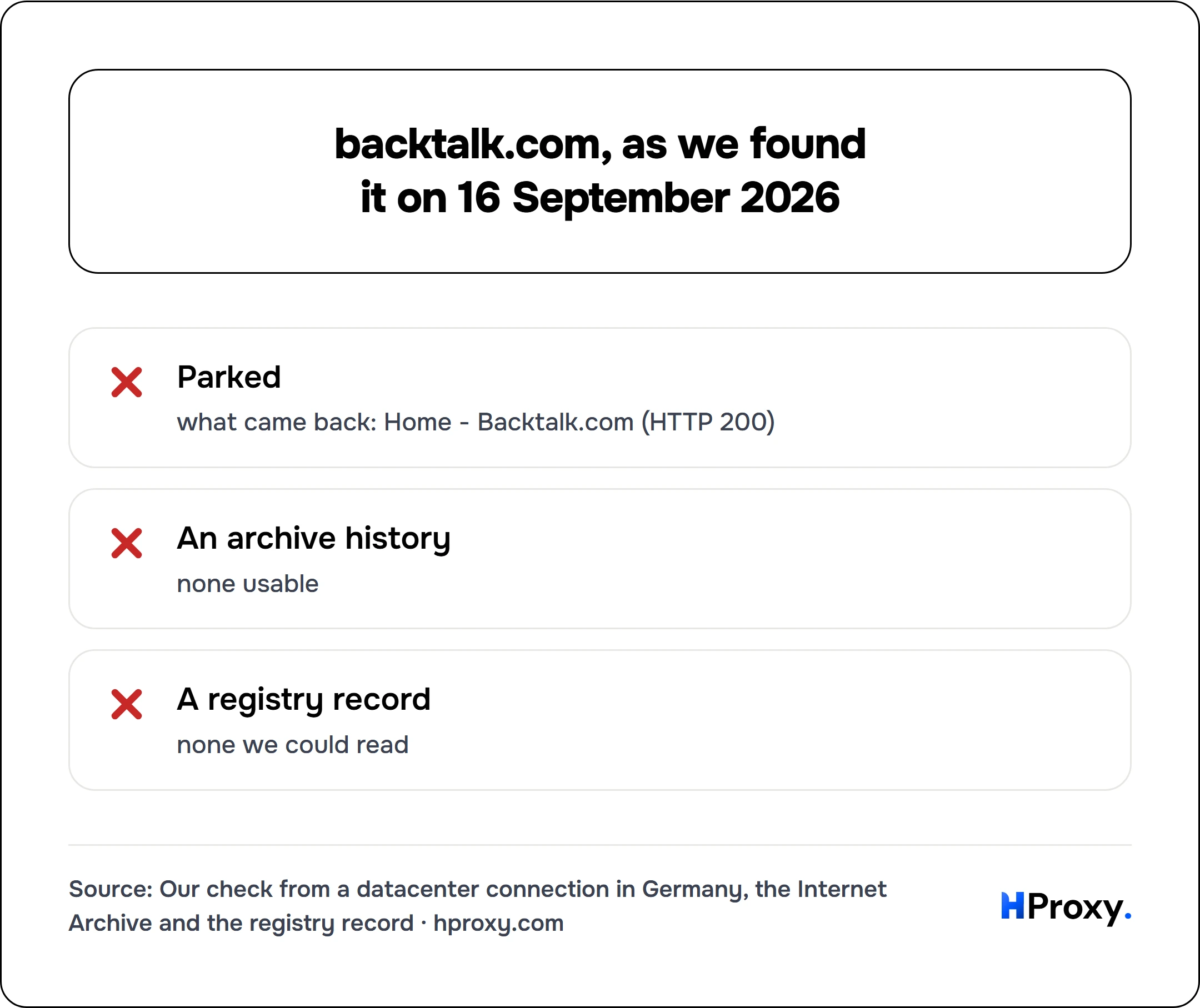
You will find them at backtalk.com.
We price the providers we can source and date, and Backtalk is not currently one of them. The rest of this page is about what to check when you read their pricing yourself.
Take down four numbers and a date: reachable rate, minimum purchase, commitment for the floor rate, and expiry period. Anything less and you cannot compare them to anyone.
Their own description, read this week
On 9 September 2026 the site introduced itself as "Home - Backtalk.com". Their meta description, the sentence Google shows under the link, says: "Coming soon."
What else that page states, without interpretation:
We found no separate pricing page linked from the homepage, which usually means the price arrives by quotation.
Those are claims, and claims are free. They earn their place here only because the date makes them checkable later.
How far back the record goes
The domain was registered on 16 April 1995, through Porkbun LLC, which makes it about 31 years old. The lookup behind those dates ran on 9 September 2026. As things stand the domain is held to 17 April 2027.
This proves nothing about the product. It is a cheap check against the one failure mode that costs buyers real money in this market, which is paying a provider that will not exist in six months.
What buyers type into Google about them
Search volume around the name runs to 10 a month, split as 10 a month for a review of them. Figures read from Google Keyword Planner on 9 September 2026.
The biggest slice is people checking whether to trust it, so the useful thing to hand a reader is evidence rather than an opinion.
What you still do not know after reading their site
Why 195 countries tells you nothing
Country totals are counted generously across this whole market. A country with a handful of addresses counts the same as one with hundreds of thousands. If your work depends on one location, test that location before you switch.
Per gigabyte against per address
Half this market prices bandwidth and half prices addresses. A per-address plan is cheap for heavy traffic through few exits and ruinous for light traffic through many, and the reverse holds for per-gigabyte plans.
Concurrency limits decide throughput
A plan with generous traffic and a low thread limit is a slow plan. Find both numbers before you size anything, because the smaller of the two is your actual ceiling.
The two of us, on the questions that matter
Set the two side by side on the questions that decide the outcome, rather than on feature counts:
| Question to ask | Backtalk | HProxy |
|---|---|---|
| Entry price | Not verified by us, read their page | From $0.44/GB, pay as you go |
| Does unused balance expire? | Read their current terms | Never |
| Minimum commitment | Check the current terms, this one moves | None |
| Identity checks | Their terms page answers this | Card orders are screened, and verification is sometimes requested |
| Targeting | Check the current terms, this one moves | Country, city and ISP |
| Free way to evaluate | Their terms page answers this | Free proxy list and proxy checker |
The useful part of that table is the left column. Take those six questions to any provider in this market and the answers will sort them faster than any review.
The test that beats this page
It is a small amount of money for an answer that is actually about your target.
- Fund both accounts with the least money each will accept, and note what that minimum was, because it is part of the comparison.
- Aim both at the page that matters to you rather than a test endpoint, and keep every other variable fixed.
- Write down two numbers per provider: the share of requests that succeeded, and the traffic it cost.
- Run a sample of the addresses through an independent lookup, because advertised geography and actual geography differ more often than the market admits.
- Go with whichever performed, then measure again next quarter. Networks change underneath you.
The rest of the shortlist
Buyers comparing this name usually have two or three of these open in other tabs:
- Cop.guru alternatives
- Coproxy alternatives
- Coronium alternatives
- Crawlbase alternatives
- CrawlMagic alternatives
- CryptoProxy alternatives
What we sell, stated plainly
Our position is narrow. Residential from $0.44 per GB, no subscription, no expiry on the balance, and a public record of what our free network actually does. A provider unwilling to be measured is telling you something, and so is one that asks to be.