India is one of the strongest cases for buying residential proxies by country, and one of the few where the checkout itself is part of the decision. The data jobs are real and locality-shaped, the target sites run serious bot defenses, and Indian buyers hit a payment problem with international providers that most pricing pages never mention. This guide takes the three in order, with the limits stated as plainly as the pitch.
Why Indian jobs are locality jobs
In most countries, a country-level exit answers most questions. India is more granular. The platforms people study most, food delivery, quick commerce, classifieds, local search, key their answers to the specific locality: the same query in two Mumbai neighborhoods can return different restaurants, prices and delivery fees. We wrote up the two flagship examples in detail already: proxies for Swiggy, which serves per-locality menus and Instamart prices across 720-plus cities behind an AWS WAF challenge, and proxies for Zomato, same shape across 800-plus cities. Both posts exist because the demand is real.
That granularity decides the product you need. Country targeting gets you into India, and Residential Lite covers that. City targeting gets you into the Mumbai, Delhi or Bangalore answer specifically, and it comes with Residential Premium, a separate per-gigabyte product whose price is further down this page.
The other locality layer is language. Indian sites localize into regional languages by geography, and google.co.in results shift with them. Testing what a Hindi-first visitor in Delhi sees, against what an English-first visitor in Bangalore sees, is a legitimate QA and SEO job, and it only works from exits in those places.
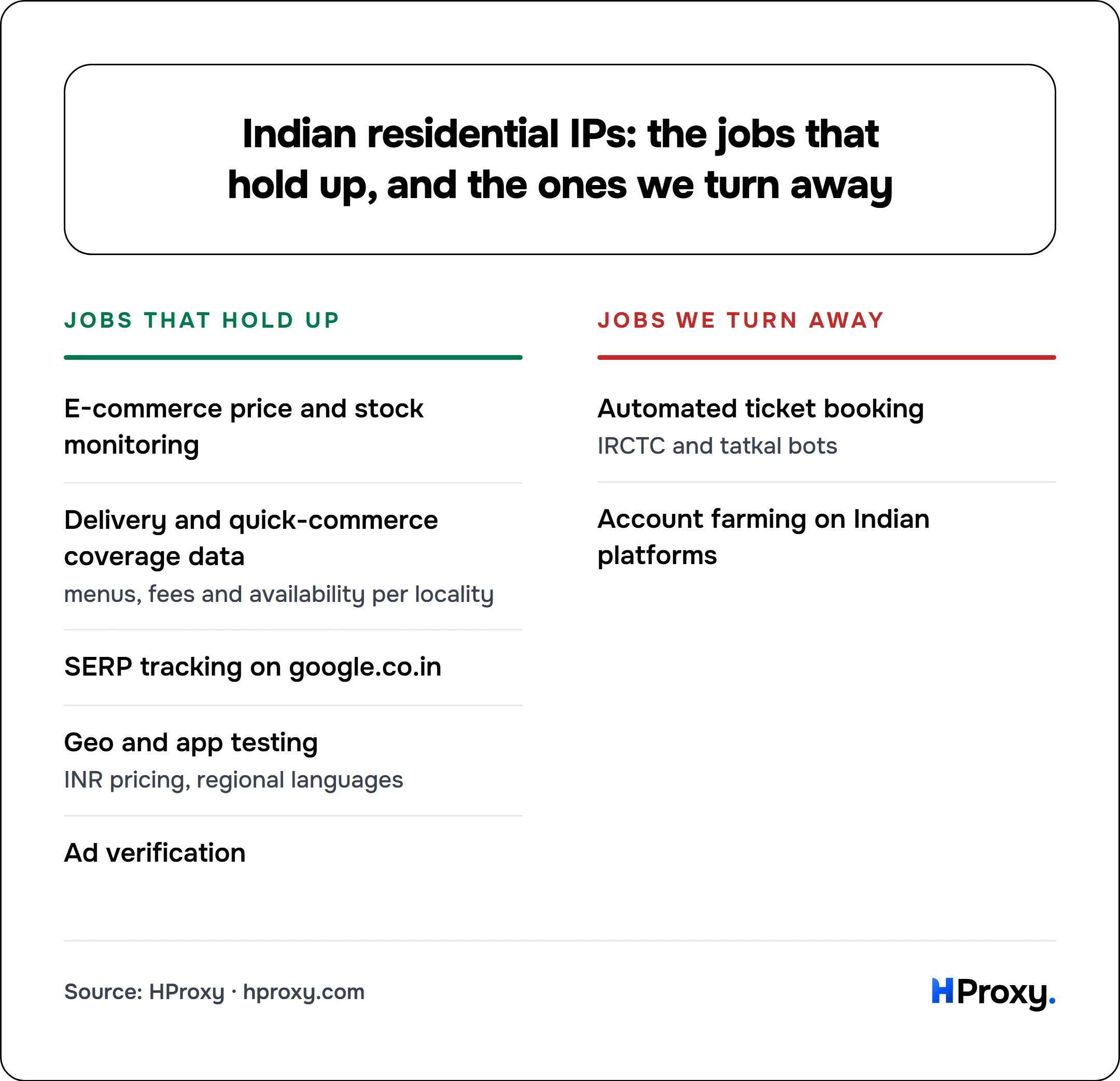
The jobs that hold up
- E-commerce price and stock monitoring. The large Indian marketplaces run real bot management, and datacenter IPs get challenged early. Residential exits reading as ordinary Indian households are what keeps a daily price sweep alive.
- Delivery and quick-commerce coverage data. Menus, fees, zones and item availability per locality, the Swiggy and Zomato shape above, extended to any platform that asks "where are you?" before it answers.
- SERP tracking on google.co.in. Indian rankings from Indian exits, city-level where local intent matters.
- Geo and app testing. Confirming your own product's Indian experience: pricing pages in INR, regional-language rendering, the CDN actually serving from nearby.
- Ad verification. Indian campaigns checked from Indian residential connections, the way the audience sees them.
The jobs we turn away
Two, stated without hedging. Automated ticket booking, IRCTC and tatkal bots above all, is off the table: it breaks the platform's terms and Indian authorities have prosecuted tatkal automation. No exit IP changes that, and a provider that winks at it is telling you how it treats its whole pool. And account-farming schemes on Indian platforms are the same story in a different costume. The network sells location and reputation for data work, not cover for automation a platform forbids. That is the same line every honest page on this site draws, and it is why the pool stays clean enough to be worth buying.
Jobs that hold up
E-commerce price and stock monitoring
Delivery and quick-commerce coverage data
menus, fees and availability per locality
SERP tracking on google.co.in
Geo and app testing
INR pricing, regional languages
Ad verification
Jobs we turn away
Automated ticket booking
IRCTC and tatkal bots
Account farming on Indian platforms
The payment catch, and why pay as you go fits India
The part most providers gloss over: paying for proxies from India is often harder than using them. International card payments fail frequently, bank-side rules around cross-border and recurring charges break subscription billing, and a monthly plan that cannot renew is a monthly outage.
Our checkout sidesteps the whole shape of that problem:
- No recurring mandate at all. Pay as you go means nothing renews, so there is no standing charge for a bank to decline. The arithmetic of that model is in pay as you go residential proxies.
- Rails that work when cards do not. PayPal, Bitcoin and Ethereum sit next to Visa, Mastercard and Alipay, all feeding one wallet, top up from $2. The crypto route, and what no-KYC does and does not mean, is written up in buy proxies with crypto.
- A balance that never expires. One successful top-up covers months of a light monitoring job, which matters exactly where every individual payment is friction.
Residential runs from $0.44 per GB with country targeting, city and ISP targeting come with Residential Premium from $1.00 per GB, and there is no India surcharge. The India proxies page shows the coverage in detail, and every number is on the pricing page.
Start free, then buy the gigabytes the job measured
The free proxy list's India slice re-verifies every few minutes and is enough to prove your setup: point your tool at a free Indian exit, confirm the locality logic works, run the exit through the proxy checker to see what an Indian site actually reads from it. Then measure twenty real requests, multiply out your monthly volume, and top up that much, the worked method is in how much residential proxies cost. Free proves the path; residential survives the target. Buying in that order is the cheapest way to be right.