Zdaye (站大爷, zdaye.com) is a proxy IP service from Shenyang, China, run by Shenyang Xiaotu Technology Co., Ltd. It sells China IPs as tunnel proxies, short-lived IPs and pools, billed by requests a second or by IPs a day, and it runs free proxy lists. Prices below are in yuan as its carts showed them on 27 September 2026. Dollar figures use the ECB rates of 25 September 2026, 6.71 yuan to the dollar. For the comparison, jump to the alternatives table.
Zdaye at a glance
| what we found on 27 September 2026 | |
|---|---|
| status | live, plans on sale |
| operator | Shenyang Xiaotu Technology Co., Ltd., founded 2017 |
| licence | Chinese telecom licence 辽B2-20180026 |
| where the IPs are | China, 290+ cities by its own count |
| tunnel | ¥450 a month at 5 requests a second ($67.03) |
| residential | ¥150 a month for 1,000 IPs a day ($22.34) |
| protocols | HTTP, HTTPS, SOCKS4 and SOCKS5 |
| sign-up | a mobile number, then real-name verification |
| payment | Alipay, WeChat Pay or bank transfer |
| logs | every user action kept for 6 months |
What Zdaye sells
Tunnel proxy. One fixed gateway that changes the exit IP for you, on every request or every 15 seconds to 30 minutes. It claims more than 3 million IPs a day across 290+ Chinese cities, with a choice of province, city and carrier. Two pools share one price: a residential edge pool and an enterprise pool.
Short-lived IPs. IPs pulled through an API, each living 1 to 6 minutes by its carts. The residential edition sells a daily quota, from 1,000 IPs a day. A classic edition on carrier dynamic IPs and a SOCKS5 edition sell pulls of 5 IPs every 10 seconds.
Exclusive and shared pools. An exclusive pool of dynamic proxy servers for one customer, with IPs held up to 48 hours. The shared pool is split by ten customers and changes its IPs every 5 minutes.
Free lists. Daily lists of free proxies in China and abroad. Its own note says they are collected from the internet, are not its own, and suit only learning and code tests.
What Zdaye charges
Every price comes from its cart pages, read on 27 September 2026, with dollars at 6.71 yuan to the dollar.
| product | smallest buy | a month |
|---|---|---|
| tunnel, 5 requests a second | ¥89.20 for 3 days ($13.29) | ¥450 ($67.03) |
| residential, 1,000 IPs a day | ¥9 for 1 day ($1.34) | ¥150 ($22.34) |
| classic, 5 IPs every 10 s | ¥25 for 1 day ($3.72) | ¥680 ($101.29) |
| SOCKS5, 5 IPs every 10 s | ¥28 for 1 day ($4.17) | ¥700 ($104.27) |
| exclusive pool, 1 server | ¥16 for 1 day ($2.38) | ¥182 ($27.11) |
| shared pool, 50 servers | ¥50 for 1 day ($7.45) | ¥1,003 ($149.41) |
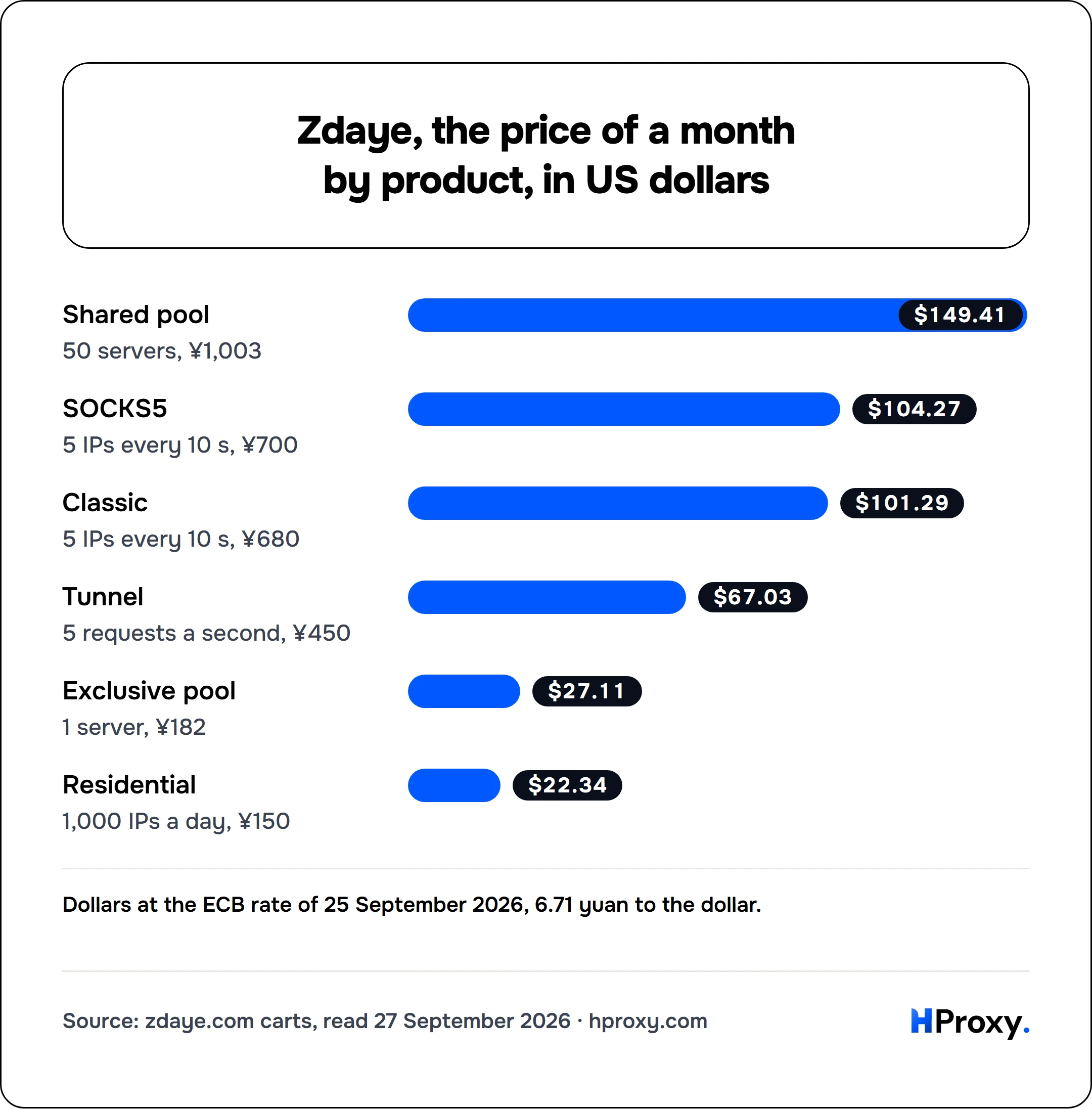
A faster tunnel costs more: ¥960 a month at 10 requests a second and ¥5,040 at 50. Half a year of a short-lived plan takes 10 percent off, and a full year 20 percent. Nothing is billed by the gigabyte, since each plan caps bandwidth instead, at 5 Mb/s for the smallest tunnel.
The fine print
Real-name verification. Its tunnel guide says you register with a code sent to a mobile number. After you log in, you complete real-name verification in the console as prompted.
Uses it does not serve. Its tunnel introduction rules out foreign sites that China IPs cannot reach, "such as Google and Facebook". It also rules out large file downloads, illegal content and attacks.
Logs kept for six months. The footer of every page says it collects, stores and sells no data. The same footer says every user action is logged and kept for 6 months.
Payment inside China. The carts offer Alipay, WeChat Pay or a bank transfer to the company, and no card or crypto option.
Free trials. A 24-hour trial of the tunnel and a 4-hour trial of short-lived IPs.
How Zdaye changed
The domain was registered on 21 April 2014. In July 2014 it was a webmaster tools site, with expired domain lookups, ICP and Whois checks, a test for sites blocked in China, and a proxy IP section. By its own account the team has worked on proxy IPs since 2014 and founded the company in 2017.
The Internet Archive holds no readable copy of its homepage from 2019 to early 2024, only error and firewall pages. By April 2025 the site sold enterprise proxy IPs from a pool of 15 million, and in September 2026 it claimed more than 20 million.
Where Zdaye is stronger
China, city by city. Tunnel IPs in 290+ Chinese cities with carrier choice, for sites that serve China.
Many IPs for little. ¥150 a month buys 1,000 residential IPs a day, and daily quotas reach 1 million.
A local company. A licensed Chinese firm that prices in yuan and takes WeChat Pay and bank transfers.
Where HProxy differs
We sell proxies too, so read this part as the account of a competitor. Every HProxy fact here comes from our own product code and pages.
No documents. We ask for no documents at sign-up or at an ordinary checkout.
China and the world on one balance. Our residential pools reach China, and the rest of the world, from the same account.
Priced by the gigabyte. Premium, our pool with state, city and ISP targeting, costs $1.49/GB for one gigabyte, with sessions held from 3 minutes to 24 hours. Lite reaches China by country at $0.50/GB for one gigabyte, and purchased gigabytes have no scheduled expiry date.
Payment from abroad. We take cards, Alipay and thirty-two crypto options.
Where we are behind. Inside China, Zdaye sells cheap daily quotas of short-lived IPs and a gateway priced by requests rather than traffic, all in yuan. For China we sell residential traffic by the gigabyte only.
The alternatives, side by side
China IPs at the smallest monthly buy. The Zdaye rows come from its carts, and the Kuaidaili and Wandou rows from their own pages, all read on 27 September 2026.
| provider | how it bills | smallest monthly buy |
|---|---|---|
| Zdaye tunnel | requests a second | ¥450 at 5 a second ($67.03) |
| Zdaye residential | IPs a day | ¥150 for 1,000 a day ($22.34) |
| Kuaidaili tunnel | a new IP per request or per minute | ¥306 to ¥360 ($45.58 to $53.63) |
| Kuaidaili private proxy | IPs a day, from 2,000 | ¥306 ($45.58) |
| Wandou HTTP | per IP pulled | from ¥0.01 an IP in its price list |
| HProxy Premium | per GB, China by city | $1.49/GB a GB |
| HProxy Lite | per GB, China by country | $0.50/GB a GB |
The Chinese sellers bill by requests or by IPs, and we bill by traffic, so the cheapest choice depends on how much data each IP carries. Our reviews of Kuaidaili and Wandou IP cover their terms in full.
Who Zdaye suits
It suits a team inside China that collects data from Chinese sites, needs many short-lived IPs a day, and pays by Alipay or WeChat Pay. That team must also pass the real-name check.
It suits you less if you work outside China, need foreign sites such as Google, or want to sign up without an identity check.
Before you commit
Take a free trial first: 24 hours of the tunnel or 4 hours of short-lived IPs. Check the real-name step before you pay, since its guide puts it right after sign-up. Our proxy checker shows whether an address answers, how fast, and from where, whoever sold it.
The limits of this review
We did not buy from Zdaye or test its network. Prices come from its carts and their price rules as they stood on 27 September 2026, in yuan. The dollar figures use the ECB rates of 25 September 2026. Its pool sizes, city counts and uptime figures are its own claims.
Every figure here carries the day it was read, and this page is due for a check by 27 December 2026.
Sources
- Zdaye, zdaye.com: homepage, about page, tunnel product page and introduction, residential introduction, tunnel guide, six cart pages and the free proxy page. Read 27 September 2026.
- Internet Archive, copies of zdaye.com from July 2014, June 2019, February 2021 to January 2024, and April 2025.
- Verisign, registry record for zdaye.com. Read 27 September 2026.
- European Central Bank, euro reference rates of 25 September 2026.
- Kuaidaili and Wandou IP, price pages. Read 27 September 2026.
- HProxy, our China page, our own product records, price table and terms.