Whoer.net is an IP checker, registered in 2008, that people still look up 550,000 times a month. Its page shows your address and a "disguise" score that loses 10% for each of 16 findings, three of them for the Flash, Java and ActiveX plugins of the old web. Around the free check it sells its own VPN, two browsers, residential proxies and aged accounts. For the check alone, ipleak.net, dnsleaktest.com and BrowserLeaks test the same leaks. The table sorts the alternatives by the question you are asking.
What Whoer checks
Whoer refuses requests from our server with a browser check, so we read its pages through the Internet Archive, in copies of 1 August and 1 October 2026. The home page lists each finding with "-10%" beside it, 16 in all.
The 16 checks in Whoer's disguise score
| Group | Checks |
|---|---|
| Your IP address | Tor exit, web proxy, proxy, data center IP, blacklist, open proxy ports |
| Your settings against your IP | DNS server country, system time, languages, real IP behind the shown one, WebRTC addresses, browser headers |
| Old browser plugins | Flash, Java, ActiveX |
| Tracking | Do Not Track switched off |
whoer.net in the Internet Archive, copy of 1 October 2026
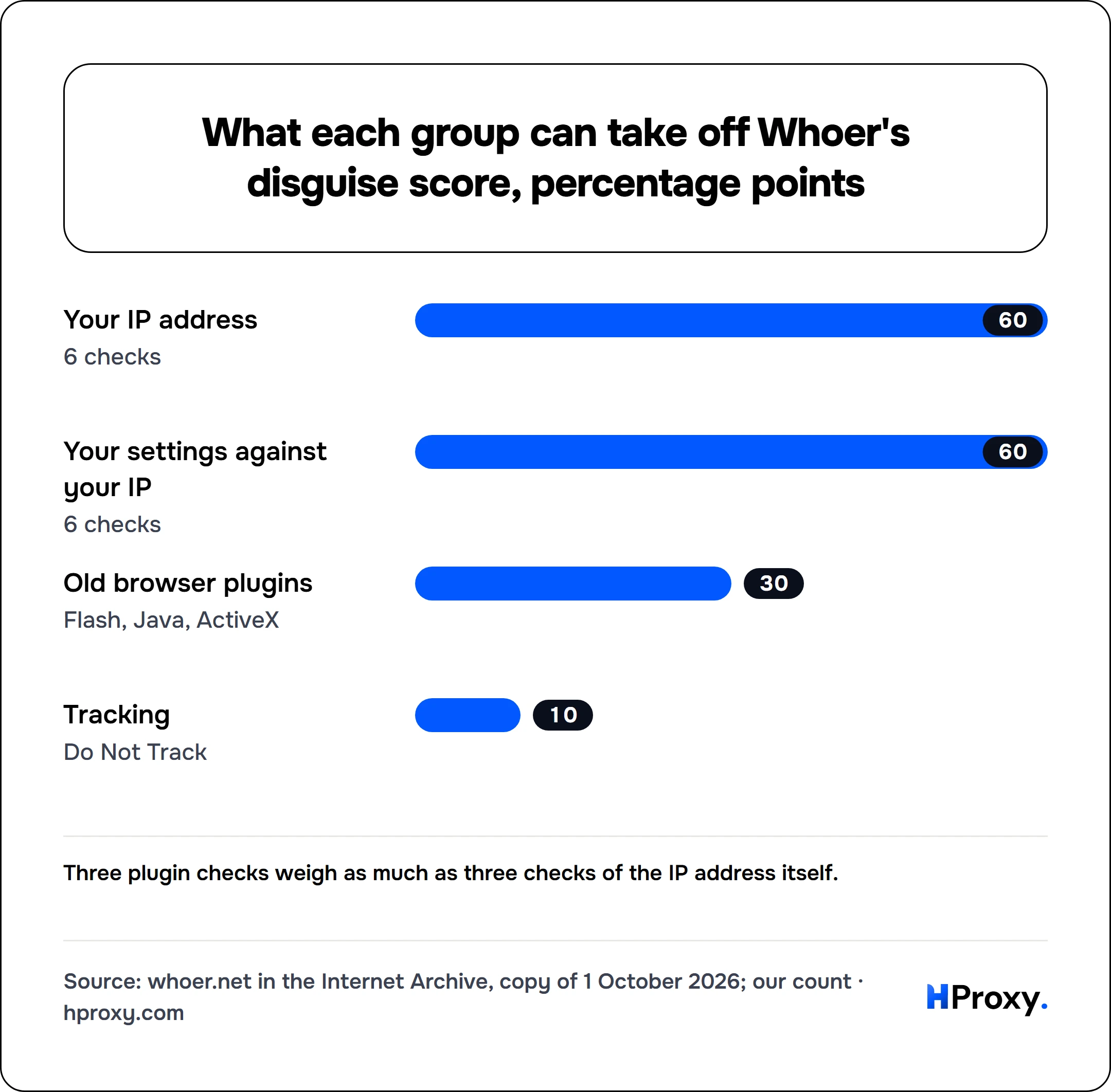
The plugin checks measure software the main browsers have dropped. The Chromium project's roadmap lists "Flash Support Removed from Chromium (Target: Chrome 88+ - Jan 2021)". Java's own help page says that "As of September, 2018, Firefox no longer offers a version which supports NPAPI, the technology required to run Java applets". Microsoft lists ActiveX controls among the "Internet Explorer functionality" that Edge supports only in its IE mode. Internet Explorer itself "is officially retired and out of support as of today, June 15, 2022", in Microsoft's words of that day.
The settings checks treat any mismatch with the IP's country as a sign of hiding. "Languages different" costs 10% when your browser's language differs from the language of your IP's country, and "System time different" when your clock's time zone does. A traveller, or anyone who reads in a second language, loses points without hiding anything. The tracking check costs 10% when Do Not Track is off, although Whoer's own text says "Do Not Track signals are often ignored by websites".
What Whoer sells around the check
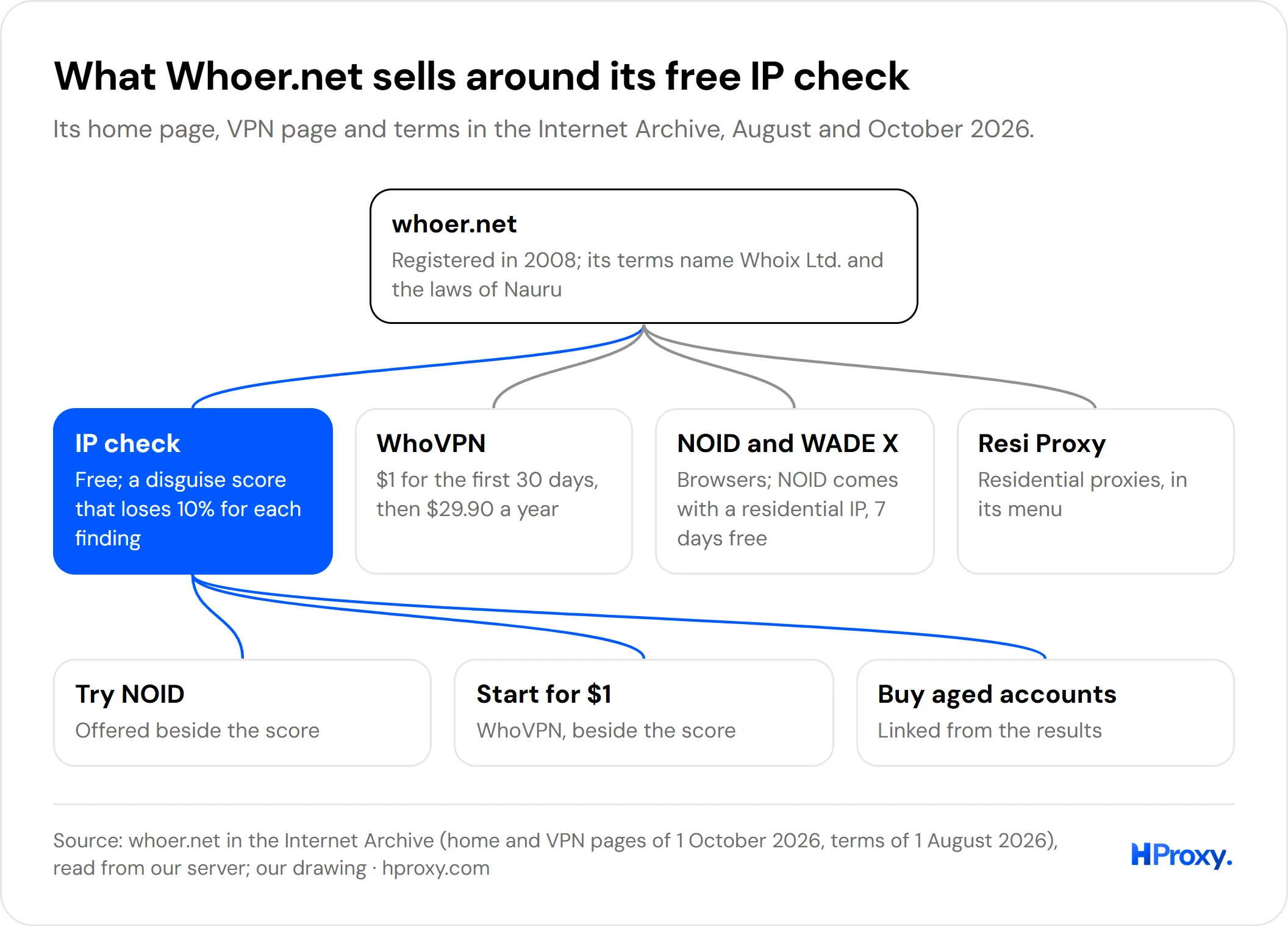
Beside the score, the home page offers WhoVPN, "VPN access for $1", at "$1 for the first 30 days · then $29.90/year". It also offers the NOID browser, "Fresh fingerprint and residential IP included", for "7 days free · No card required". Its menu adds the WADE X "Multi-Acc Browser", residential proxies, virtual cards, DDoS protection and an AML check, and the results link to "Buy aged accounts". Its VPN page ranks five "Best VPN services 2026" with WhoVPN first, "from $2.47". Its side column advertises other sellers' residential proxies "from $0.30/GB", temporary SMS numbers and virtual cards.
Who stands behind it, and what it keeps
The terms of 1 August 2026 say the VPN is "provided by Whoix Ltd." and give no country for that company. They place legal matters under the "existing legislation of Republic of Nauru". The contacts page lists an email address and a Telegram link, and none of the pages we read gives a postal address. Its privacy policy, in an archive copy of 1 January 2026, names the data controller in full: "WHOIX LTD, a private limited liability company registered in Cyprus with company number HE 356927". OpenCorporates lists that company as dissolved and shows the date only to registered users.
The same policy lists what the site collects automatically: your "IP address, coarse geolocation inferred from IP", your browser, system, language and device type, and referrers and timestamps. Its leak tests add the WebRTC candidates and DNS behaviour they see. It keeps "Web & security logs" for "up to 90 days". It shows ads through Google AdSense and Mediavine, whose partners may use cookies for interest-based advertising.
Other checkers, by question
Where else to check, 12 October 2026
| Question | Checker, and who runs it |
|---|---|
| What is my IP, and do DNS or WebRTC leak it? | ipleak.net, "powered by" AirVPN; BrowserLeaks |
| Does my VPN leak DNS requests? | dnsleaktest.com, whose privacy policy is IVPN Limited's |
| How unique is my browser? | AmIUnique, kept by researchers at Inria; Cover Your Tracks, by the EFF |
| Does my setup look like a bot? | Pixelscan; BrowserScan; CreepJS, open source |
| Is my IP flagged for fraud? | Scamalytics; IPQualityScore |
Each checker's own pages, read from our server on 12 October 2026
Leak tests: ipleak.net, dnsleaktest.com and BrowserLeaks
ipleak.net shows the IP your browser presents, the addresses WebRTC reveals and the DNS servers that answer for you. It also finds the address your torrent client uses and draws two maps of where you appear to be. Its footer reads "powered by" over AirVPN's logo. dnsleaktest.com tests DNS and, from its menu, WebRTC, and its privacy policy is IVPN Limited's. BrowserLeaks offers a set of separate tests and says "This website does not collect personal data, store user fingerprints, or set non-essential cookies."
How unique your browser is: AmIUnique and Cover Your Tracks
The research checkers answer a different question. AmIUnique says it "was created and is maintained by a team of researchers", at Inria, and asks visitors to "Contribute to AmIUnique Research". Cover Your Tracks, the Electronic Frontier Foundation's test since 2010 under the name Panopticlick, says it "does not log IP addresses". Our Pixelscan comparison covers the bot and fraud checkers in detail, including what each stores. BrowserScan, for one, says "We may store this usage data for up to three years."
Searches show where people go. Besides the 550,000 for "whoer" in October 2026, Keyword Planner counted 201,000 for "whoer ip", 165,000 for "dns leak test", 90,500 for "ipleak" and 74,000 for "browserleaks". The last two rose over the year, from 74,000 and 60,500 in September 2025.
Whoer's VPN against two others
Three VPNs, prices read in October 2026
| VPN | Price | Money back |
|---|---|---|
| WhoVPN | $1 for 30 days, then $29.90 a year | Not read |
| Proton VPN | Free plan; Plus $3.49 a month over two years | 30 days |
| Mullvad | €5 a month, VAT included | 14 days, not for cash |
whoer.net in the Internet Archive, protonvpn.com/pricing and mullvad.net/en/pricing
Proton VPN bills its two-year Plus plan at $83.76 and then renews it at $83.88 a year, and its free plan costs nothing. Mullvad keeps one rate whether you pay for a month or a year, says its price has never changed, and takes cash, Monero and bank wire among other methods. Whoer's refund policy sat behind archive errors on the day we read, so the table leaves it open.
Where HProxy fits
We sell proxies, and we publish free checks of our own: an IP lookup, a proxy leak test, a WebRTC leak test and a proxy anonymity checker. Our residential traffic costs $0.50 per GB with no plan, over HTTP and SOCKS5.
Which one to pick
- ipleak.net to see your IP, DNS and WebRTC leaks on one page.
- dnsleaktest.com to test a VPN's DNS alone.
- BrowserLeaks for separate browser tests, with no fingerprints stored by its own account.
- AmIUnique or Cover Your Tracks to see how unique your browser looks.
- Whoer if you want one score, reading past the 30 points for Flash, Java and ActiveX.
- Mullvad or Proton VPN for a VPN with its refund terms on its price page.
What we could not find out
Whoer.net answers our server with a browser check, so every Whoer fact here comes from Internet Archive copies of January to October 2026. Its refund policy returned archive errors that day. We ran none of the checkers: their tests run in the visitor's browser. OpenCorporates shows when WHOIX LTD was dissolved only to registered users, so we cannot date it. We plan to look at Whoer's archived pages again by 12 January 2027.
Sources
- Whoer.net in the Internet Archive: home page and VPN page (1 October 2026), terms of use (1 August 2026), privacy policy (1 January 2026), contacts (24 November 2025); its registry record and its answer to our server, 12 October 2026; OpenCorporates' record of WHOIX LTD, Cyprus.
- ipleak.net, dnsleaktest.com, Proton VPN's and Mullvad's price pages, read from our server on 12 October 2026.
- BrowserLeaks, AmIUnique, Cover Your Tracks and BrowserScan, read for our Pixelscan page on 12 October 2026.
- The Chromium project's Flash roadmap, Java's help page on Firefox, Microsoft's page on Internet Explorer mode and its Internet Explorer retirement post.
- Worldwide search counts from Keyword Planner, 12 October 2026.
- HProxy's price, taken from our live price data.