 Covered HighProxies
HighProxies was a fixture of the private-proxy years. It ran at highproxies.com and sold dedicated, shared, and "social media" datacenter proxies, marketed as elite, fast, and reliable. If you were running Instagram accounts or other social automation in the mid-2010s, its name came up constantly.
Then the thing it was built on stopped working the way it used to. Not seized, not exposed: at our checks the site was still live and actively maintained, and by mid-2026 it had even added VPN products, so we will not claim it is dead or gone. We run a residential proxy network and watch these shops closely, and what we can tell you is concrete: what it sold, why the specific product it was known for, the datacenter social-media proxy, stopped working the way it used to, and how to think about a shop like this today.
What HighProxies was
HighProxies sold datacenter proxies in a few flavours. Dedicated proxies were assigned to you alone. Shared proxies were split across a few customers to bring the price down. And "social media" proxies were datacenter IPs it presented as tuned for platforms like Instagram, sold by the IP, usually around two dollars thirty per IP per month in our competitor research.
The important detail is that all of them were datacenter IPs at heart: addresses living in server farms rather than on home connections. The "social media" label described the job the proxy was sold for, not where the address came from. That distinction is small at checkout and enormous in practice, and it is most of the reason HighProxies faded.
The social media proxy trap
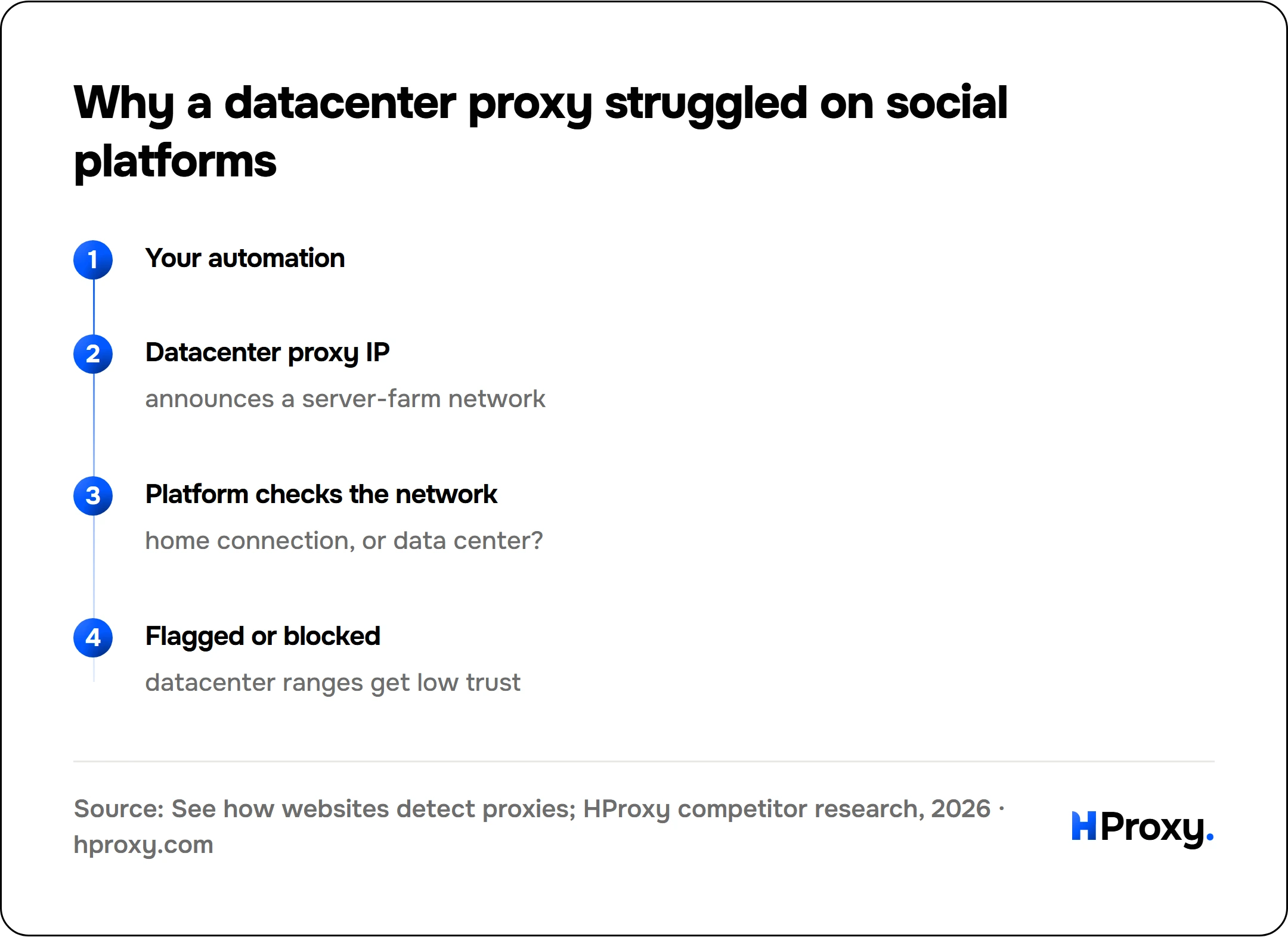
The product HighProxies was best known for, the social media proxy, is also the clearest example of why its category faded. Selling a datacenter IP as an Instagram proxy worked while platforms mostly checked whether an IP was on a blocklist. It stopped working when platforms started asking a better question: what network does this IP belong to?
Your automation
Datacenter proxy IP
announces a server-farm network
Platform checks the network
home connection, or data center?
Flagged or blocked
datacenter ranges get low trust
A datacenter IP announces a hosting company's network. A real phone or home connection announces a consumer internet provider. Once platforms learned to weight that difference, a datacenter "social media proxy" became one of the easier things to flag, no matter how fresh or "elite" it was sold as. The demand moved to residential and mobile IPs, which come from real consumer connections, and the datacenter-and-social pairing that shops like HighProxies were built on quietly stopped being a good idea. You can read the mechanics in how websites detect proxies.
Is HighProxies still up?
Our competitor research tracks highproxies.com. At the March 2026 sweep it served an "Elite Proxies" homepage, and by mid-2026 it had been redesigned into a broader "Private Proxies, SOCKS5 and Business VPN" storefront, so the site is not just resolving, it is being worked on. We do not have a reliable domain creation date in our records, and we have not seen a shutdown notice.
So we will not tell you HighProxies is dead, because it plainly is not. What we can tell you is that its signature product, the datacenter social-media proxy, no longer fits the platforms it targeted. Treat it like any shop still selling that product: the site loading, even a fresh redesign, is the floor, not the proof, and you verify before you trust.
The buyer lesson
If you land on HighProxies, or a shop like it, while looking for social media proxies, keep a few things in mind:
- A datacenter IP is the wrong tool for most social automation now, whatever it is labelled. Residential or mobile is what looks like a real user.
- "Elite," "fast," and "virgin" describe the IP, not where it came from or how a platform will score it.
- Verify any proxy before you build on it. Our free proxy checker shows the real exit and the network an IP belongs to, which is exactly what a platform is looking at.
- Reach support and test the smallest order first, the same as you would with any dormant-looking store.
What to look for now
HighProxies is not a scandal, and we are not going to turn it into one. It looks like a legitimate datacenter proxy shop that was very good at a use case the platforms then closed off, and it is still trading today. That still leaves you with the same question every post like this comes back to: even when the site is live and freshly redesigned, is there a living business, running the right kind of IPs, on the other end of your money?
If you just need to test tooling or run something low-stakes, our free proxy list says plainly what it is: mostly short-lived datacenter IPs, re-checked continuously. When you need residential IPs that actually pass as real users, we sell them at $0.44/GB pay as you go with a balance that never expires, and we would rather compete on telling you what you are getting than on a label.
Sources
- HProxy competitor research and domain sweep (March 2026): highproxies.com selling dedicated, shared, and social media datacenter proxies at roughly two dollars thirty per IP per month, and still resolving with an "Elite Proxies" homepage at the last check. No reliable domain creation date is on file, and no shutdown was confirmed.
- HProxy guide, How websites detect proxies: why datacenter IPs are flagged by the network they announce.