 Covered LimeProxies
If you were buying dedicated proxies in the middle of the 2010s, LimeProxies was a name you ran into. It sat at the premium end of the datacenter proxy market, the shop that charged more and promised cleaner, more reliable IPs than the two-dollar crowd. Today it is hard to pin down. The strange part is the paperwork: the limeproxies.com domain is registered, transfer-locked, and paid through to 2030, and when we went looking for the storefront our automated checks came back empty, even though third-party review sites still list the service as operating.
We run a residential proxy network, so we spend a lot of time watching which competitors are alive, which are coasting, and which are gone. LimeProxies is a clean example of a specific kind of decline that has nothing to do with a botnet or a police raid. It is the fading of a business model. The datacenter proxy shop, sold by the IP and by the month, was the standard way to buy proxies for years. Then the market moved, and a lot of those shops quietly went dark or coasted on autopilot. What makes LimeProxies worth a close look is the gap between a domain you can look up and a storefront you can actually reach, which is a lesson worth having before you send anyone money.
What LimeProxies was
LimeProxies sold datacenter proxies. A datacenter proxy is an IP address that lives in a server farm, rented from a hosting company, rather than on a home internet connection. You would buy a set of them, usually dedicated (meaning the IP was yours alone, not shared with other customers), and point your software at a fixed list of IP and port pairs.
Its angle was premium. Where a lot of the market sold datacenter IPs for a dollar or two per IP per month, LimeProxies positioned higher, around five dollars per IP per month in our competitor research, and sold itself on reliability and speed rather than the lowest price. The limeproxies.com domain was registered on January 7, 2010, which puts its launch near the start of the modern proxy-shop era, back when a fixed list of clean datacenter IPs was what most buyers actually wanted.
The timeline: registered in 2010, hard to reach by 2026
The domain record tells a quiet story.
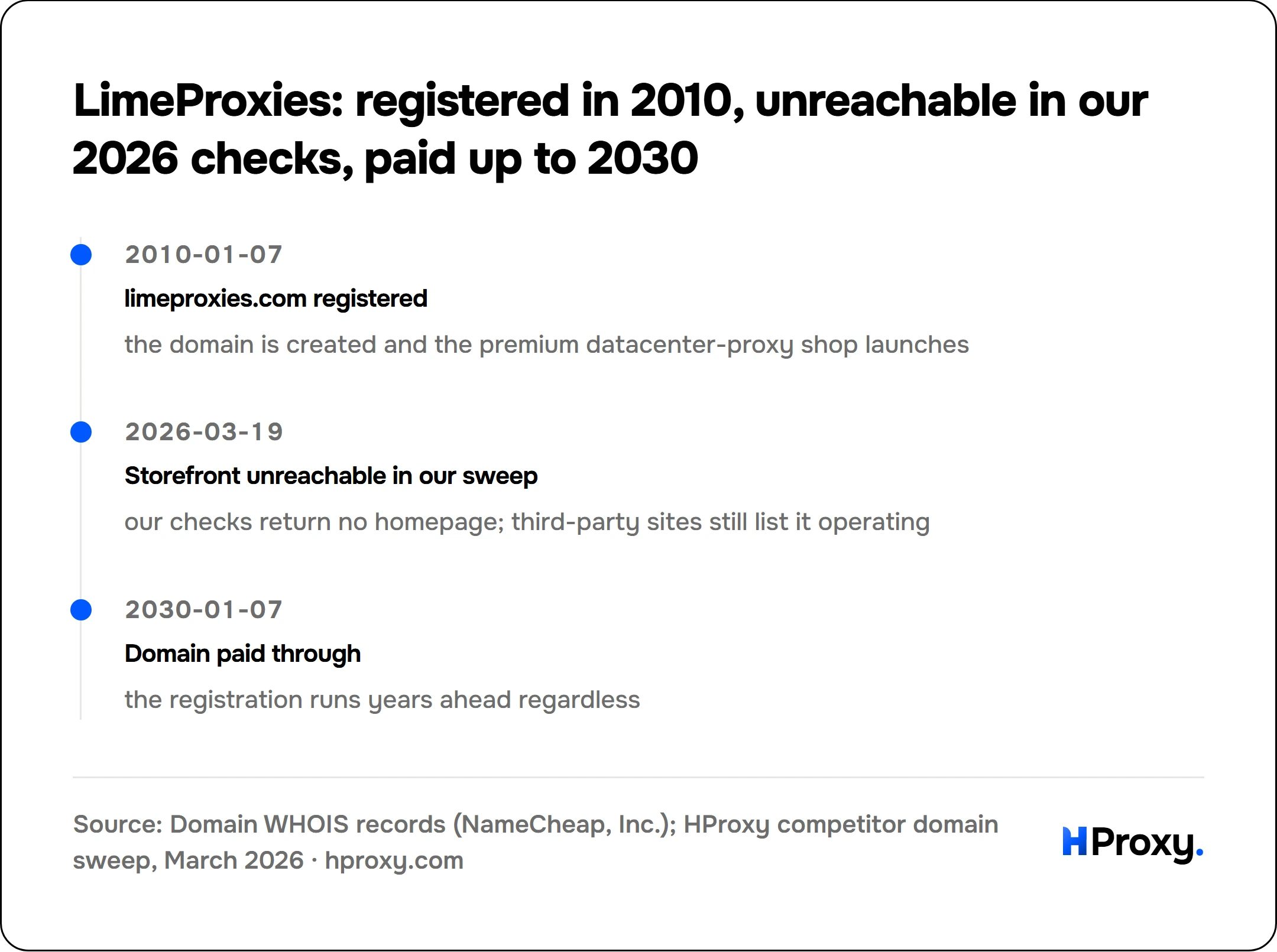
2010-01-07
limeproxies.com registered
the domain is created and the premium datacenter-proxy shop launches
2026-03-19
Storefront unreachable in our sweep
our checks return no homepage; third-party sites still list it operating
2030-01-07
Domain paid through
the registration runs years ahead regardless
The domain was created in 2010. When our competitor domain sweep checked limeproxies.com in March 2026, and again when we fetched it later in 2026, our automated checks returned nothing usable: no store, no dashboard, no working homepage. At the same time, third-party review sites still describe LimeProxies as an operating service with a free trial. We cannot reconcile those two things from the outside, so we will not declare it dead. What we can say is that we could not reach a working storefront, and that alone is reason enough to verify before you trust it.
Why a shop like LimeProxies faded
Nobody outside the company can tell you precisely why LimeProxies stopped, and we will not pretend to. But the pattern across the whole premium-datacenter-shop category is not a mystery, and LimeProxies fits it. Three things moved at once.
First, detection got better. Websites and platforms learned to look at the network an IP belongs to, and a datacenter IP announces a hosting company's network, not a home connection. That made datacenter proxies easy to flag for exactly the jobs people were buying them for. The mechanics are in how websites detect proxies, and they are the single biggest reason the old shops lost ground.
Second, the use cases moved to residential and mobile. The people buying proxies for social media, sneakers, and ad checks needed IPs that looked like real homes and phones, and that is a residential or mobile proxy, not a datacenter one. A premium datacenter IP was still a datacenter IP.
Third, the pricing model flipped. The old shops sold you a fixed set of IPs by the month, whether you used them or not. The market moved to pay-as-you-go bandwidth, where you top up a balance and spend it across a much larger pool. A shop charging five dollars per IP per month was selling the exact thing the market was walking away from.
A live domain does not prove a live business
This is the part worth keeping.
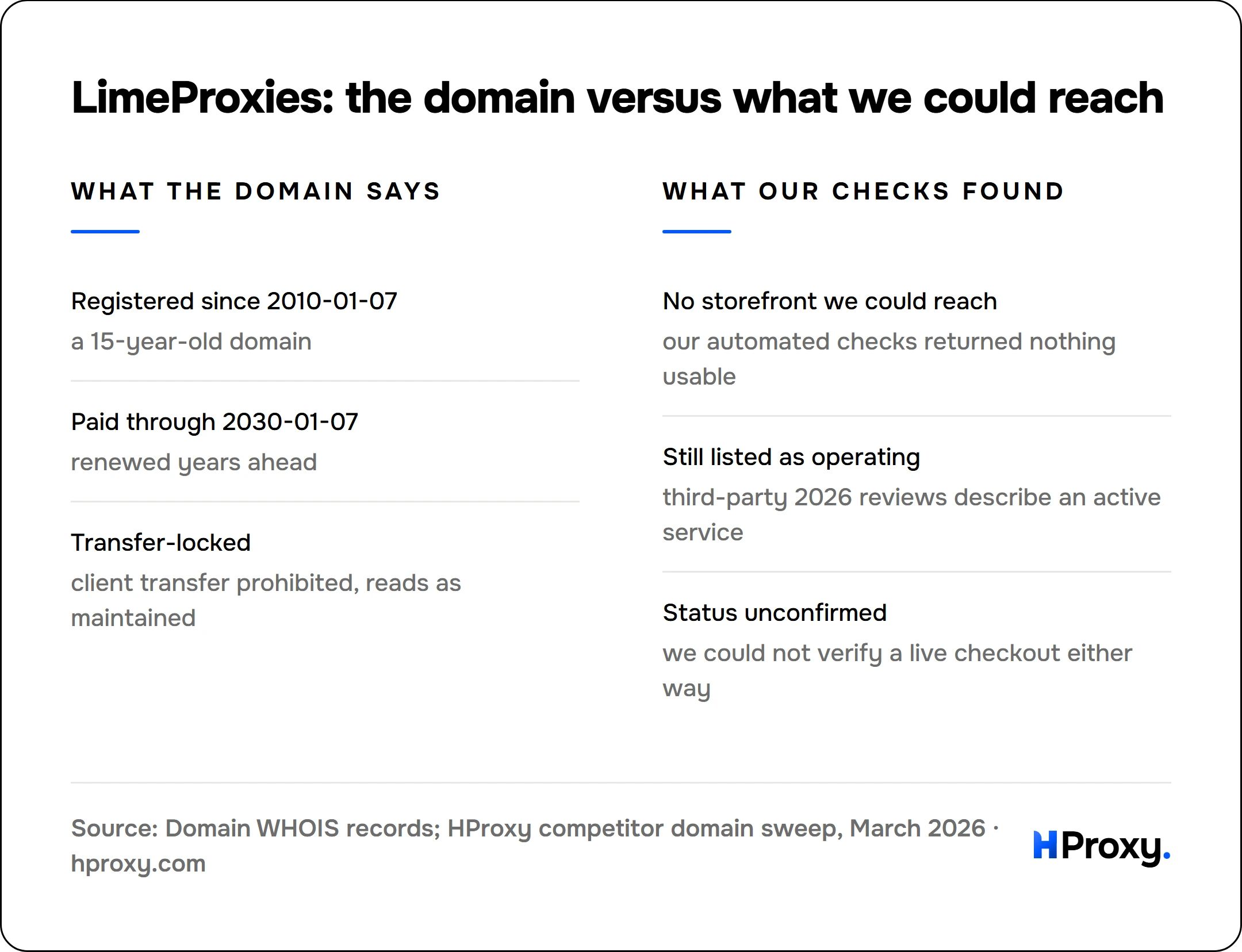
What the domain says
Registered since 2010-01-07
a 15-year-old domain
Paid through 2030-01-07
renewed years ahead
Transfer-locked
client transfer prohibited, reads as maintained
What our checks found
No storefront we could reach
our automated checks returned nothing usable
Still listed as operating
third-party 2026 reviews describe an active service
Status unconfirmed
we could not verify a live checkout either way
LimeProxies is registered until 2030 and transfer-locked, which are the signals people read as "this is a real, maintained company." They are not. A domain can be renewed automatically, parked, or held by whoever last owned it, long after the business behind it is gone. The registration says almost nothing about whether there is a team, a working checkout, or anyone who will answer when your proxies stop.
Treat a resolving domain as the floor, not the proof. The question is never "does the site load," it is "is there a living business on the other end of my money."
How to tell a live proxy shop from a coasting domain
You can check most of this in a few minutes before you pay:
- Look for a real, dated pulse. Recent blog posts, a status page, changelogs, support replies. A site frozen on a 2018 design is a tell.
- Reach support before you buy, not after. A shop that cannot answer a pre-sale question will not answer a post-sale one.
- Confirm the checkout and dashboard actually work. A store that takes your card but never provisions anything is worse than one that is openly closed.
- Verify an IP before you trust it. Whatever a proxy shop claims, put one of its IPs through a checker and see the real exit location, anonymity grade, and the network it belongs to. Our free proxy checker does exactly that.
Where to buy now
LimeProxies is not a scandal. As far as anyone can tell it is a legitimate datacenter proxy shop that priced itself at the premium end, from an era the market has largely moved past toward residential IPs and pay-as-you-go. Whether it is still actively run or just coasting, that is a gentler story than a botnet takedown. The lesson for a buyer is the boring one: the label on the door and the date on the domain do not tell you whether the lights are on.
If you just need to test tooling or run something low-stakes, our free proxy list says plainly what it is: mostly short-lived datacenter IPs, re-checked continuously. When you need residential IPs that hold up, we sell them at $0.44/GB pay as you go with a balance that never expires. The whole point of a graveyard like this is to buy from a network that will still be here, and one that can tell you what you are actually getting.
Sources
- Domain WHOIS records for limeproxies.com (NameCheap, Inc.): creation date January 7, 2010, expiry January 7, 2030, status client transfer prohibited.
- HProxy competitor research and domain sweep (March 2026): the premium positioning and roughly five dollars per IP per month price point, and the finding that limeproxies.com did not serve a storefront our automated checks could reach, while third-party review sites still list the service as operating.
- HProxy guide, How websites detect proxies: why datacenter IPs are easy to flag by the network they announce.