This page exists because the search you ran has almost no honest results. Nearly every page ranking for "VMLogin alternative" earns a commission on the answer it gives you. We earn money if you pick us, which we are stating in the first paragraph rather than the footer.
The record we hold
The domain is vmlogin.us.
A price is missing here on purpose. We have not captured a sourced rate for VMLogin recently enough to publish one, and a stale number in this market is a wrong number.
Copy down the entry rate, the commitment attached to the cheapest rate, the minimum top-up and the expiry rule. Those four turn a marketing figure into something you can compare.
How VMLogin presents itself
On 9 September 2026 their homepage carried the title "vmlogin - Antidetect Multi-Login Browser". The one-paragraph pitch on their own page: "VMlogin antidetect browser, replace multiple computers or vps with virtual browser profiles, login and manage multiple accounts same time in one place. 100% security isolation, prevention of information leakage, it"
Also on the page, stated plainly:
The product lines named on that page are mobile. The page offers some form of free trial. A refund or money-back term is mentioned. We found no separate pricing page linked from the homepage, which usually means the price arrives by quotation.
Every line above is a quotation from their marketing rather than a measurement by us. It is included because it is checkable, not because it is evidence of performance.
What they have built around the product
Our own crawl reached 22 of their pages. The mix was 2 blog pages.
That mix tells you how the company sells. Heavy location pages mean a geography-led pitch, heavy blog means a search-led one, and a single pricing page usually means one simple offer or one sales call.
What the advertised numbers cannot tell you
The expiry question
Expiry is the quietest price increase in this market. A plan sized for a busy month is expensive in a slow one, and the difference never appears in any comparison table, including ones written by vendors who benefit from it.
What the lowest rate actually costs
The lowest published rate in this market usually sits behind a monthly commitment measured in thousands. Quoting it beside a pay as you go rate is not a comparison. Compare the rate you can reach today.
What actually caps your throughput
Rate limits are often enforced per account rather than per plan, which means buying more traffic does not raise them. Confirm how yours scales before you assume a bigger plan runs faster.
What separates them, in a table
The rows below are the ones that change what you pay and whether the job runs:
| Question to ask | VMLogin | HProxy |
|---|---|---|
| Entry price | Not verified by us, read their page | From $0.44/GB, pay as you go |
| Does unused balance expire? | Check the current terms, this one moves | Never |
| Minimum commitment | Not published clearly, ask before paying | None |
| Identity checks | On their own terms page | Card orders are screened, and verification is sometimes requested |
| Targeting | Not published clearly, ask before paying | Country, city and ISP |
| Free way to evaluate | On their own terms page | Free proxy list and proxy checker |
Blanks in that table are deliberate. We print what we read and date it, and leave the rest empty rather than repeating something we cannot stand behind.
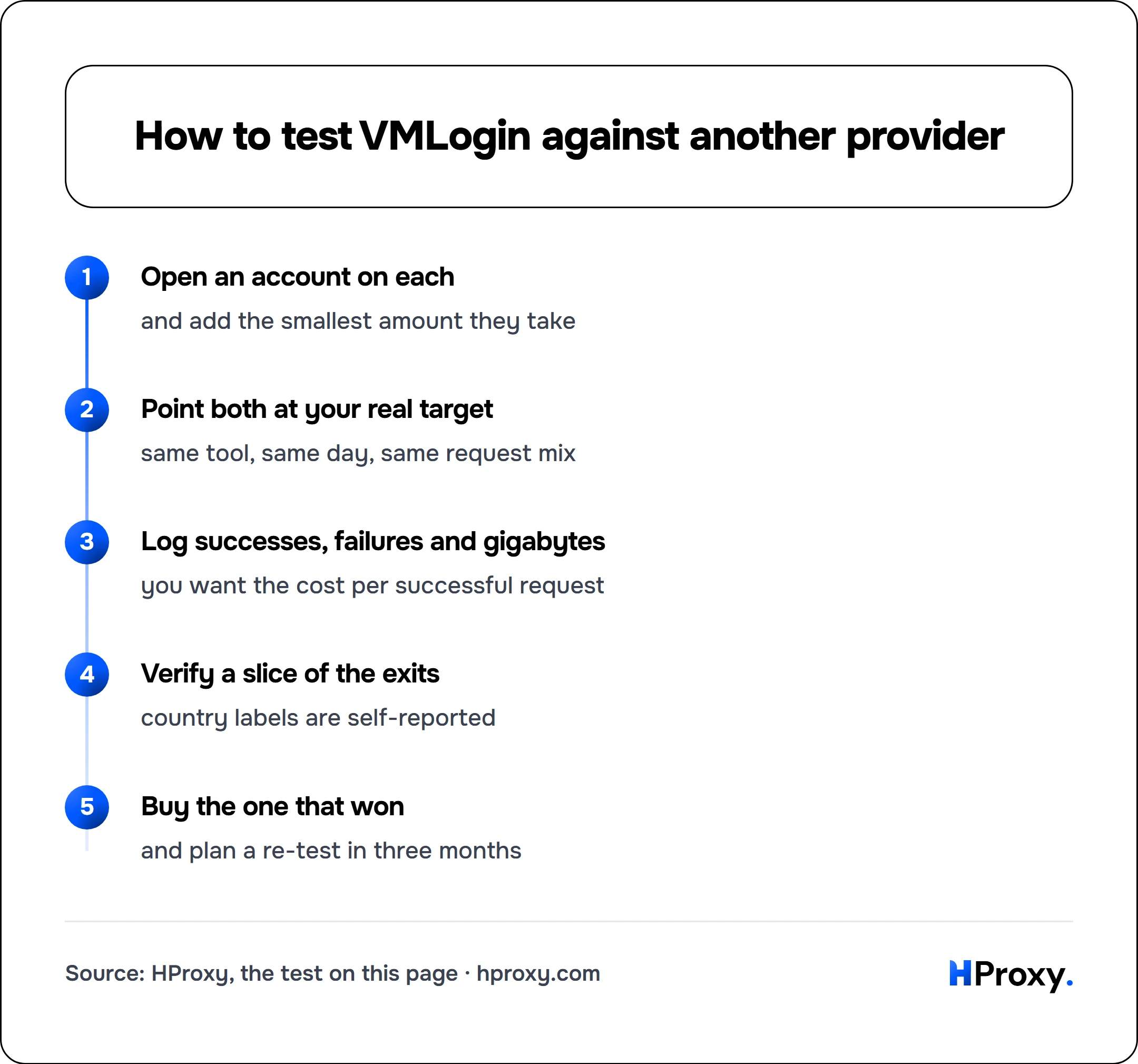
How to settle it yourself in ten minutes
Run this before you commit any volume. It replaces every opinion on this page, including ours.
- Open an account on each and add the smallest amount they take. Skip the trial if a paid unit is cheap enough to buy outright.
- Point both at your real target, through your real tool, on the same day, with the same mix of requests.
- Log successes, failures and gigabytes used. Cost per successful request is the figure you are after.
- Verify a slice of the exits independently. Country labels in this market are self-reported and are not always right.
- Buy the one that won on your target, and diarise a re-test in three months.
Open an account on each
and add the smallest amount they take
Point both at your real target
same tool, same day, same request mix
Log successes, failures and gigabytes
you want the cost per successful request
Verify a slice of the exits
country labels are self-reported
Buy the one that won
and plan a re-test in three months
Who else is in this bracket
The same treatment, applied to the providers most often weighed against this one:
The competing offer, for completeness
We are the pay as you go option in this market. Residential from $0.44 per GB, ISP and datacenter per address, mobile alongside them, all from one balance with nothing to forfeit. That model wins on irregular volume and loses on very large steady volume, which is worth knowing before you test.