A proxy provider is a network, and networks age in ways a screenshot cannot show. What was true about Proxys a year ago may be wrong today, which is why the last section is a test rather than a verdict.
Everything we can stand behind
Proxys trades at proxys.io. They compete with us as a proxy provider.
We price the providers we can source and date, and Proxys is not currently one of them. The rest of this page is about what to check when you read their pricing yourself.
The four figures worth copying down are the rate without a commitment, the smallest purchase allowed, what happens to unspent balance, and whether a failed request still costs money.
The site, as it reads today
Their homepage title, read on 9 September 2026: "Купить анонимные прокси по выгодным ценам. Недорогие индивидуальные и приватные прокси-сервера". Their own summary of the product runs: "Платные прокси , это отличное решение для тех, кто привык экономить свое время и пользоваться только лучшими сервисами. Прокси от PROXYS.IO , это образец надежности и стабильности."
Taken from the same page, on the same day:
The product lines named on that page are SOCKS5 and IPv6. Payment methods mentioned: crypto, Alipay and cards. Support is advertised as around the clock. We found no separate pricing page linked from the homepage, which usually means the price arrives by quotation.
Every line above is a quotation from their marketing rather than a measurement by us. It is included because it is checkable, not because it is evidence of performance.
How long Proxys has been trading
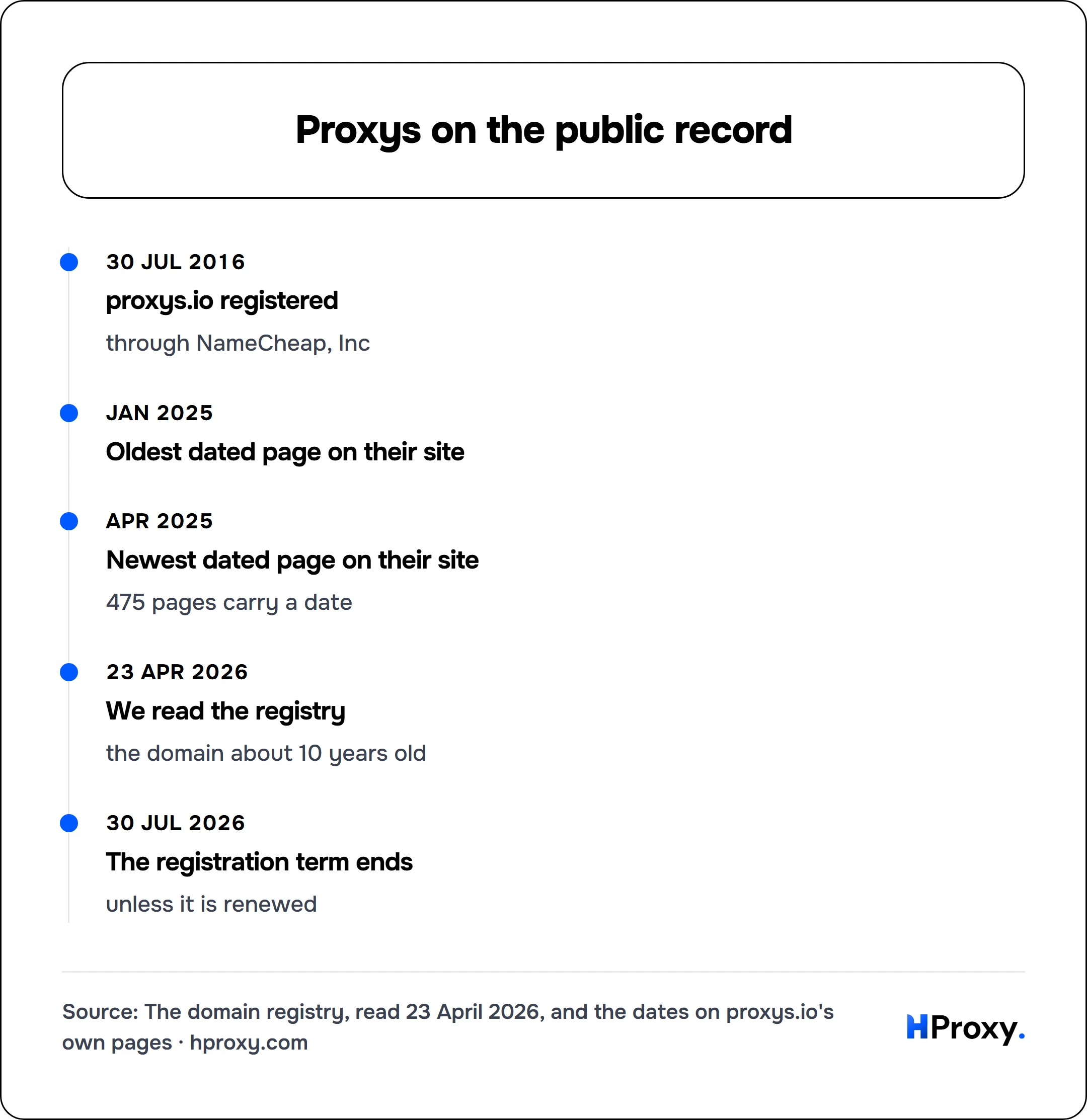
The domain was registered on 30 July 2016, through NameCheap, Inc, which makes it about 10 years old. Checked against the registry on 23 April 2026. The Internet Archive holds 20 snapshots of the site, the earliest from August 2016. The registration currently runs to 30 July 2026.
30 Jul 2016
proxys.io registered
through NameCheap, Inc
Jan 2025
Oldest dated page on their site
Apr 2025
Newest dated page on their site
475 pages carry a date
23 Apr 2026
We read the registry
the domain about 10 years old
30 Jul 2026
The registration term ends
unless it is renewed
This proves nothing about the product. It is a cheap check against the one failure mode that costs buyers real money in this market, which is paying a provider that will not exist in six months.
What our crawl found
A crawl of 475 pages on 19 June 2026 returned 145 blog pages.
The number is not a compliment or a criticism. It describes how much of their effort goes into being found, which is worth knowing when you are weighing a marketing claim against a measurement.
How active Proxys still is
Our crawl of their site found 475 pages carrying a date, 145 of them articles. The oldest is from January 2025 and the newest from April 2025.
A site that has not been touched in a year is a signal, not a verdict. It can mean a stable product with nothing to announce, or a company that has stopped. The way to tell them apart is to ask them.
What you still do not know after reading their site
Advertised rate against the rate you reach
Divide what you spent in a month by what you actually used, and you have the only rate worth quoting. It usually sits well above the figure on the homepage, because tiers, minimums and unused allocation all sit between the two.
Who else is using your address
Ask how many accounts can sit on one address at once. Where the answer is unlimited or unspecified, price the plan as shared regardless of what the product is called.
Ask whether failed requests are billed
Divide the spend by the successful responses, not by the requests sent. That single change reorders most price comparisons in this market, and your accounting will use it eventually anyway.
The two of us, on the questions that matter
Six questions, both answers, and an honest blank where we do not hold a current figure:
| Question to ask | Proxys | HProxy |
|---|---|---|
| Entry price | Not verified by us, read their page | From $0.44/GB, pay as you go |
| Does unused balance expire? | Their terms page answers this | Never |
| Minimum commitment | On their own terms page | None |
| Identity checks | Not published clearly, ask before paying | Card orders are screened, and verification is sometimes requested |
| Targeting | Worth confirming in writing before you commit | Country, city and ISP |
| Free way to evaluate | Read their current terms | Free proxy list and proxy checker |
The useful part of that table is the left column. Take those six questions to any provider in this market and the answers will sort them faster than any review.
What to do instead of reading more comparisons
The steps below take about ten minutes and settle the question properly.
- Put a few dollars on each account. Trials are fine for a first look, but paid traffic is what you will actually be buying.
- Run them against the site you actually care about, using the code you actually run, within the same hour.
- Record the success rate and the data consumed for the identical batch on each side.
- Take a handful of the addresses you were given and verify their country and type against a checker you do not control.
- Keep the winner, and repeat the whole thing quarterly, because pools age.
Comparable providers
We hold the same record for these, and the same honest limits apply to each:
- Ip2Proxy alternatives
- Ipaddress alternatives
- IPBurger alternatives
- IPCloud alternatives
- Ipcola alternatives
Our own position
Residential starts at $0.44 per GB with country targeting, the balance never expires, there is no minimum commitment and no sales call, and city and ISP targeting come with Residential Premium from $1.00 per GB. We publish our free side openly, 129,131,311 verification checks and counting, because a network that is confident has no reason to fear measurement.