There are two honest ways to compare proxy providers. Read both pricing pages carefully and match the units, or run the same batch through both and count. This page does the first and tells you how to do the second.
What is on file for Vision Browser
Vision Browser trades at visionbrowser.com.
We price the providers we can source and date, and Vision Browser is not currently one of them. The rest of this page is about what to check when you read their pricing yourself.
Take down four numbers and a date: reachable rate, minimum purchase, commitment for the floor rate, and expiry period. Anything less and you cannot compare them to anyone.
Vision Browser in its own words
Their homepage title, read on 9 September 2026: "visionbrowser.com - Informationen zum Thema visionbrowser.". The one-paragraph pitch on their own page: "visionbrowser.com ist Ihre erste und beste Informationsquelle über visionbrowser. Hier finden Sie auch weitere interessante Links. Wir hoffen, dass Sie bei Ihrer Suche erfolgreich sind!"
What else that page states, without interpretation:
We found no separate pricing page linked from the homepage, which usually means the price arrives by quotation.
Treat all of it as advertising, because it is. Its value is that it is dated and quotable, which is more than most comparison pages offer.
Age, and why it matters here
The domain was registered on 14 October 2008, through Name.com, Inc, which makes it about 17 years old. Checked against the registry on 23 April 2026. The registration currently runs to 14 October 2026.
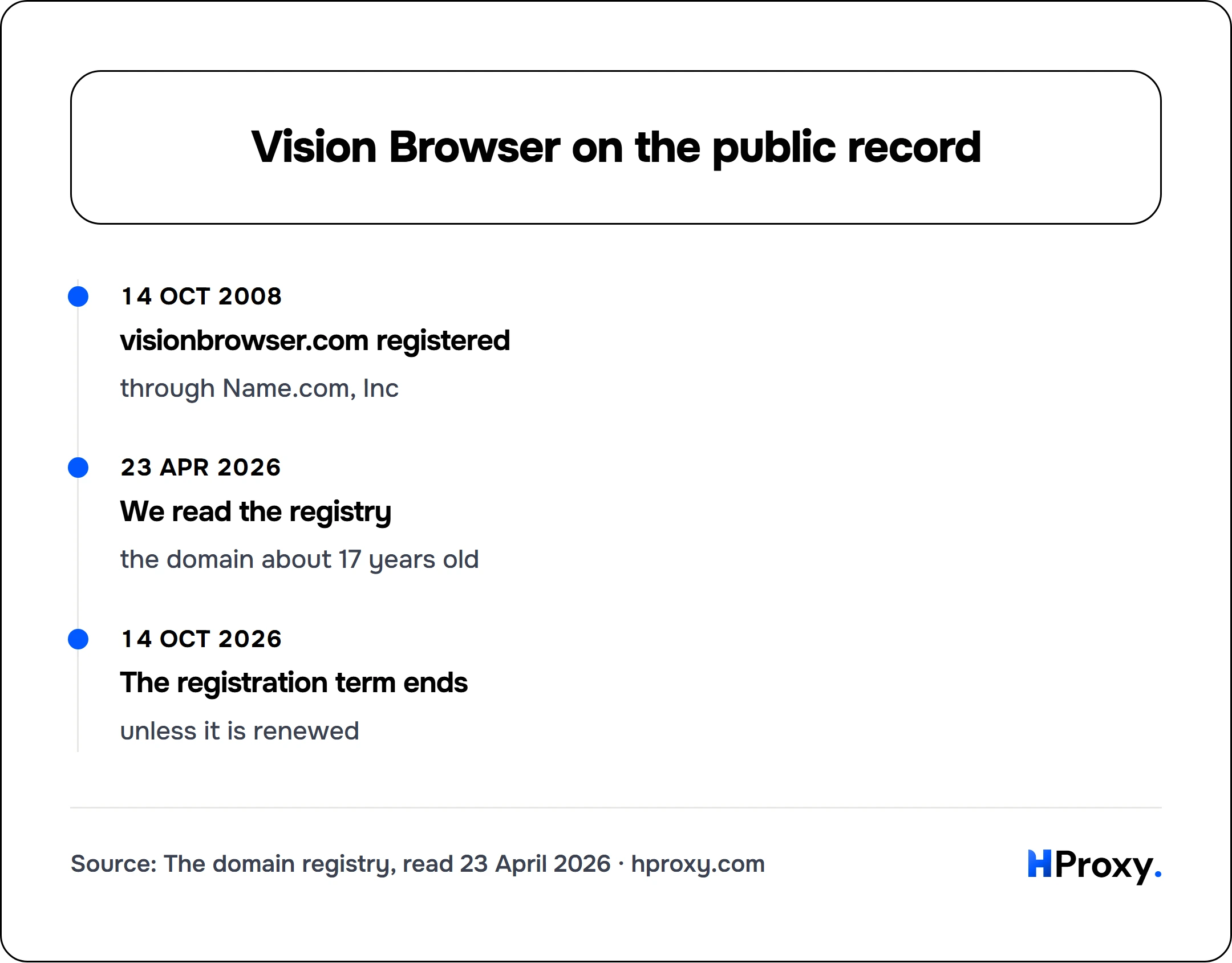
14 Oct 2008
visionbrowser.com registered
through Name.com, Inc
23 Apr 2026
We read the registry
the domain about 17 years old
14 Oct 2026
The registration term ends
unless it is renewed
This proves nothing about the product. It is a cheap check against the one failure mode that costs buyers real money in this market, which is paying a provider that will not exist in six months.
What you still do not know after reading their site
Why a cheap address is often a used one
An address you share carries the reputation of everyone else on it. That is acceptable for some work and fatal for anything involving a login. The price difference between shared and dedicated usually reflects exactly this.
What a blocked response costs you
On a hard target, failures are the majority of your traffic. Whether those failures are billed decides the real cost, and the clause covering it is rarely on the pricing page.
Concurrency limits decide throughput
A plan with generous traffic and a low thread limit is a slow plan. Find both numbers before you size anything, because the smaller of the two is your actual ceiling.
The two of us, on the questions that matter
Set the two side by side on the questions that decide the outcome, rather than on feature counts:
| Question to ask | Vision Browser | HProxy |
|---|---|---|
| Entry price | Not verified by us, read their page | From $0.44/GB, pay as you go |
| Does unused balance expire? | Read their current terms | Never |
| Minimum commitment | Check the current terms, this one moves | None |
| Identity checks | Their terms page answers this | Card orders are screened, and verification is sometimes requested |
| Targeting | On their own terms page | Country, city and ISP |
| Free way to evaluate | Not published clearly, ask before paying | Free proxy list and proxy checker |
Six rows is enough. Longer comparison tables in this market are usually padded with features nobody chooses on, which makes them look thorough and read as noise.
The test that beats this page
It is a small amount of money for an answer that is actually about your target.
- Fund both accounts with the least money each will accept, and note what that minimum was, because it is part of the comparison.
- Aim both at the page that matters to you rather than a test endpoint, and keep every other variable fixed.
- Write down two numbers per provider: the share of requests that succeeded, and the traffic it cost.
- Take a handful of the addresses you were given and verify their country and type against a checker you do not control.
- Keep the winner, and repeat the whole thing quarterly, because pools age.
Comparable providers
We hold the same record for these, and the same honest limits apply to each:
What we sell, stated plainly
Our position is narrow. Residential from $0.44 per GB, no subscription, no expiry on the balance, and a public record of what our free network actually does. A provider unwilling to be measured is telling you something, and so is one that asks to be.