Readers land here mid-decision, usually with a cart open somewhere. The fastest thing we can do is set out what Froxy publishes, what it does not, and what a few dollars of testing settles better than any argument.
What is on their pricing page
Read from their own public pricing pages on 10 August 2026, and stated as advertised rather than as verified by us:
- Datacenter: $0.42 per GB on not disclosed; HEATWAVE sale price through 2026-08-31, list price $0.60/GB.
- Datacenter: from $24 per month on none, smallest datacenter plan.
- ISP: from $5.50 per month.
- Mobile: $2.73 per GB on not disclosed; HEATWAVE sale price through 2026-08-31, list price $3.90/GB.
- Mobile: from $7.50 per month on none, smallest mobile plan.
- Residential: $1.88 per GB on not disclosed; this is a promo price, the HEATWAVE sale of 'up to 30% off all proxies' running through 2026-08-31.
- Residential: from $5.50 per month on none, this is the smallest residential plan Froxy sells.
Every one of those is a published rate rather than a measured outcome. That is not a criticism of Froxy: our own page is built from the same material. It is the reason the rest of this comparison is about what published rates leave out.
What is on their front page
Read 9 September 2026, the homepage titles itself "Your Trusted Proxy Provider Froxy, Elite Proxies and Scraper". Their own summary of the product runs: "Description: Buy proxy, E-commerce and SERP scrapers ✔ 200+ countries ✔ Automatic rotation ✔ Targeting settings ✔ Pool of over 120 million IP addresses"
Taken from the same page, on the same day:
The product lines named on that page are residential, datacenter, mobile and SOCKS5. They advertise 200 countries or locations. Payment methods mentioned: crypto. We found no separate pricing page linked from the homepage, which usually means the price arrives by quotation.
Nothing there has been tested. It is a record of what the page said on the day, which is the honest limit of what a page like this can offer without a measurement.
Longevity, on the public record
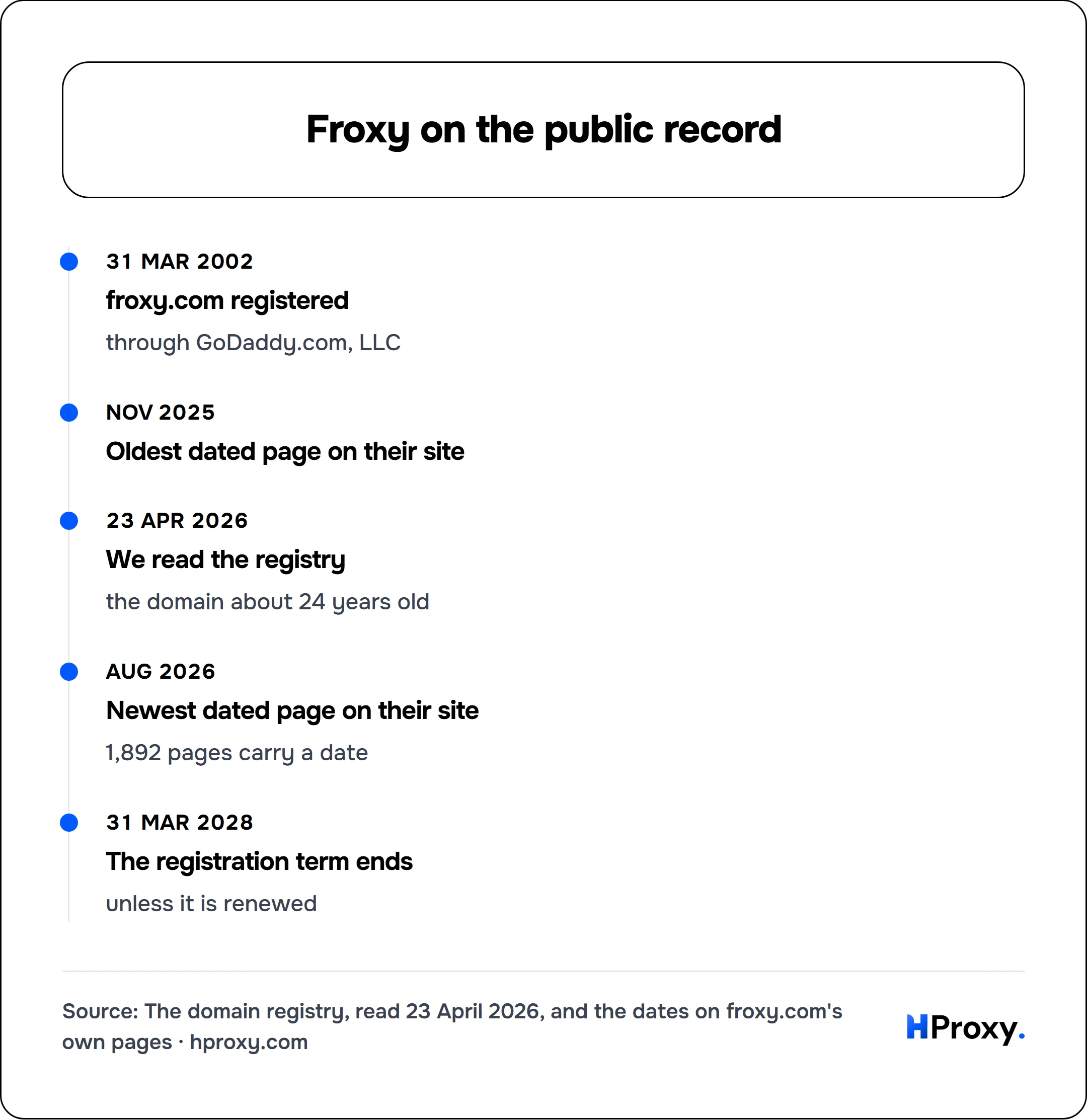
The domain was registered on 31 March 2002, through GoDaddy.com, LLC, which makes it about 24 years old. That record was read from the registry on 23 April 2026. The registry shows it renewed to 31 March 2028.
31 Mar 2002
froxy.com registered
through GoDaddy.com, LLC
Nov 2025
Oldest dated page on their site
23 Apr 2026
We read the registry
the domain about 24 years old
Aug 2026
Newest dated page on their site
1,892 pages carry a date
31 Mar 2028
The registration term ends
unless it is renewed
Read that as a floor rather than a recommendation. Longevity says somebody has kept paying the registrar, and in a market with this much churn that is worth ten seconds of your attention.
How much site there is
A crawl of 2.323 pages returned 35 pricing pages, 1.250 location pages, 25 use-case pages and 130 integration pages.
That mix tells you how the company sells. Heavy location pages mean a geography-led pitch, heavy blog means a search-led one, and a single pricing page usually means one simple offer or one sales call.
The activity record
Our crawl of their site found 1,892 pages carrying a date. The oldest is from November 2025 and the newest from August 2026. 1,892 of them carry a date inside the last twelve months.
An actively maintained site is table stakes rather than a recommendation. It does rule out the failure that costs buyers the most here, which is prepaying a company that has quietly stopped.
Where the interest in Froxy goes
The Keyword Planner puts brand demand at 10 a month: 10 a month for a review of them. Figures read from Google Keyword Planner on 9 September 2026.
Weighted towards people checking whether to trust it. A comparison that ignores that and opens with a pitch has misread the room.
What the advertised numbers cannot tell you
Coverage in the one country you need
Country totals are counted generously across this whole market. A country with a handful of addresses counts the same as one with hundreds of thousands. If your work depends on one location, test that location before you switch.
The response time nobody advertises
Test the support channel before you need it. Ask something specific and technical, and judge both the speed and whether the answer came from somebody who understood the question.
Nothing here stays true for long
Every review of this market, this one included, is a photograph of a moving thing. Read the date on any comparison you find, and discount it heavily once it is more than a few months old.
What separates them, in a table
This is the shortest table that still decides the purchase:
| Question to ask | Froxy | HProxy |
|---|---|---|
| Entry price | Published, see above, dated 10 August 2026 | From $0.44/GB, pay as you go |
| Does unused balance expire? | Check the current terms, this one moves | Never |
| Minimum commitment | Lower rates require one, see above | None |
| Identity checks | On their own terms page | Card orders are screened, and verification is sometimes requested |
| Targeting | Read their current terms | Country, city and ISP |
| Free way to evaluate | Worth confirming in writing before you commit | Free proxy list and proxy checker |
That comparison covers what is publishable. What is not publishable, and what actually decides this, is how many of your requests come back correct.
A test worth more than this comparison
Do this once and you will never need a comparison page for this decision again.
- Start with the smallest purchase each vendor allows, so the test costs less than the decision it replaces.
- Use your own scraper and your own target. A benchmark against a neutral site measures nothing you will experience.
- Count how many requests returned what you wanted, and how much bandwidth each side spent doing it.
- Spot-check the exits. Confirm they are in the country you paid for and the connection type you were sold.
- Buy the one that won on your target, and diarise a re-test in three months.
Who else is in this bracket
The same treatment, applied to the providers most often weighed against this one:
- AWMProxy alternatives
- AYCD alternatives
- Backtalk alternatives
- Baker Proxies alternatives
- Bartproxies alternatives
Where HProxy sits in that test
We sell residential proxies from $0.44 per GB with no subscription and a balance that does not expire, plus ISP, mobile and datacenter in the same account. That is the pitch, and the test above is a better judge of it than this paragraph.