Readers land here mid-decision, usually with a cart open somewhere. The fastest thing we can do is set out what The Social Proxy publishes, what it does not, and what a few dollars of testing settles better than any argument.
The record we hold
The domain is thesocialproxy.com. They are filed here as a proxy provider.
What we do not hold is a current, sourced price for The Social Proxy. Rather than print a figure we cannot stand behind, this page leaves it out and tells you what to look for when you read their page yourself.
Read their page for the reachable rate rather than the headline, the minimum spend, the expiry clause and the billing treatment of blocked requests. Write down the date, because all four move.
Longevity, on the public record
The domain was registered on 24 November 2019, through GoDaddy.com, LLC, which makes it about 6 years old. Those dates come from a registry query on 23 April 2026. Their registration is booked through 24 November 2027.
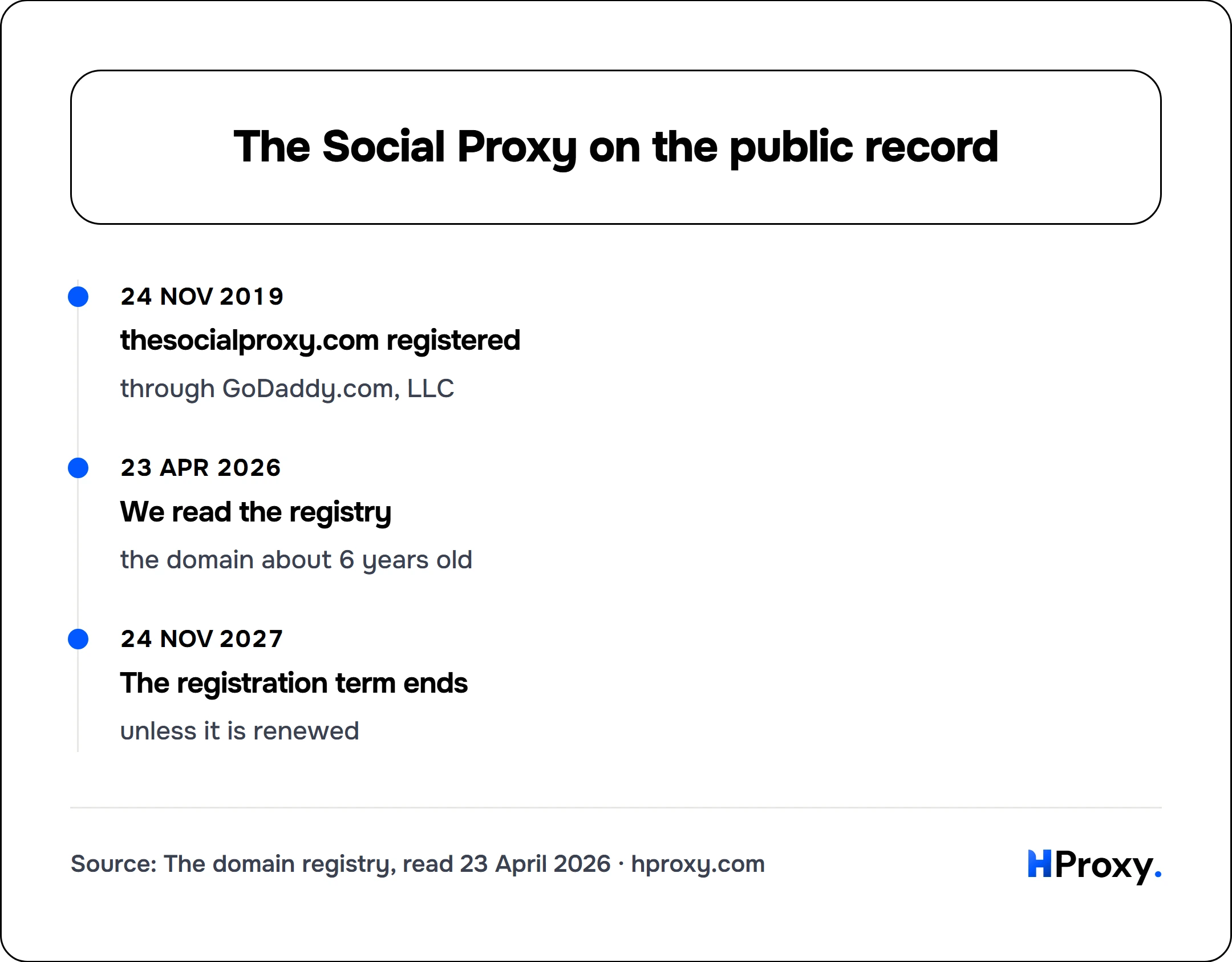
24 Nov 2019
thesocialproxy.com registered
through GoDaddy.com, LLC
23 Apr 2026
We read the registry
the domain about 6 years old
24 Nov 2027
The registration term ends
unless it is renewed
Read that as a floor rather than a recommendation. Longevity says somebody has kept paying the registrar, and in a market with this much churn that is worth ten seconds of your attention.
Where published figures stop being useful
What happens when it breaks at two in the morning
Every provider works when nothing is wrong. The difference shows up on the day a subnet gets flagged or a gateway stops answering. Before committing volume, send one real question through the support channel and time the reply.
Why an old benchmark is wrong
Supply changes hands quietly in this industry. The network behind a brand can be replaced with no announcement, which is why a benchmark is a perishable good and a re-test is cheap insurance.
What actually caps your throughput
A plan with generous traffic and a low thread limit is a slow plan. Find both numbers before you size anything, because the smaller of the two is your actual ceiling.
A comparison that admits what it cannot say
This is the shortest table that still decides the purchase:
| Question to ask | The Social Proxy | HProxy |
|---|---|---|
| Entry price | Not verified by us, read their page | From $0.44/GB, pay as you go |
| Does unused balance expire? | Check the current terms, this one moves | Never |
| Minimum commitment | Not published clearly, ask before paying | None |
| Identity checks | On their own terms page | Card orders are screened, and verification is sometimes requested |
| Targeting | Read their current terms | Country, city and ISP |
| Free way to evaluate | Worth confirming in writing before you commit | Free proxy list and proxy checker |
That comparison covers what is publishable. What is not publishable, and what actually decides this, is how many of your requests come back correct.
A test worth more than this comparison
Do this once and you will never need a comparison page for this decision again.
- Start with the smallest purchase each vendor allows, so the test costs less than the decision it replaces.
- Use your own scraper and your own target. A benchmark against a neutral site measures nothing you will experience.
- Count how many requests returned what you wanted, and how much bandwidth each side spent doing it.
- Spot-check the exits. Confirm they are in the country you paid for and the connection type you were sold.
- Buy the one that won on your target, and diarise a re-test in three months.
The other names that come up
Other providers in the same bracket, priced and dated the same way:
- Ipaddress alternatives
- IPBurger alternatives
- IPCloud alternatives
- Ipcola alternatives
- IPCook alternatives
Our side of it
What we offer is one account holding residential, ISP, mobile and datacenter, priced from $0.44 per GB on residential, with no tier to climb and no allocation to lose at month end. Whether that suits you depends on how steady your volume is.