There are two honest ways to compare proxy providers. Read both pricing pages carefully and match the units, or run the same batch through both and count. This page does the first and tells you how to do the second.
What we know about Spider (ex-Mysterium), and what we do not
You will find them at spider.com.
We have no verified current rate for Spider (ex-Mysterium) on file. Printing a guess would make this page worse than useless, so the price row below is empty and the reading list is not.
The four figures worth copying down are the rate without a commitment, the smallest purchase allowed, what happens to unspent balance, and whether a failed request still costs money.
Their own description, read this week
Their homepage title, read on 9 September 2026: "Residential Proxies and API - Millions of IPs, Spider.com". Written for search engines, their description says: "Backconnect proxy with powerful API. Don't get blocked when you are crawling. Chrome Extension. 24/7 Support. 14 Day Free Trial. API for SERP and Fetch using the Spider.com network."
Reading the same page for the things buyers actually ask about:
The product lines named on that page are residential. Support is advertised as around the clock. Their pricing page is titled "Pricing, Spider® Residential IPs + SERP API".
All of the above is their copy, not our finding. A dated quotation is the weakest kind of evidence that is still evidence.
How far back the record goes
The domain was registered on 27 January 1997, through SafeNames Ltd, which makes it about 29 years old. Checked against the registry on 23 April 2026. The registration currently runs to 28 January 2031.
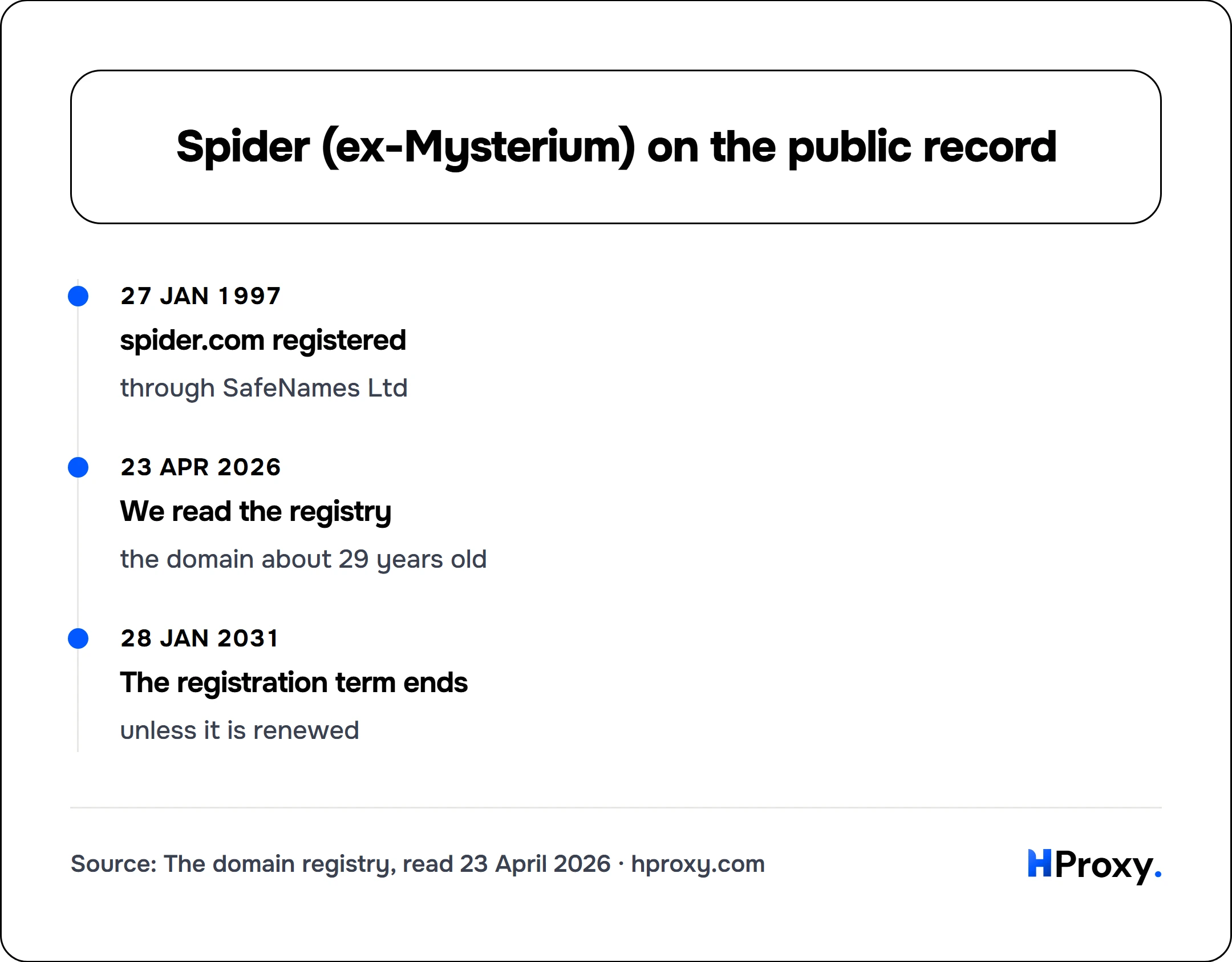
27 Jan 1997
spider.com registered
through SafeNames Ltd
23 Apr 2026
We read the registry
the domain about 29 years old
28 Jan 2031
The registration term ends
unless it is renewed
This proves nothing about the product. It is a cheap check against the one failure mode that costs buyers real money in this market, which is paying a provider that will not exist in six months.
What our crawl found
A crawl of 165 pages returned 58 blog pages, 1 pricing page and 3 use-case pages.
The number is not a compliment or a criticism. It describes how much of their effort goes into being found, which is worth knowing when you are weighing a marketing claim against a measurement.
The questions behind the numbers
The comparison that is not a comparison
Residential is normally billed per gigabyte, datacenter and ISP per address, mobile per day or per port. Setting one against another produces a number that means nothing. Convert both sides into the unit your own workload consumes.
Who else is using your address
A shared address arrives with a history you did not create and cannot see. For read-only work it rarely matters. For anything that keeps a session, it is the most common cause of unexplained failure.
Ask whether failed requests are billed
On a hard target, failures are the majority of your traffic. Whether those failures are billed decides the real cost, and the clause covering it is rarely on the pricing page.
The comparison, honestly framed
Set the two side by side on the questions that decide the outcome, rather than on feature counts:
| Question to ask | Spider (ex-Mysterium) | HProxy |
|---|---|---|
| Entry price | Not verified by us, read their page | From $0.44/GB, pay as you go |
| Does unused balance expire? | Read their current terms | Never |
| Minimum commitment | Check the current terms, this one moves | None |
| Identity checks | Their terms page answers this | Card orders are screened, and verification is sometimes requested |
| Targeting | Check the current terms, this one moves | Country, city and ISP |
| Free way to evaluate | Their terms page answers this | Free proxy list and proxy checker |
Six rows is enough. Longer comparison tables in this market are usually padded with features nobody chooses on, which makes them look thorough and read as noise.
The test that beats this page
It is a small amount of money for an answer that is actually about your target.
- Take the smallest paid unit each provider will sell you. A free trial works for a first pass, though trials sometimes ride better pools than paid plans do.
- Fire the same batch through both on one afternoon. Different days are different conditions, and that ruins the comparison.
- Track the success rate and the bandwidth. A cheap gigabyte that fails half the time is not cheap.
- Run a sample of the addresses through an independent lookup, because advertised geography and actual geography differ more often than the market admits.
- Go with whichever performed, then measure again next quarter. Networks change underneath you.
Comparable providers
We hold the same record for these, and the same honest limits apply to each:
Our own position
Residential starts at $0.44 per GB with country targeting, the balance never expires, there is no minimum commitment and no sales call, and city and ISP targeting come with Residential Premium from $1.00 per GB. We publish our free side openly, 129,131,311 verification checks and counting, because a network that is confident has no reason to fear measurement.