US-Proxy.org published a free list of US proxies from 2013 until July 2025, when its own page last appears in the Internet Archive. Since August 2025 the name forwards to the US page of free-proxy-list.net, where the same list has also run since 2013. That page says it is brought to you by Didsoft Ltd, which also sells paid lists of public proxies. The alternatives table compares five options, read on 27 September 2026.
The record, with dates
| date | what happened |
|---|---|
| March 2013 | First archived copy of the US list on free-proxy-list.net. |
| 30 September 2013 | The domain us-proxy.org is registered. |
| by 2019, to July 2025 | us-proxy.org runs its own "US Proxy List", updated "every 10 minutes". |
| August 2025 | The archive shows us-proxy.org forwarding. |
| 27 September 2026 | Our check: us-proxy.org forwards to free-proxy-list.net/us-proxy.html. |
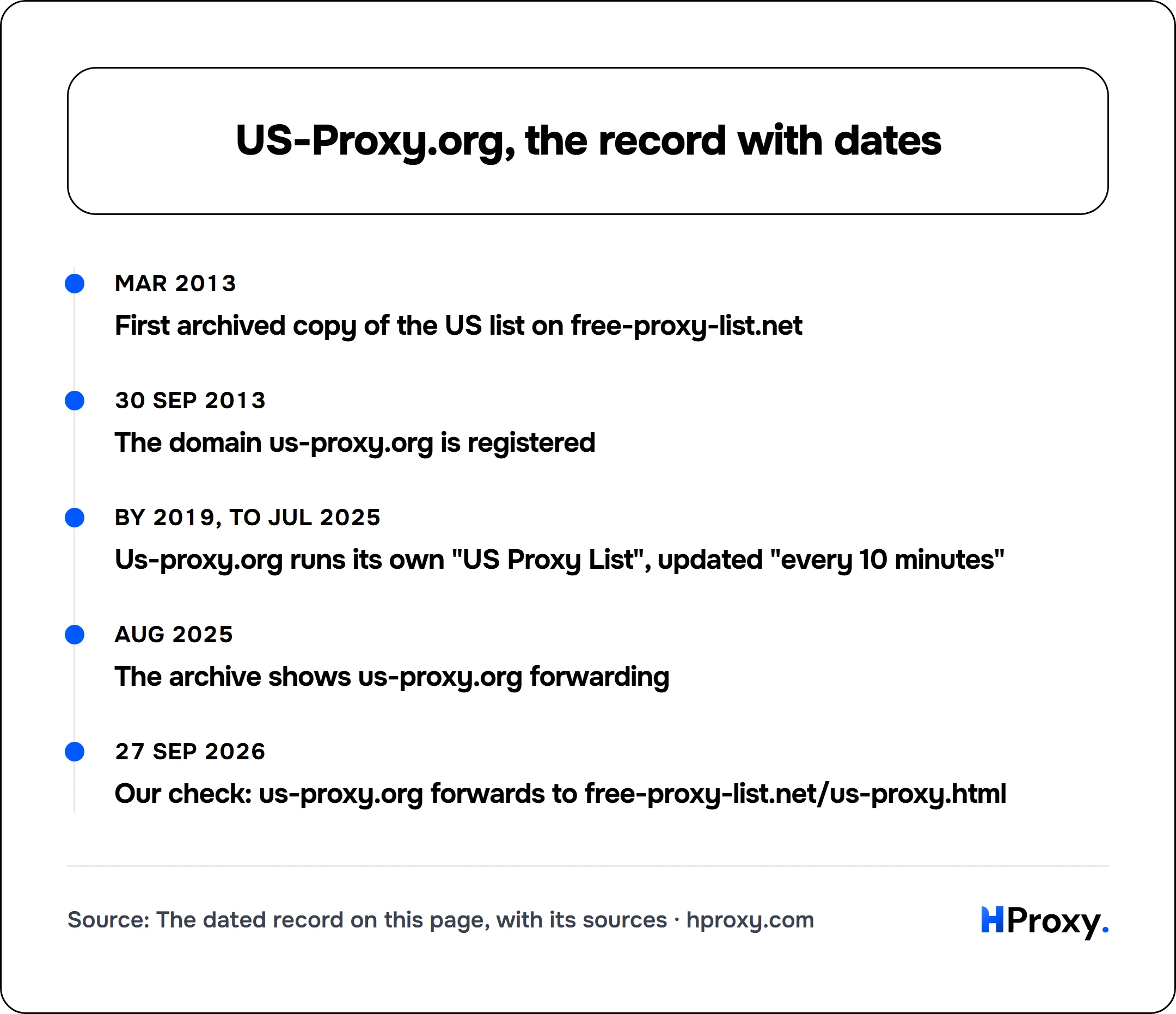
Mar 2013
First archived copy of the US list on free-proxy-list.net
30 Sep 2013
The domain us-proxy.org is registered
by 2019, to Jul 2025
Us-proxy.org runs its own "US Proxy List", updated "every 10 minutes"
Aug 2025
The archive shows us-proxy.org forwarding
27 Sep 2026
Our check: us-proxy.org forwards to free-proxy-list.net/us-proxy.html
Sources: the .org registry, the Internet Archive and our own check.
Its sister names forward the same way: sslproxies.org opens the SSL list of free-proxy-list.net, and socks-proxy.net opens its SOCKS list.
What the list held on 27 September 2026
We fetched the US list once from our server at 11:53 UTC and counted its table. We did not use or test any proxy on it.
| measure | count |
|---|---|
| entries | 200, all in the United States |
| anonymity | 94 elite, 33 anonymous, 73 transparent |
| HTTPS support | 39 yes, 161 no |
| works with Google, by its column | 22 yes, 118 no, 60 blank |
| last check | from 16 seconds to 6 hours 37 minutes ago |
A transparent proxy passes your own IP address on to the site, so more than a third of the list hides nothing. The page says it updates every 10 minutes, yet 21 entries carried a last check more than 6 hours old.
What its operator sells
Didsoft sells paid lists of the same kind of proxies, updated every 30 minutes. HTTP 1000 costs $9.92 a month for "63 working proxy daily", HTTP 3000 costs $28.95 for 188, and HTTP 6500 costs $59.95 for 408. All come with a 15-day money-back guarantee.
Its own FAQ is plain about them: "Those proxies are public proxies which we collect from the Internet", and they do not work on Google, Instagram or Craigslist. It also calls them "unstable and usually slow but very cheap".
What we could not check
- Whether the entries work: we did not use or test them.
- Why the name stopped serving its own page in 2025: no notice was archived.
- Who owns Didsoft Ltd beyond its name.
Five alternatives, read the same day
Every line below comes from the page of each option, read from our server on 27 September 2026.
| option | price | how often it changes | what it says about testing |
|---|---|---|---|
| Proxifly free proxy list | free | "every 5 minutes" | It "found 33460 working proxies from 141 countries" in its latest update. |
| monosans proxy list | free | "re-checked every hour" | "Every proxy in this repository was verified minutes ago." |
| ProxyScrape free proxy list | free | "refreshed every minute" | "Verified by automated checkers", in 180+ countries. |
| HProxy free proxy list | free | verified around the clock | Live HTTP, HTTPS, SOCKS4 and SOCKS5 proxies. No sign-up. |
| HProxy Lite | $0.50/GB for 1 GB, $0.44/GB at 2,000 GB+ | a rotating residential line | The balance never expires. |
Which one to pick
- You used the US list for quick checks that tolerate dead entries: a free list that tests what it lists, filtered to the United States.
- You need US addresses that hold a login or a checkout: a paid line. Our Lite costs $0.50/GB for 1 GB, and Premium adds city and ISP targeting at $1.49 for one GB.
Whichever list you use, run it through our free proxy checker first. It tests up to 100,000 proxies with no sign-up.
The limits of this record
Our count is one reading of a table that changes every few minutes, and every figure about the list is its own. This page is due for a check by 27 December 2026.
Sources
Read on 27 September 2026, from our server:
- us-proxy.org, sslproxies.org and socks-proxy.net, live requests, and the Internet Archive captures of us-proxy.org from 2013 to 2025.
- Public Interest Registry, the record for us-proxy.org.
- free-proxy-list.net, its US list and its paid list page with FAQ.
- Proxifly and monosans repositories, and the ProxyScrape free proxy list page.
- HProxy, our free proxy list, proxy checker and product catalogue.