Before anything about ProxyStores: pool totals, uptime badges and country counts predict almost nothing about your result. What predicts it is a measured success rate on your own target, and that measurement costs a few dollars.
ProxyStores on the record
ProxyStores operates from proxystores.com. Our classification for them is proxy provider.
What we do not hold is a current, sourced price for ProxyStores. Rather than print a figure we cannot stand behind, this page leaves it out and tells you what to look for when you read their page yourself.
Look for the tier you would actually land in, not the one at the bottom of the table, and find the expiry and failed-request clauses before the rate impresses you.
What is on their front page
As of 9 September 2026 the tab reads "Купить прокси - индивидуальные IPv4 и IPv6 прокси, ProxyStores". Written for search engines, their description says: "Купите индивидуальные IPv4 и IPv6 прокси по низкой цене. Быстрые прокси с HTTP/SOCKS5, безлимитным трафиком, ручным выбором IP и гарантией возврата 48 часов."
Also on the page, stated plainly:
The product lines named on that page are IPv6. Payment methods mentioned: crypto. We found no separate pricing page linked from the homepage, which usually means the price arrives by quotation.
That is the vendor speaking, not us. We print it because a claim with a date attached is at least falsifiable.
Longevity, on the public record
The domain was registered on 2 August 2022, through GoDaddy.com, LLC, which makes it about 4 years old. Those dates come from a registry query on 9 September 2026. Their registration is booked through 2 August 2033.
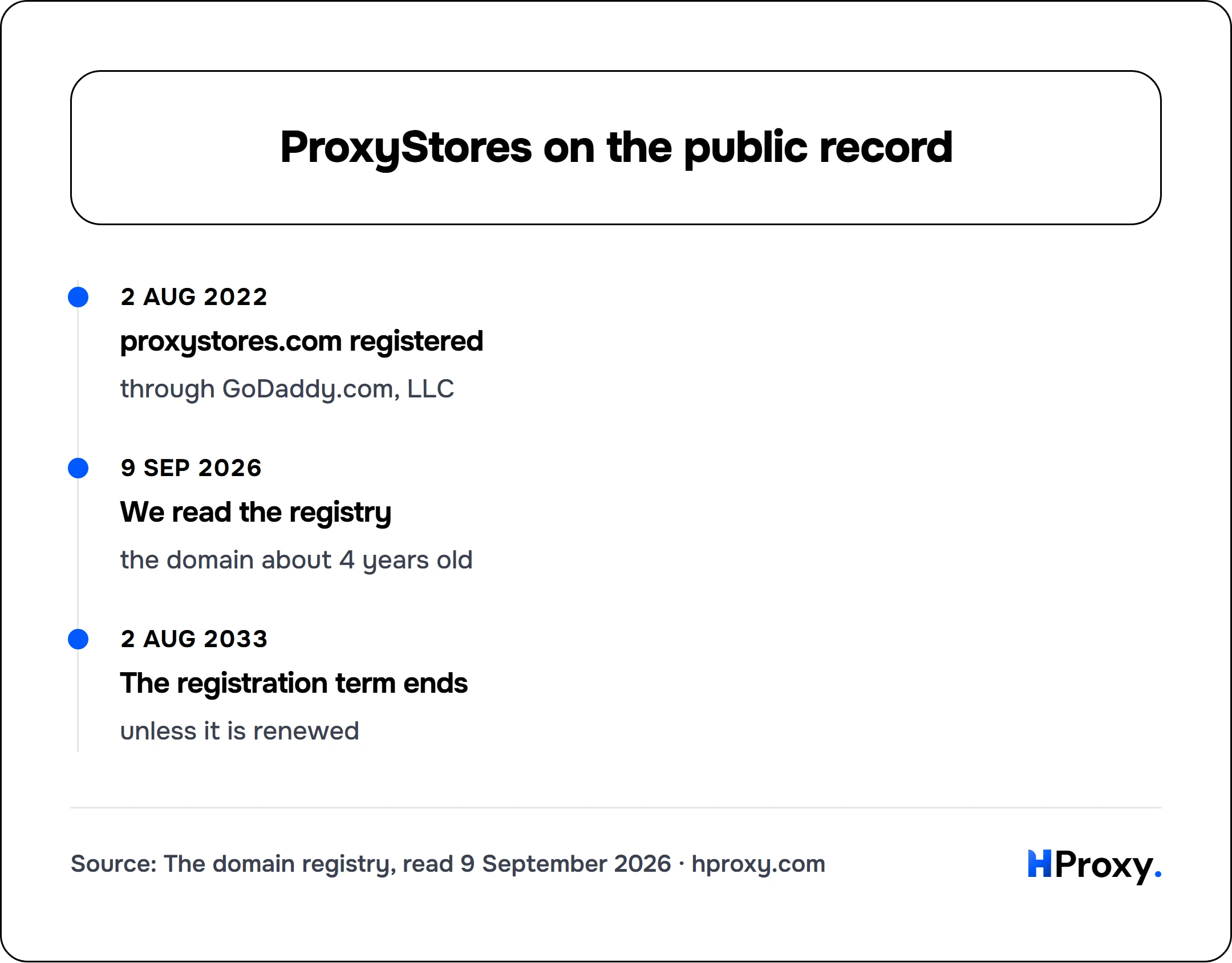
2 Aug 2022
proxystores.com registered
through GoDaddy.com, LLC
9 Sep 2026
We read the registry
the domain about 4 years old
2 Aug 2033
The registration term ends
unless it is renewed
Read that as a floor rather than a recommendation. Longevity says somebody has kept paying the registrar, and in a market with this much churn that is worth ten seconds of your attention.
We also track proxystores.ru under the same name. Where a brand runs several domains, check which entity your contract is actually with.
How much site there is
We crawled 595 pages of their site on 19 June 2026 and found 54 blog pages.
That mix tells you how the company sells. Heavy location pages mean a geography-led pitch, heavy blog means a search-led one, and a single pricing page usually means one simple offer or one sales call.
Where published figures stop being useful
What happens when it breaks at two in the morning
Support quality is invisible until it is the only thing that matters. A cheap provider that takes three days to answer a routing problem has cost you more than the saving, and no pricing page reveals that.
Why a cheap address is often a used one
An address you share carries the reputation of everyone else on it. That is acceptable for some work and fatal for anything involving a login. The price difference between shared and dedicated usually reflects exactly this.
Who pays for the requests that fail
Divide the spend by the successful responses, not by the requests sent. That single change reorders most price comparisons in this market, and your accounting will use it eventually anyway.
A comparison that admits what it cannot say
This is the shortest table that still decides the purchase:
| Question to ask | ProxyStores | HProxy |
|---|---|---|
| Entry price | Not verified by us, read their page | From $0.44/GB, pay as you go |
| Does unused balance expire? | On their own terms page | Never |
| Minimum commitment | Read their current terms | None |
| Identity checks | Worth confirming in writing before you commit | Card orders are screened, and verification is sometimes requested |
| Targeting | Their terms page answers this | Country, city and ISP |
| Free way to evaluate | Check the current terms, this one moves | Free proxy list and proxy checker |
Blanks in that table are deliberate. We print what we read and date it, and leave the rest empty rather than repeating something we cannot stand behind.
A test worth more than this comparison
Do this once and you will never need a comparison page for this decision again.
- Buy the minimum each side offers. Prefer a small paid batch over a trial, because trial traffic does not always ride the same pool.
- Send an identical workload through each: same target, same tooling, same time of day, same request mix.
- Measure what came back correctly and what it consumed, then divide the spend by the successes.
- Push a sample of exit addresses through an independent checker and confirm the country and connection type are what was advertised.
- Keep whichever pool won on your job. Re-run this whenever success rate drops or the bill moves.
Who else is in this bracket
The same treatment, applied to the providers most often weighed against this one:
Our side of it
What we offer is one account holding residential, ISP, mobile and datacenter, priced from $0.44 per GB on residential, with no tier to climb and no allocation to lose at month end. Whether that suits you depends on how steady your volume is.