
Most pages titled "MangoProxy alternative" are affiliate lists with the payout order baked in. This one is written by a rival, which is a different bias and an easier one to correct for, because you can check every number we print.
MangoProxy on the record
The company behind the name sits at mangoproxy.com. We carry them as a proxy provider.
A price is missing here on purpose. We have not captured a sourced rate for MangoProxy recently enough to publish one, and a stale number in this market is a wrong number.
Copy down the entry rate, the commitment attached to the cheapest rate, the minimum top-up and the expiry rule. Those four turn a marketing figure into something you can compare.
What MangoProxy says about itself today
On 9 September 2026 their homepage carried the title "Buy Fast and Secure Proxies & API Scraper - MangoProxy".
Also on the page, stated plainly:
The product lines named on that page are residential, datacenter, ISP or static residential, mobile and SOCKS5. They advertise 200 countries or locations. Payment methods mentioned: PayPal and crypto. Support is advertised as around the clock. A refund or money-back term is mentioned.
Every line above is a quotation from their marketing rather than a measurement by us. It is included because it is checkable, not because it is evidence of performance.
What the registration record shows
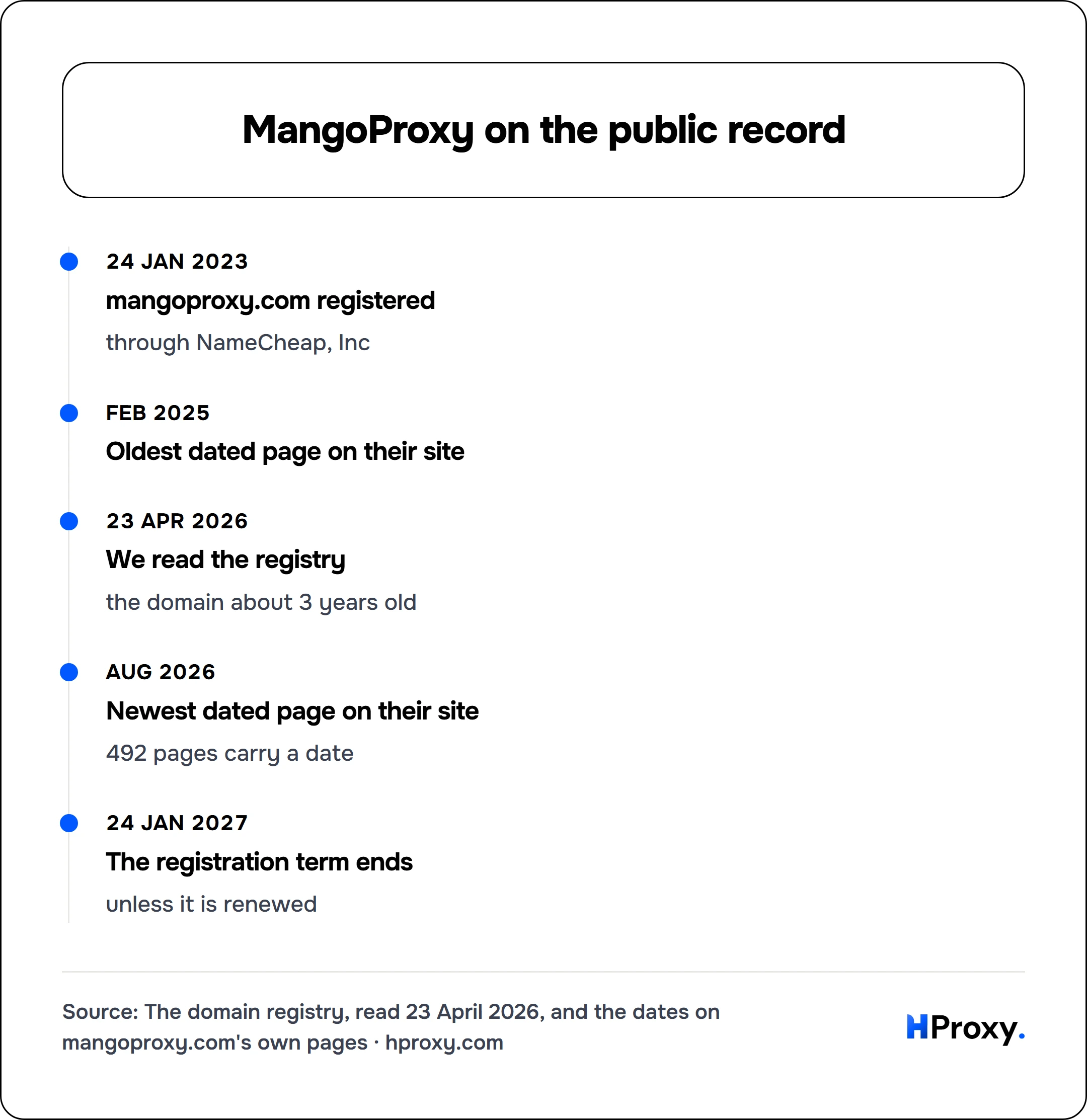
The domain was registered on 24 January 2023, through NameCheap, Inc, which makes it about 3 years old. Those dates come from a registry query on 23 April 2026. Their registration is booked through 24 January 2027.
24 Jan 2023
mangoproxy.com registered
through NameCheap, Inc
Feb 2025
Oldest dated page on their site
23 Apr 2026
We read the registry
the domain about 3 years old
Aug 2026
Newest dated page on their site
492 pages carry a date
24 Jan 2027
The registration term ends
unless it is renewed
Age is not quality. A long registration does not make a network good, and a new one does not make it bad. What it does rule out is the shortest-lived pattern in this market, which is a site that appears, sells, and is gone inside a year.
The shape of their site
A crawl of 531 pages returned 354 blog pages, 104 location pages and 2 integration pages.
Read it as a map of what they emphasise. It is our count, from our crawler, on the date shown, and it is the only figure on this page that neither of us can dispute.
Signs of life
Our crawl of their site found 492 pages carrying a date, 337 of them articles. The oldest is from February 2025 and the newest from August 2026. 484 of them carry a date inside the last twelve months.
Recent dates prove somebody is still at the keyboard. They prove nothing about the network, which is what the test at the end of this page is for.
Where published figures stop being useful
The gap between the headline and the bill
Rates in this market are quoted from the bottom of the table. The relevant question is which row you land on at your volume, and whether reaching a cheaper row costs more in commitment than it saves per unit.
Ask what happens to unused balance
Expiry is the quietest price increase in this market. A plan sized for a busy month is expensive in a slow one, and the difference never appears in any comparison table, including ones written by vendors who benefit from it.
Minimums, contracts and sales calls
Treat a required call with a salesperson as a cost. It delays the work, it usually arrives with an annual term attached, and it exists because the published price is negotiable in one direction only.
A comparison that admits what it cannot say
The table answers what we can answer and marks what we cannot:
| Question to ask | MangoProxy | HProxy |
|---|---|---|
| Entry price | Not verified by us, read their page | From $0.44/GB, pay as you go |
| Does unused balance expire? | On their own terms page | Never |
| Minimum commitment | Their terms page answers this | None |
| Identity checks | Check the current terms, this one moves | Card orders are screened, and verification is sometimes requested |
| Targeting | Their terms page answers this | Country, city and ISP |
| Free way to evaluate | Worth confirming in writing before you commit | Free proxy list and proxy checker |
We would rather show an incomplete table than a confident wrong one. Anything we could not source is left for you to read at the source, with the date you read it.
The ten minute version of this decision
For a few dollars you can get a verdict specific to your job, which no comparison page can honestly promise you.
- Buy the minimum each side offers. Prefer a small paid batch over a trial, because trial traffic does not always ride the same pool.
- Send an identical workload through each: same target, same tooling, same time of day, same request mix.
- Log successes, failures and gigabytes used. Cost per successful request is the figure you are after.
- Verify a slice of the exits independently. Country labels in this market are self-reported and are not always right.
- Keep whichever pool won on your job. Re-run this whenever success rate drops or the bill moves.
The other names that come up
Other providers in the same bracket, priced and dated the same way:
Where HProxy sits in that test
Our own lane is easy to state. Residential starts at $0.44 per GB with country targeting, the balance is topped up when you want and does not expire, there is no subscription unless the optional discount suits you, and city and ISP targeting come with Residential Premium from $1.00 per GB. If the test above puts us second on your target, buy the winner.