Switching free proxy lists is cheap to try and expensive to get wrong. The cheap part is a small paid test on your own target. The expensive part is choosing on a homepage. This page is about doing the first thing before the second.
What we know about Proxylists, and what we do not
Proxylists trades at proxylists.net. They compete with us as a free proxy list.
We price the providers we can source and date, and Proxylists is not currently one of them. The rest of this page is about what to check when you read their pricing yourself.
Take down four numbers and a date: reachable rate, minimum purchase, commitment for the floor rate, and expiry period. Anything less and you cannot compare them to anyone.
The site, as it reads today
On 9 September 2026 the site introduced itself as "Free Proxy List - Updated Daily with HTTPS, SOCKS4, and SOCKS5 Servers". The one-paragraph pitch on their own page: "Discover our free proxy list, updated daily with reliable HTTPS, SOCKS4, and SOCKS5 servers. Download the latest proxy servers for enhanced internet anonymity!"
Taken from the same page, on the same day:
The product lines named on that page are datacenter and SOCKS5. Payment methods mentioned: cards. The page offers some form of free trial. Their pricing page is titled "404 Not Found".
None of that is verified performance. It is what the vendor chose to publish, recorded with a date so you can see whether it still says the same thing.
How long Proxylists has been trading
The domain was registered on 17 February 2004, through GoDaddy.com, LLC, which makes it about 22 years old. The lookup behind those dates ran on 9 September 2026. As things stand the domain is held to 17 February 2027.
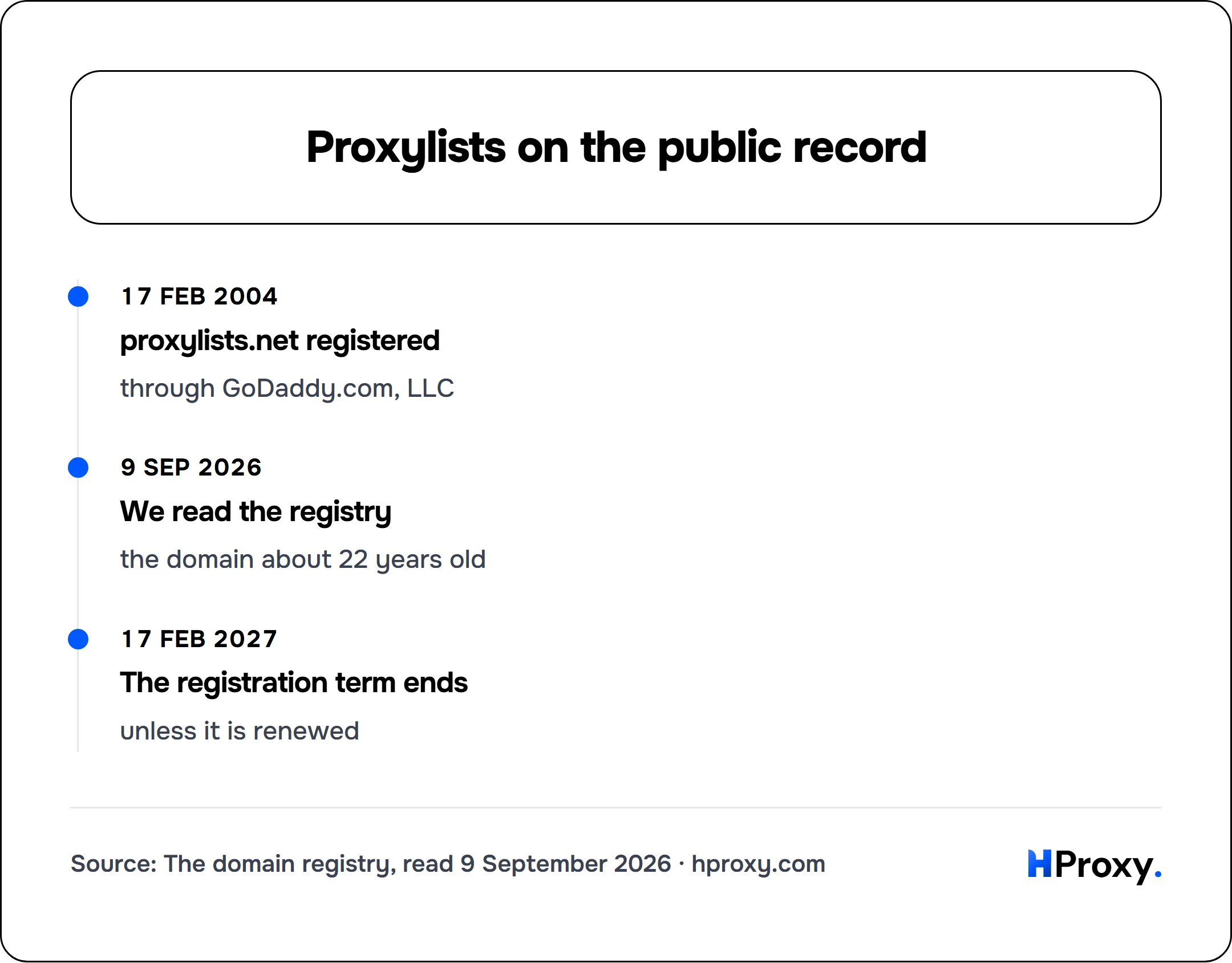
17 Feb 2004
proxylists.net registered
through GoDaddy.com, LLC
9 Sep 2026
We read the registry
the domain about 22 years old
17 Feb 2027
The registration term ends
unless it is renewed
This proves nothing about the product. It is a cheap check against the one failure mode that costs buyers real money in this market, which is paying a provider that will not exist in six months.
Ownership of the list
We checked this one by hand on 6 September 2026. It is a list, and we record the operator as independent.
It appears to be independently operated. That is the better case for neutrality, and it says nothing about whether the addresses work.
The Internet Archive has it from 3 March 2004 to 7 April 2026, about 22 years of coverage. The domain was registered 17 February 2004 through GoDaddy.com, LLC.
Every list in this category has the same underlying problem, which is decay. We measure it on our own network and publish it: 4,023 alive on 2026-08-11, out of 589,918 ever discovered. Those that worked, then stopped, lasted a median 10 days, counting only addresses with fewer than 20 of them, without Amazon's networks or one June evening when our checker failed (measured 2026-09-28). A list is only as good as its last check.
What you still do not know after reading their site
The privacy question worth asking
Anything routing your traffic can read it unless it is encrypted end to end, and can alter anything that is not. Assume the operator sees the metadata and decide whether that is acceptable for the work.
A verdict has a shelf life
Supply changes hands quietly in this industry. The network behind a brand can be replaced with no announcement, which is why a benchmark is a perishable good and a re-test is cheap insurance.
Shared or dedicated changes everything
Ask how many accounts can sit on one address at once. Where the answer is unlimited or unspecified, price the plan as shared regardless of what the product is called.
The two of us, on the questions that matter
Six questions, both answers, and an honest blank where we do not hold a current figure:
| Question to ask | Proxylists | HProxy |
|---|---|---|
| Entry price | Not verified by us, read their page | From $0.44/GB, pay as you go |
| Does unused balance expire? | Not published clearly, ask before paying | Never |
| Minimum commitment | Worth confirming in writing before you commit | None |
| Identity checks | Read their current terms | Card orders are screened, and verification is sometimes requested |
| Targeting | Check the current terms, this one moves | Country, city and ISP |
| Free way to evaluate | Their terms page answers this | Free proxy list and proxy checker |
Six rows is enough. Longer comparison tables in this market are usually padded with features nobody chooses on, which makes them look thorough and read as noise.
The test that beats this page
It is a small amount of money for an answer that is actually about your target.
- Take the smallest paid unit each provider will sell you. A free trial works for a first pass, though trials sometimes ride better pools than paid plans do.
- Fire the same batch through both on one afternoon. Different days are different conditions, and that ruins the comparison.
- Track the success rate and the bandwidth. A cheap gigabyte that fails half the time is not cheap.
- Run a sample of the addresses through an independent lookup, because advertised geography and actual geography differ more often than the market admits.
- Choose on the measurement, not the marketing, and expect the answer to change within a year.
Where else buyers look
If this one does not fit, these are the nearest comparable providers we have written up, each on the same terms as this page.
- FreeProxyList.cc alternatives
- Freeproxylists alternatives
- fyvri/fresh-proxy-list alternatives
- Geonix alternatives
- Geonode (old list host) alternatives
- hideip.me alternatives
Our own position
Residential starts at $0.44 per GB with country targeting, the balance never expires, there is no minimum commitment and no sales call, and city and ISP targeting come with Residential Premium from $1.00 per GB. We publish our free side openly, 129,131,311 verification checks and counting, because a network that is confident has no reason to fear measurement.