Comparison

Geonode (old list host) alternatives: where the lists actually come from

Weighing up Geonode (old list host)? What is actually published, what it does not tell you, and how to settle the decision on your own target for a few dollars.

HProxy Team··4 min read
HProxy.Comparison

Free proxies won't hold up here.

Shared datacenter IPs get flagged and dropped fast. When it has to hold, gaming, streaming, accounts, you need mobile and residential IPs that read as a real device, from $0.44/GB, pay as you go.

See plans & pricing

We compete with Geonode (old list host), so treat every line below as coming from an interested party. What follows is the record we hold, the questions their marketing page does not answer, and a test you can run yourself that outranks this page and every other review.

What is on file for Geonode (old list host)

Their site is proxylist.geonode.com. Category, as we track it: free proxy list.

There is no price in this comparison because we do not have one we can date and attribute. What follows instead is the set of questions that decide the cost once you do read their page.

Take down four numbers and a date: reachable rate, minimum purchase, commitment for the floor rate, and expiry period. Anything less and you cannot compare them to anyone.

The site, as it reads today

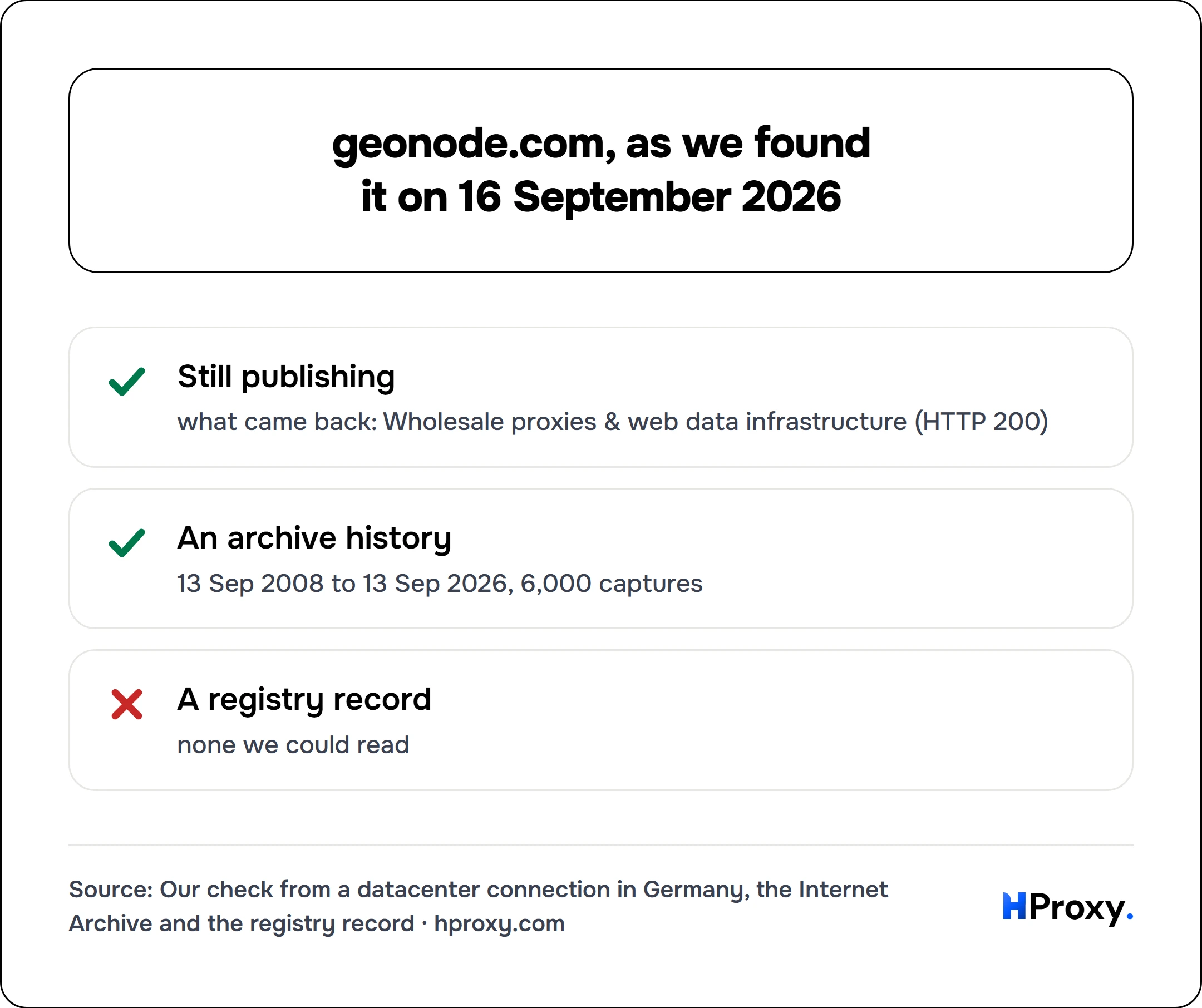
The title tag on 9 September 2026 was "404 Not Found".

Reading the same page for the things buyers actually ask about:

We found no separate pricing page linked from the homepage, which usually means the price arrives by quotation.

Treat all of it as advertising, because it is. Its value is that it is dated and quotable, which is more than most comparison pages offer.

Who actually runs Geonode (old list host)

We checked this one by hand on 6 September 2026. It is a list, and we record the operator as a company that sells proxies. It has been folded into another list rather than shut down, so the name survives as a redirect. Old host of the geonode list, now 404.

This list belongs to a business selling proxies. Read it as marketing that happens to contain data rather than as a neutral survey, in the same way you should read ours.

The Internet Archive has it from 1 October 2022 to 2 April 2023, about 2 years of coverage.

Every list in this category has the same underlying problem, which is decay. We measure it on our own network and publish it: 4023 alive right now out of 589918 ever discovered, median lifespan 145 hours. A list is only as good as its last check.

The questions behind the numbers

Networks age, so re-test quarterly

Supply changes hands quietly in this industry. The network behind a brand can be replaced with no announcement, which is why a benchmark is a perishable good and a re-test is cheap insurance.

Ten million addresses, and none of them yours

Claims of ten million, one hundred million or more say nothing about whether your requests get through this week. Your job meets the handful of exits it draws, in your countries, against one target. Rotation policy and freshness move that outcome far more than the headline total.

Why a cheap address is often a used one

A shared address arrives with a history you did not create and cannot see. For read-only work it rarely matters. For anything that keeps a session, it is the most common cause of unexplained failure.

The comparison, honestly framed

Here are the comparisons that survive contact with a real workload:

Question to askGeonode (old list host)HProxy
Entry priceNot verified by us, read their pageFrom $0.44/GB, pay as you go
Does unused balance expire?Their terms page answers thisNever
Minimum commitmentWorth confirming in writing before you commitNone
Identity checksRead their current termsCard orders are screened, and verification is sometimes requested
TargetingWorth confirming in writing before you commitCountry, city and ISP
Free way to evaluateRead their current termsFree proxy list and proxy checker

Treat the right-hand column as a claim by an interested party, because it is one. Every line in it is checkable on our own pages and in our own terms.

What to do instead of reading more comparisons

The steps below take about ten minutes and settle the question properly.

  1. Fund both accounts with the least money each will accept, and note what that minimum was, because it is part of the comparison.
  2. Aim both at the page that matters to you rather than a test endpoint, and keep every other variable fixed.
  3. Record the success rate and the data consumed for the identical batch on each side.
  4. Check some of the addresses yourself for country, ASN and type before you trust the label on the plan.
  5. Keep the winner, and repeat the whole thing quarterly, because pools age.

The rest of the shortlist

Buyers comparing this name usually have two or three of these open in other tabs:

What we sell, stated plainly

If you want our side of it: $0.44 per GB for residential, pay as you go, nothing expires, and the free tools stay free. We would rather you measured than believed us, which is why the test comes before this paragraph rather than after it.

Frequently asked questions

Is a cheaper provider usually worse?
Not reliably. Price in this market reflects the supply model and the sales overhead as much as the network. What price does not tell you is the success rate on your target, and that is the figure that decides whether the cheaper option was cheap or expensive. Measure before assuming either way.
How is HProxy different?
The models differ more than the products do. HProxy is pay as you go from a balance you top up when you want, the balance does not expire, there is no subscription unless the optional discount suits you, and residential starts at $0.44 per GB with city and ISP targeting included. Whether that beats a tiered plan depends on your usage pattern, which a short test settles.
Do I have to talk to sales or sign a contract to switch?
Not with us. You can sign up, add funds and send traffic without a call, a minimum or a subscription. Whether another provider requires any of those is on their own pricing page and is worth reading, because a required commitment is part of the price even when it is not part of the rate.
How often should I re-test a provider?
Quarterly is a reasonable rhythm for most workloads, and immediately after a noticeable drop in success rate. Pools are rebuilt, suppliers change and detection improves, so a benchmark from last year describes a network that no longer exists.
Does a bigger pool mean better results?
No. Your job meets only the exits it draws, in the countries it needs, against one target's defences. Freshness and rotation policy move the outcome far more than the headline total, and pool totals across this market are counted generously and rarely audited.

Proxies that don't die mid-job

Residential, ISP, datacenter and mobile, verified by the same engine that runs tens of millions of checks. They read as a real device and hold up under load. Pay as you go, and your balance never expires. $0.44/GB is the 2,000 GB+ rate; a single gigabyte is $0.50/GB, with no minimum order.

129M+ proxy checks run · 100+ countries · HTTP / HTTPS / SOCKS · re-checked every few minutes · no signup