Before anything about Proxy Tools: pool totals, uptime badges and country counts predict almost nothing about your result. What predicts it is a measured success rate on your own target, and that measurement costs a few dollars.
The record we hold
The domain is proxy-tools.com.
What we do not hold is a current, sourced price for Proxy Tools. Rather than print a figure we cannot stand behind, this page leaves it out and tells you what to look for when you read their page yourself.
Their pricing page will answer three of the four questions that matter. Send an email for the fourth, which is usually whether blocked requests are billed, and keep the reply.
How Proxy Tools presents itself
Read 9 September 2026, the homepage titles itself "Free lists of checked proxy servers online – Proxy-Tools.com". Their meta description, the sentence Google shows under the link, says: "Free lists of checked proxy servers online. SOCKS, HTTPS and HTTP proxies."
What else that page states, without interpretation:
The product lines named on that page are SOCKS5. We found no separate pricing page linked from the homepage, which usually means the price arrives by quotation.
Every line above is a quotation from their marketing rather than a measurement by us. It is included because it is checkable, not because it is evidence of performance.
What the registration record shows
The domain was registered on 27 February 2021, through Internet Domain Service BS Corp, which makes it about 5 years old. That record was read from the registry on 9 September 2026. The registry shows it renewed to 27 February 2027.
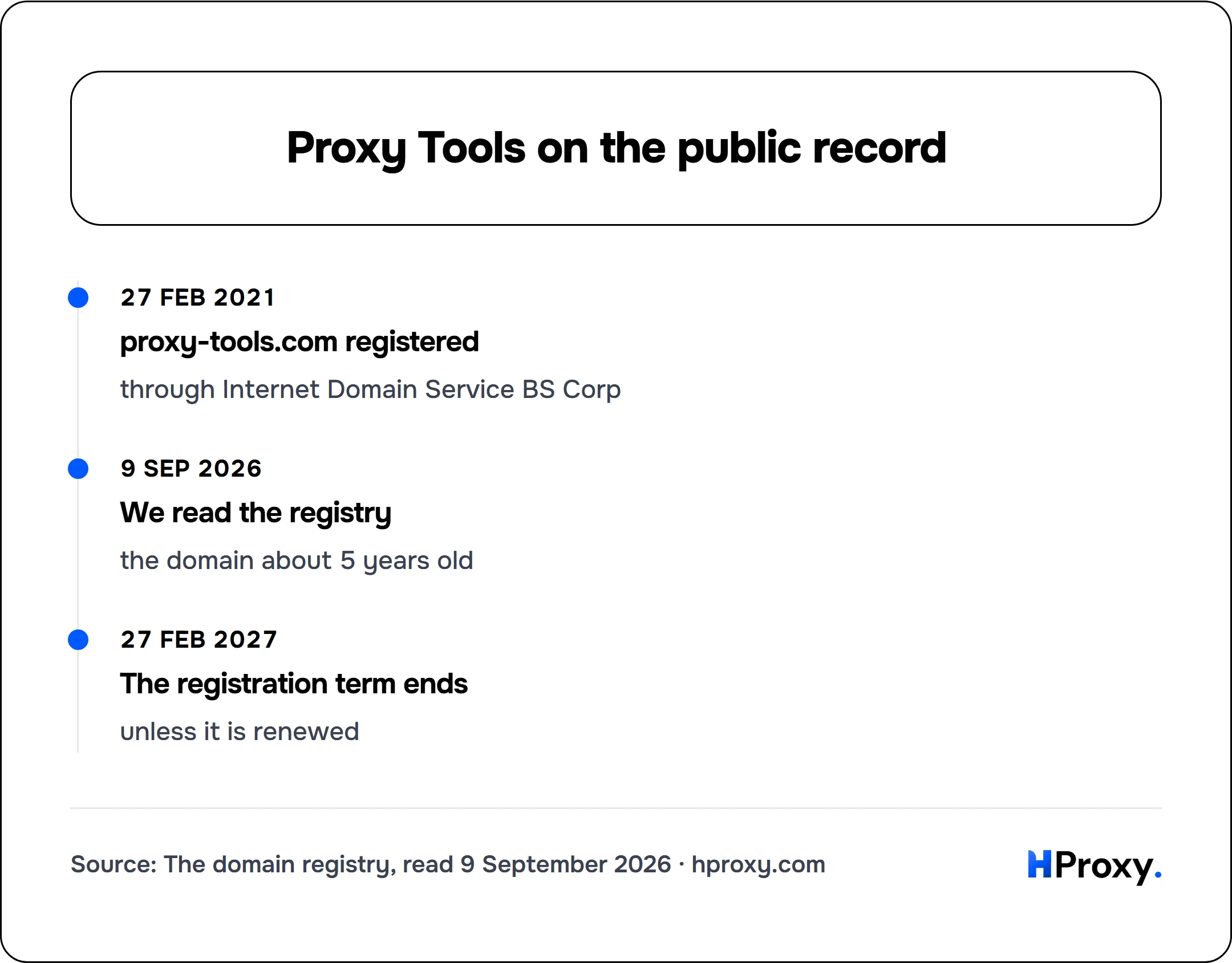
27 Feb 2021
proxy-tools.com registered
through Internet Domain Service BS Corp
9 Sep 2026
We read the registry
the domain about 5 years old
27 Feb 2027
The registration term ends
unless it is renewed
Read that as a floor rather than a recommendation. Longevity says somebody has kept paying the registrar, and in a market with this much churn that is worth ten seconds of your attention.
Where published figures stop being useful
What happens when it breaks at two in the morning
Every provider works when nothing is wrong. The difference shows up on the day a subnet gets flagged or a gateway stops answering. Before committing volume, send one real question through the support channel and time the reply.
Why an old benchmark is wrong
Supply changes hands quietly in this industry. The network behind a brand can be replaced with no announcement, which is why a benchmark is a perishable good and a re-test is cheap insurance.
What actually caps your throughput
A plan with generous traffic and a low thread limit is a slow plan. Find both numbers before you size anything, because the smaller of the two is your actual ceiling.
A comparison that admits what it cannot say
This is the shortest table that still decides the purchase:
| Question to ask | Proxy Tools | HProxy |
|---|---|---|
| Entry price | Not verified by us, read their page | From $0.44/GB, pay as you go |
| Does unused balance expire? | On their own terms page | Never |
| Minimum commitment | Read their current terms | None |
| Identity checks | Worth confirming in writing before you commit | Card orders are screened, and verification is sometimes requested |
| Targeting | Their terms page answers this | Country, city and ISP |
| Free way to evaluate | Check the current terms, this one moves | Free proxy list and proxy checker |
Blanks in that table are deliberate. We print what we read and date it, and leave the rest empty rather than repeating something we cannot stand behind.
How to settle it yourself in ten minutes
Run this before you commit any volume. It replaces every opinion on this page, including ours.
- Buy the minimum each side offers. Prefer a small paid batch over a trial, because trial traffic does not always ride the same pool.
- Send an identical workload through each: same target, same tooling, same time of day, same request mix.
- Measure what came back correctly and what it consumed, then divide the spend by the successes.
- Push a sample of exit addresses through an independent checker and confirm the country and connection type are what was advertised.
- Keep whichever pool won on your job. Re-run this whenever success rate drops or the bill moves.
Others in this market
Nearest alternatives by product shape rather than by who pays us, since nobody does:
- Proxystores alternatives
- ProxyStyler alternatives
- ProxySwag alternatives
- ProxyTee alternatives
- Proxyuniverse alternatives
- Proxyup alternatives
Our side of it
What we offer is one account holding residential, ISP, mobile and datacenter, priced from $0.44 per GB on residential, with no tier to climb and no allocation to lose at month end. Whether that suits you depends on how steady your volume is.