ProxySwag is trading at proxyswag.com, and it sells one product: dedicated static residential ISP proxies. They come from the United States, the United Kingdom, Germany and Canada. One proxy costs $2.99 a month on a small monthly order. The price falls to $1.29 for 1,001 to 2,000 proxies on a yearly plan. The operator is Traxler Technologies Private Limited, of Pune, India. The like-for-like prices are in the alternatives table.
Is ProxySwag legit? The record in one table
| what we read on 27 September 2026 | |
|---|---|
| website | proxyswag.com redirects to www.proxyswag.com, which answers normally |
| company | Traxler Technologies Private Limited, incorporated in India |
| company numbers | CIN U62099PN2025PTC238270, GSTIN 27AALCT6048H1ZY |
| address | Bibvewadi, Pune, Maharashtra, India |
| domain | registered 10 April 2023, through Dynadot |
| product | dedicated static residential ISP proxies, in 4 countries |
| governing law | India |
| Trustpilot | a verification wall to our server, and no archived copy |
It is a registered Indian company that publishes its company number, tax number, address and phone number on a legal page. Its 2023 site carried the name Traxler IT Ventures LLP.
What ProxySwag sells, and what it costs
Its FAQ is plain about scope: "At this moment, we only offer ISP Proxies". Each proxy is a fixed address that is "dedicated to you". It comes from a named ISP: Cox Communications, RCN, British Telecommunications, 1&1 Versatel or Rogers Communications. Its United States page lists cities such as New York, Los Angeles, Chicago, Dallas and Miami.
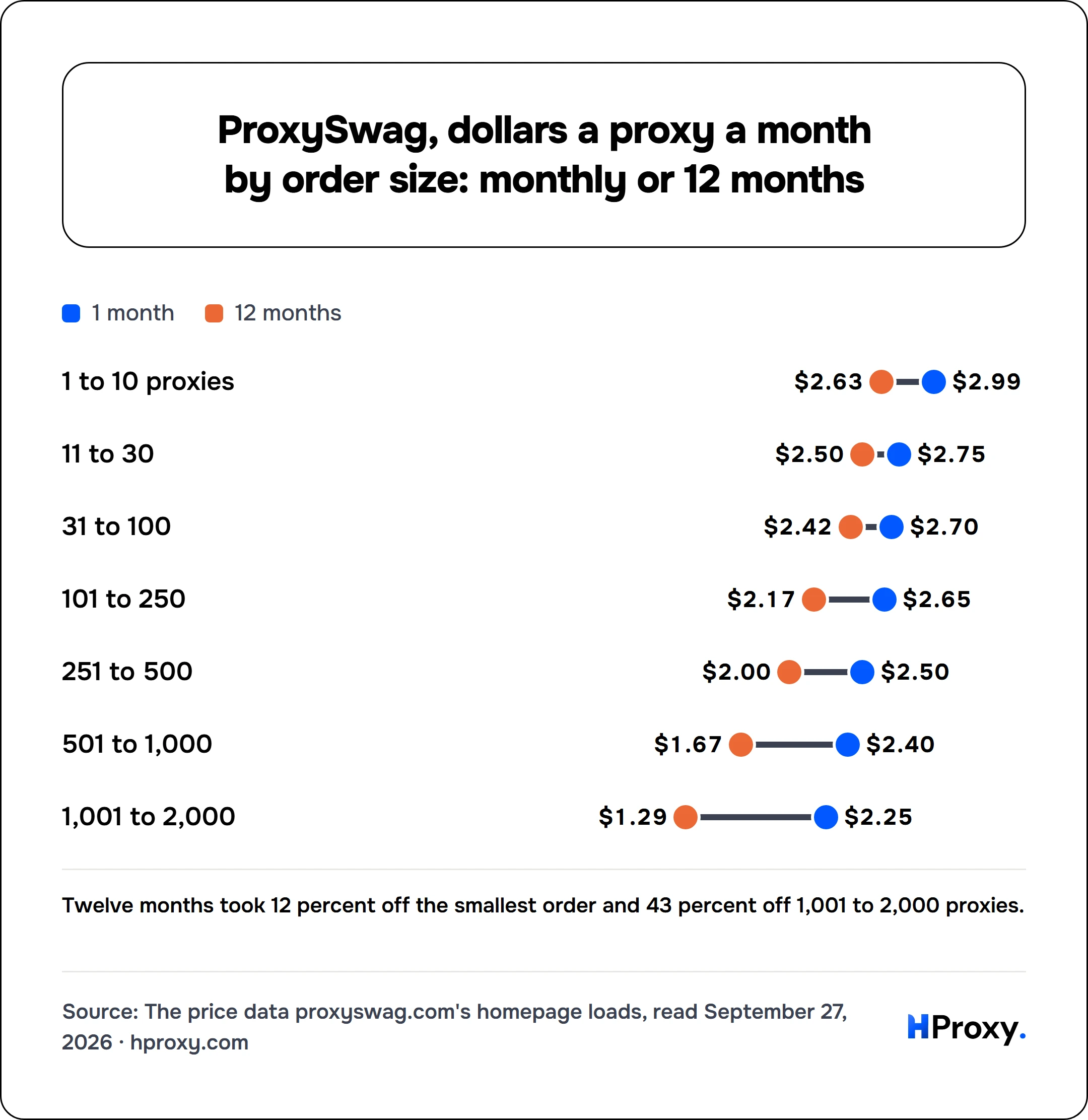
| proxies | 1 month | 3 months | 6 months | 12 months |
|---|---|---|---|---|
| 1 to 10 | $2.99 | $2.80 | $2.71 | $2.63 |
| 11 to 30 | $2.75 | $2.73 | $2.67 | $2.50 |
| 31 to 100 | $2.70 | $2.68 | $2.58 | $2.42 |
| 101 to 250 | $2.65 | $2.63 | $2.55 | $2.17 |
| 251 to 500 | $2.50 | $2.40 | $2.38 | $2.00 |
| 501 to 1,000 | $2.40 | $2.33 | $2.25 | $1.67 |
| 1,001 to 2,000 | $2.25 | $2.17 | $1.88 | $1.29 |
- 1 month
- 12 months
Source: the price data its homepage loads, read 27 September 2026. Prices are per proxy per month, in US dollars, and the calculator stops at "2000 and above".
Every plan includes "Unmetered bandwidth", "Upto 100 threads" and API access. A summary file it publishes for AI assistants names cards, bank transfers and cryptocurrency as payment. It also mentions 1-day and 3-day plans for testing.
The fine print that decides the cost
Refunds are the exception. The refund policy, updated on 14 October 2025, says "cancellations are not accepted". It refunds in full when an order is not delivered within 8 hours, if you ask within 24 hours. Static and ISP proxies are "usually not refundable". The FAQ also promises a refund when the proxies do not work and no replacement can be found.
An old offer on the page. The homepage still shows a 33% cashback offer "Valid till 28th February 2026". Ask before you count on it.
Logs of the sites you visit. Its fair usage policy says it logs the websites a customer visits through the service. The logs are kept "for approximately 60 days".
Protocols differ by page. The plan box lists "HTTP, SOCKS4 and SOCKS5", while the FAQ names HTTP and SOCKS5.
Indian law. The terms, updated on 25 September 2025, are "governed by the laws of the India".
Where the IPs come from
ProxySwag says its US addresses are "issued by legitimate American internet service providers". Its FAQ adds that it is not a reseller and runs its own proxy infrastructure. Its 2023 site sold two kinds of address: static residential IPs "announced on residential ISP" and native ISP IPs owned by a Tier 1 ISP. It warned then that the first kind could be detected as datacenter IPs.
A June 2026 post by its founder explains how each address is locked to one customer at a time in its database. We cannot inspect that system from outside.
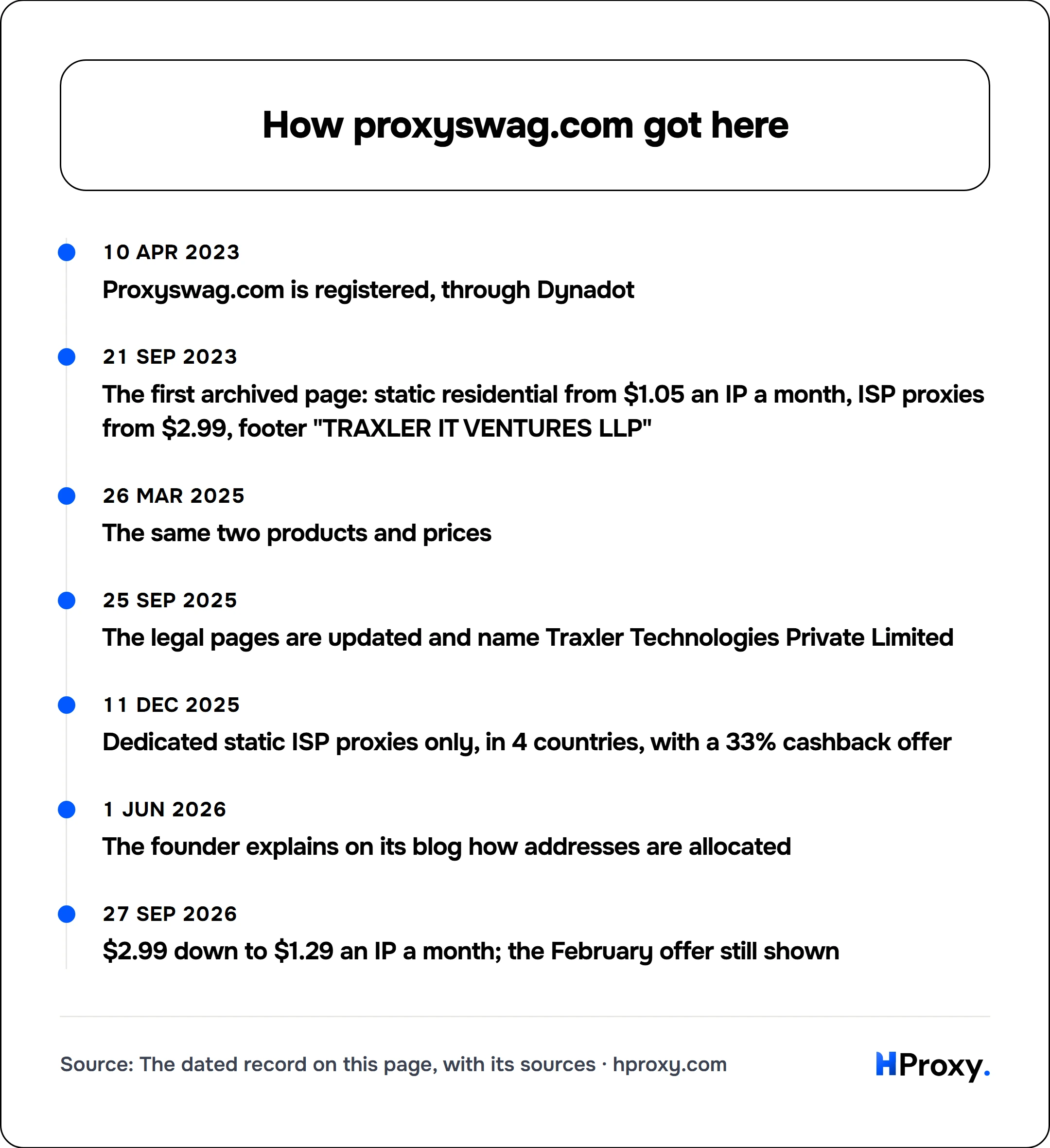
How proxyswag.com got here
| date | what the record shows |
|---|---|
| 10 April 2023 | proxyswag.com is registered, through Dynadot |
| 21 September 2023 | the first archived page: static residential from $1.05 an IP a month, ISP proxies from $2.99, footer "TRAXLER IT VENTURES LLP" |
| 26 March 2025 | the same two products and prices |
| 25 September 2025 | the legal pages are updated and name Traxler Technologies Private Limited |
| 11 December 2025 | dedicated static ISP proxies only, in 4 countries, with a 33% cashback offer |
| 1 June 2026 | the founder explains on its blog how addresses are allocated |
| 27 September 2026 | $2.99 down to $1.29 an IP a month; the February offer still shown |
10 Apr 2023
Proxyswag.com is registered, through Dynadot
21 Sep 2023
The first archived page: static residential from $1.05 an IP a month, ISP proxies from $2.99, footer "TRAXLER IT VENTURES LLP"
26 Mar 2025
The same two products and prices
25 Sep 2025
The legal pages are updated and name Traxler Technologies Private Limited
11 Dec 2025
Dedicated static ISP proxies only, in 4 countries, with a 33% cashback offer
1 Jun 2026
The founder explains on its blog how addresses are allocated
27 Sep 2026
$2.99 down to $1.29 an IP a month; the February offer still shown
Sources: the domain registry, the Internet Archive and its own pages, read 27 September 2026.
What customers say
Trustpilot answered our server with a verification wall. The archive holds no copy, so we give no Trustpilot figure. The homepage shows "4.72" and "Trusted by over 100+ customers" without naming the source of the rating.
ProxySwag alternatives for static ISP proxies
Static ISP proxies are sold per address, so the fair comparison is one address for a month and the smallest order. ProxySwag was read on 27 September 2026, the others on 26 September 2026, each from its own pricing page.
| provider | per IP a month | smallest order | who else uses the address |
|---|---|---|---|
| ProxySwag | $2.99, down to $1.29 at 1,001 or more for a year | 1 address | no one, by its FAQ |
| Wealth Proxies, USA ISPs | $1.50 | 25 addresses | no one, by its documentation |
| Webshare | $0.30 shared, $2.10 dedicated | 20 addresses | shared unless you pay for dedicated |
| Evomi | $1.00 shared, $2.50 private | not stated | graded by how many customers used it |
| Rayobyte | $5.00, falling to $4.60 at 1,000 | 5 addresses | not stated on its pricing page |
| HProxy | $2.70/IP, also by the week or 3 months | 1 address | no one: one dedicated IP |
Our static ISP proxies are one dedicated address each, with unlimited bandwidth, in the countries our live catalog lists. The ISP proxies page has the current countries and periods. Our explainer on ISP proxies covers when a fixed address beats a rotating one.
Where ProxySwag is the better buy
A named ISP and city. You pick the carrier, such as Cox or BT, and a metro area, and the address stays yours for the term.
A low rate on long, large orders. At 1,001 to 2,000 proxies on a 12-month plan, one address costs $1.29 a month.
A published company record. Its legal page gives the company number, tax number, address and phone number.
Where HProxy is the better fit
A week at a time. Our static ISP addresses rent by the week, the month or three months, from one address. The ProxySwag calculator starts at one month.
Rotation in the same account. When a job needs many addresses, the same balance buys residential proxies by the gigabyte. A first gigabyte costs $0.50 per GB on Lite, with country targeting, or $1.49 per GB on Premium, which adds state, city and ISP targeting.
A company in the EU. HProxy is run by Obsidian UG in Herford, Germany, named with its register number in our imprint.
More ways to pay. Our payment options page lists cards, 32 crypto assets and networks, Alipay, Pix and more.
Before you commit
Buy one address for a month at each provider, run your real job through both, and count the requests that came back correct. Our proxy checker shows the country and network of each address before you start.
The limits of this record
We did not buy or test ProxySwag proxies, so nothing here grades speed, uptime or how clean the addresses are. The uptime of "99.9992%" and the pool counts are its own claims. The counts, from 57,599 addresses in the US to 3,583 in Canada, have not changed on its homepage since December 2025.
The prices come from the data its homepage loads, read on 27 September 2026. Its Trustpilot page refused our server. This page is due for a check by 27 December 2026.
Sources
Every source below was read on 27 September 2026, except the pricing pages of the alternatives, read on 26 September 2026.
- ProxySwag: homepage and its price data, about page, legal about page, refund policy (updated 14 October 2025), terms of service, fair usage policy and privacy policy (updated 25 September 2025), United States page, two service pages, two blog posts and its summary file for AI assistants.
- Dynadot record for proxyswag.com, through the Verisign registry.
- Internet Archive, captures of proxyswag.com from 21 September 2023 to 14 May 2026.
- Wealth Proxies, Webshare, Evomi and Rayobyte, static proxy pricing pages.
- HProxy, our own product catalog, ISP proxies page and payment options.