ProxyDB (proxydb.net) is a free proxy list that has published IP and port pairs since 2015, with filters by protocol, anonymity, country, ISP and port, and tools to extract and check addresses. On 14 October 2026 its stats page counted 37,242 proxies in its database, while its default list showed 7,030. More than half of its HTTP proxies were marked "Transparent", the kind that passes your own address on to the site you visit. The site carries no ads and names nobody behind it. For a list we run and re-check ourselves, see our free proxy list.
What ProxyDB lists today
The front page is one long table. Each row gives the address and port, the protocol, the country, the anonymity level, an average uptime, an average response time, a gateway field and the time of the last check. On 14 October 2026 the table read "Showing 1 to 30 of 7030 total proxies", and the rows at the top had been checked "1d ago". Its country filter listed 146 countries, led by China with 2,169 entries, Canada with 896 and Bangladesh with 720.
ProxyDB's database, 14 October 2026
| Line on its stats page | Proxies |
|---|---|
| Total Proxies | 37,242 |
| HTTP, of which Transparent | 22,737, of which 11,940 |
| HTTP, Anonymous | 991 |
| HTTP, High Anonymous | 9,806 |
| HTTPS, High Anonymous | 22,426 |
| SOCKS5, High Anonymous | 9,974 |
proxydb.net/stats, read from our server on 14 October 2026
The anonymity column matters more than the count. A transparent proxy forwards your request but tells the site where it came from, so it hides nothing about you. On ProxyDB's own figures, 11,940 of its 22,737 HTTP proxies were of that kind, 53%. Its HTTPS and SOCKS5 entries were all marked High Anonymous. Our guide to transparent, anonymous and elite proxies explains what each level passes on.
How the database grew
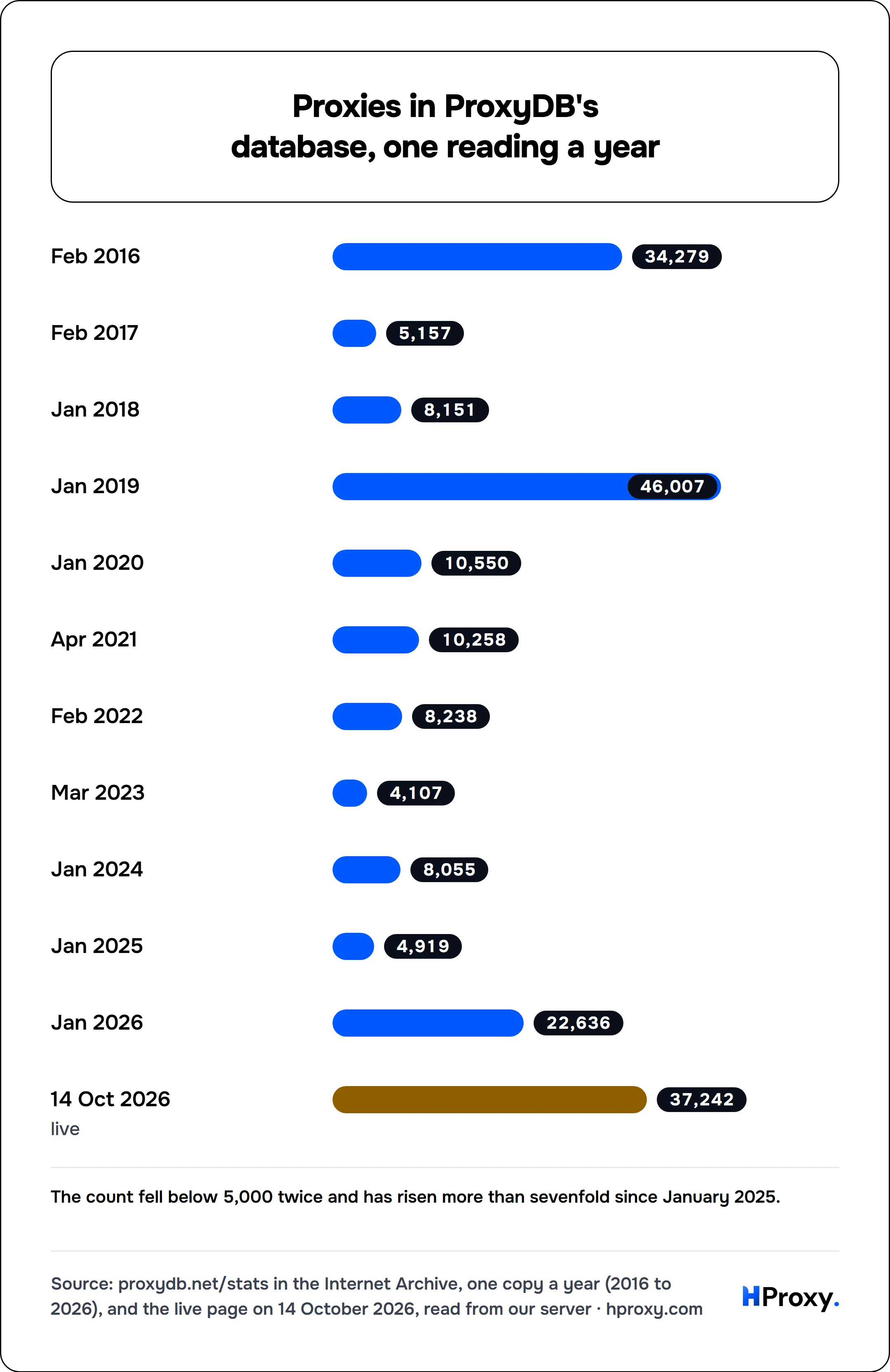
ProxyDB's stats page has been archived about once a month since July 2015, and its total has swung widely. It counted 34,279 proxies in February 2016, 5,157 a year later and 46,007 in January 2019, then fell to 4,107 by March 2023. From 4,919 in January 2025 it climbed to 22,636 a year later and 37,242 on 14 October 2026, more than seven times as many. The page does not say how long an address stays in the count after it stops answering.
The address before the list
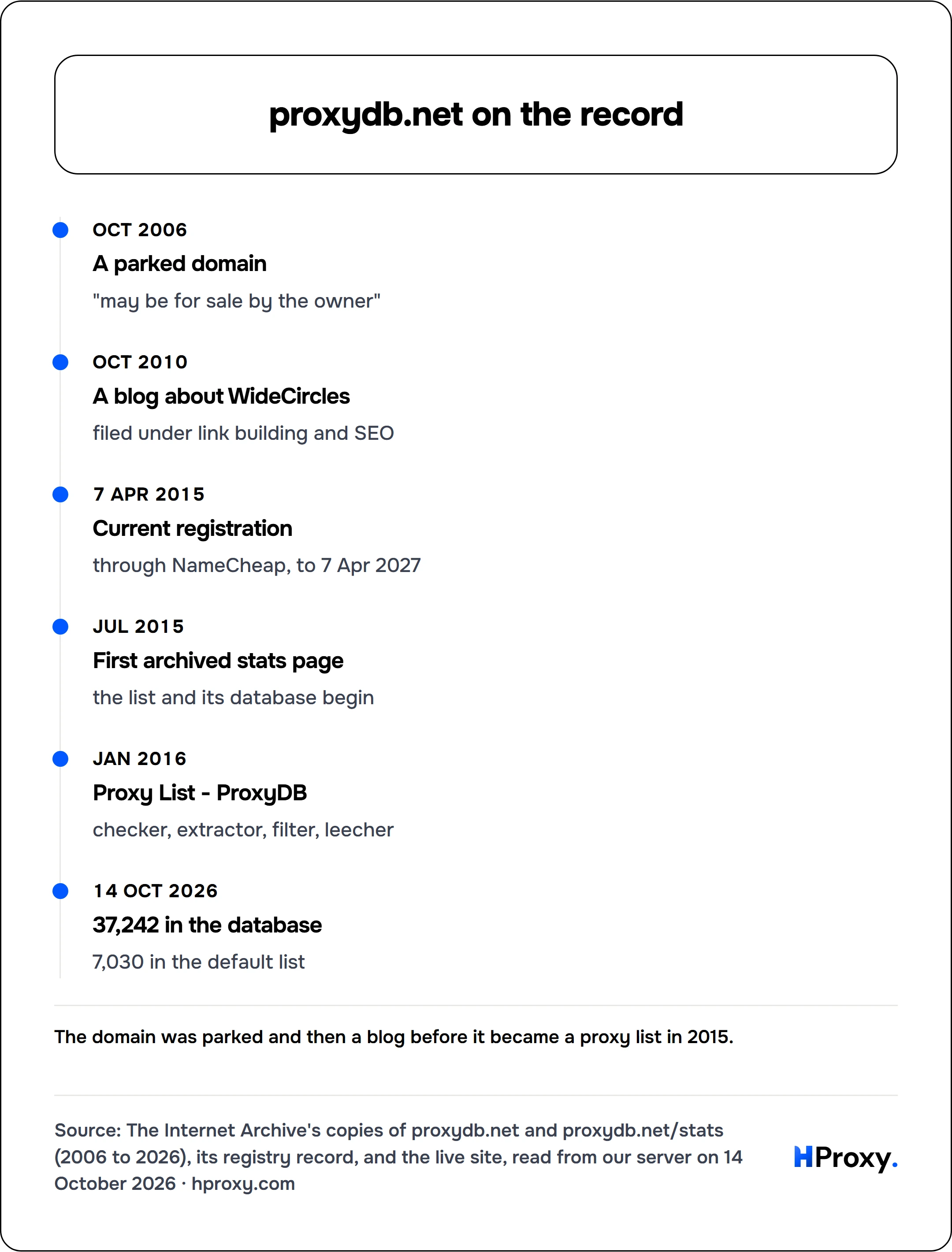
The name is older than the list. In October 2006 proxydb.net was a parked page: "This domain may be for sale by the owner". In October 2010 it held "The Dedicated WideCircles aka Wide Circles Proxy Network Database Blog", filed under link building and SEO. The current registration dates from 7 April 2015, through NameCheap, and runs to 7 April 2027.
The list appears in the archive from 2015. By January 2016 the page read "Proxy List - ProxyDB", with a proxy checker, extractor, filter and leecher, and it graded anonymity in four levels, from "None (Transparent)" to "High (Elite)". In January 2020 the tools had become an extractor, a filter, a scraper, a geo lookup and an anonymity check. In 2026 the menu offers an extractor, a filter, a country lookup, an anonymity check and the database stats.
Oct 2006
A parked domain
"may be for sale by the owner"
Oct 2010
A blog about WideCircles
filed under link building and SEO
7 Apr 2015
Current registration
through NameCheap, to 7 Apr 2027
Jul 2015
First archived stats page
the list and its database begin
Jan 2016
Proxy List - ProxyDB
checker, extractor, filter, leecher
14 Oct 2026
37,242 in the database
7,030 in the default list
Who runs it
No page we read names a person or a company. The site loads no ad scripts and no affiliate links, only its own styles and the country flags, and we found no contact address on its pages; proxydb.net/contact answered "404 page not found" on 14 October 2026. Its registry record names only the registrar. We cannot say who pays for a list kept running for eleven years without ads, sales or a name.
The numbers lists give about themselves
| list | what it says about its size | read on |
|---|---|---|
| ProxyDB | 37,242 in its database, 7,030 in its default list | 14 October 2026 |
| HProxy free list | 72,230 in rotation, 9,451 alive | 5 September 2026 |
Both figures come from each list about itself, and neither can be checked by a reader. Ours is published on our free proxy list with the date it was taken, and every row there shows when it was last checked. For a census of the free list sites still running, see the biggest free proxy lists.
What to use instead
A free proxy is someone else's machine, whatever list it comes from. Use one to see whether a site blocks proxies at all, never for a login or a payment; our page on whether free proxies are safe sets out why. If the job has to finish, come from a country you chose or keep one address, it needs proxies somebody is accountable for. Ours start at $0.44 per GB, pay as you go.
What we could not find out
We did not use or test any proxy from ProxyDB's list, so every figure on this page is one the site gives about itself. We do not know who runs it, how it finds its addresses or how often each one is checked beyond the "Checked" column. Its default list showed 7,030 of the 37,242 in its database, and the page does not say which rule picks them. ProxyDB is due for another look from us by 14 January 2027.
Sources
- proxydb.net: home page and stats page, read from our server on 14 October 2026; proxydb.net/contact and its robots file answered 404.
- proxydb.net and proxydb.net/stats in the Internet Archive: home pages of 2006, 2010, 2016 and 2020, and one stats page a year from 2015 to 2026.
- The registry record of proxydb.net, read on 17 September 2026.
- HProxy's free proxy list page, its figures of 5 September 2026.