There are two honest ways to compare free proxy lists. Read both pricing pages carefully and match the units, or run the same batch through both and count. This page does the first and tells you how to do the second.
What we know about Proxifly (GitHub), and what we do not
Proxifly (GitHub) trades at github.com/proxifly/free-proxy-list. They compete with us as a free proxy list.
We price the providers we can source and date, and Proxifly (GitHub) is not currently one of them. The rest of this page is about what to check when you read their pricing yourself.
Take down four numbers and a date: reachable rate, minimum purchase, commitment for the floor rate, and expiry period. Anything less and you cannot compare them to anyone.
Proxifly (GitHub) in its own words
On 9 September 2026 the site introduced itself as "GitHub - proxifly/free-proxy-list: 🚀 Free HTTP, SOCKS4, and SOCKS5 proxy list * Updated every 5 minutes * and rotating proxy API (100+ countries) · GitHub". Their own summary of the product runs: "🚀 Free HTTP, SOCKS4, and SOCKS5 proxy list * Updated every 5 minutes * and rotating proxy API (100+ countries) - proxifly/free-proxy-list"
Taken from the same page, on the same day:
The product lines named on that page are SOCKS5. They advertise 100 countries or locations. Support is advertised as around the clock. Their pricing page is titled "Pricing · Plans for every developer · GitHub".
None of that is verified performance. It is what the vendor chose to publish, recorded with a date so you can see whether it still says the same thing.
Age, and why it matters here
The domain was registered on 9 October 2007, through MarkMonitor Inc, which makes it about 18 years old. The lookup behind those dates ran on 9 September 2026. As things stand the domain is held to 9 October 2028.
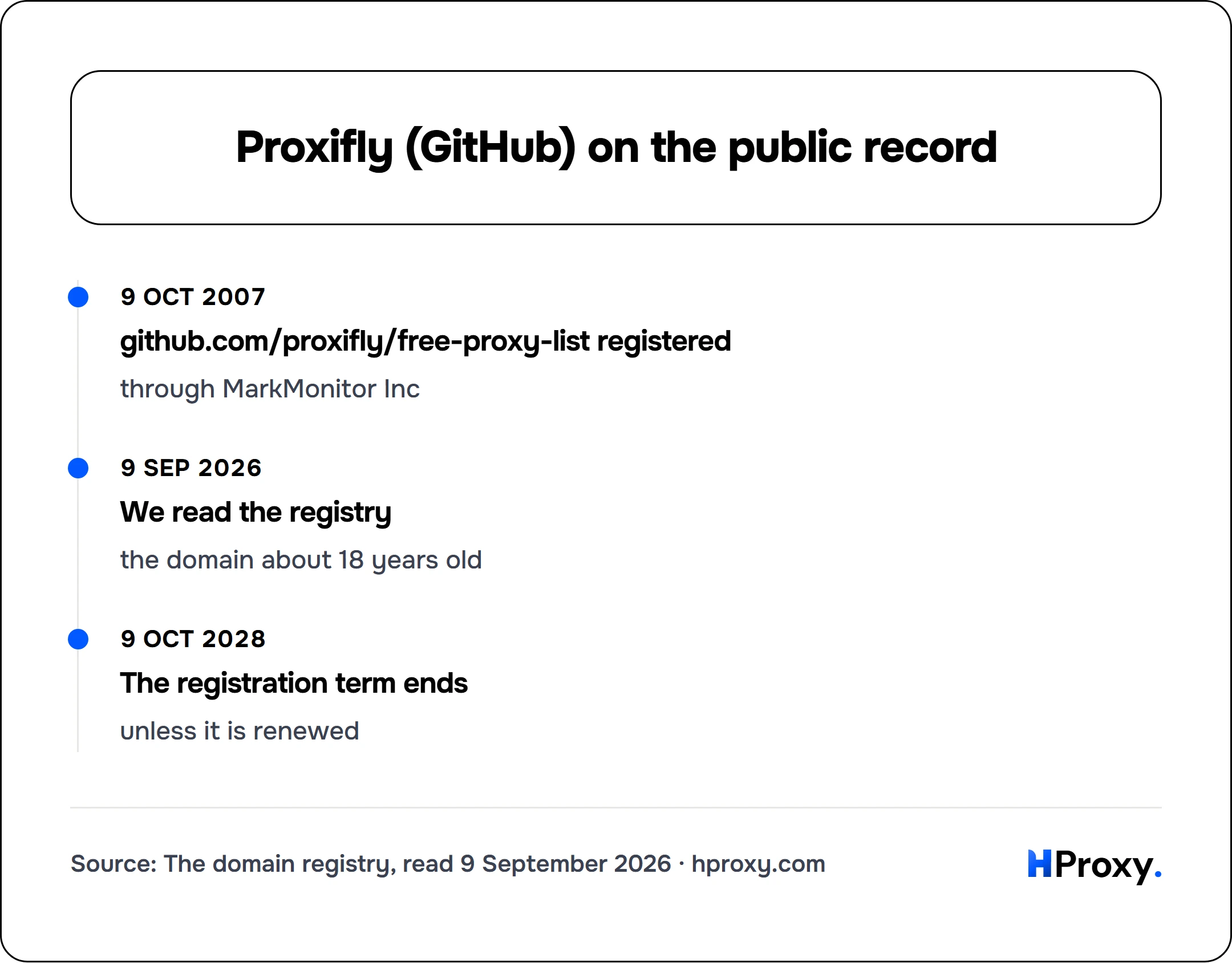
9 Oct 2007
github.com/proxifly/free-proxy-list registered
through MarkMonitor Inc
9 Sep 2026
We read the registry
the domain about 18 years old
9 Oct 2028
The registration term ends
unless it is renewed
This proves nothing about the product. It is a cheap check against the one failure mode that costs buyers real money in this market, which is paying a provider that will not exist in six months.
Who actually runs Proxifly (GitHub)
We checked this one by hand on 6 September 2026. It is a repository, and we record the operator as github. Evidence recorded: 6,700 stars, pushed 2026-09-06. Ranks #11 for "free proxy list" (DE results).
It is a public repository rather than a business. Repository lists are usually the freshest thing in this category and the least supported: nobody is on call when the scraper behind it stops.
The number that matters, and that no list page prints, is how many entries still work. Ours is public: 589,918 proxies discovered, and 4,023 alive on 2026-08-11. Those that worked, then stopped, lasted a median 10 days, counting only addresses with fewer than 20 of them, without Amazon's networks or one June evening when our checker failed (measured 2026-09-28). Apply that decay to any undated list you are reading.
What you still do not know after reading their site
Why an old benchmark is wrong
Every review of this market, this one included, is a photograph of a moving thing. Read the date on any comparison you find, and discount it heavily once it is more than a few months old.
Coverage in the one country you need
Ask for the pool size in your country rather than in total, and expect the answer to be vague. Where it is not published, the ten minute test at the end of this page settles it for a few dollars.
Support is a product feature
Test the support channel before you need it. Ask something specific and technical, and judge both the speed and whether the answer came from somebody who understood the question.
The two of us, on the questions that matter
Set the two side by side on the questions that decide the outcome, rather than on feature counts:
| Question to ask | Proxifly (GitHub) | HProxy |
|---|---|---|
| Entry price | Not verified by us, read their page | From $0.44/GB, pay as you go |
| Does unused balance expire? | Not published clearly, ask before paying | Never |
| Minimum commitment | Worth confirming in writing before you commit | None |
| Identity checks | Read their current terms | Card orders are screened, and verification is sometimes requested |
| Targeting | Worth confirming in writing before you commit | Country, city and ISP |
| Free way to evaluate | Read their current terms | Free proxy list and proxy checker |
Six rows is enough. Longer comparison tables in this market are usually padded with features nobody chooses on, which makes them look thorough and read as noise.
What to do instead of reading more comparisons
The steps below take about ten minutes and settle the question properly.
- Put a few dollars on each account. Trials are fine for a first look, but paid traffic is what you will actually be buying.
- Run them against the site you actually care about, using the code you actually run, within the same hour.
- Record the success rate and the data consumed for the identical batch on each side.
- Check some of the addresses yourself for country, ASN and type before you trust the label on the plan.
- Choose on the measurement, not the marketing, and expect the answer to change within a year.
The rest of the shortlist
Buyers comparing this name usually have two or three of these open in other tabs:
- Proxydb alternatives
- Proxyelite alternatives
- Proxyfish alternatives
- ProxyKingdom alternatives
- Proxylists alternatives
- Proxymist alternatives
What we sell, stated plainly
Our position is narrow. Residential from $0.44 per GB, no subscription, no expiry on the balance, and a public record of what our free network actually does. A provider unwilling to be measured is telling you something, and so is one that asks to be.