Proxies for Pop Mart give every account its own clean, residential-looking IP, so Pop Mart sees a crowd of separate ordinary shoppers instead of one machine firing ten entries at a single Labubu drop. The type that survives is residential: ISP (static residential) IPs for warming accounts and holding a checkout through the online queue, and rotating residential for spreading a run of entries across clean exits.
We run the pools this kind of traffic routes through, so we see what people load up on the night before a blind-box restock and what comes back as a cancelled-order ticket the next morning. This is how proxies for Pop Mart actually work: why people use them, how the online drop actually works, which proxy type fits, how many IPs you need, why region gating matters more here than on most sites, and where a proxy stops helping. No proxy guarantees a cop, and the Labubu resale market is cooling as Pop Mart floods supply, but the wrong proxy guarantees you miss.
What proxies are best for Pop Mart?
Residential and ISP proxies, region-matched to the storefront the drop is on. ISP (static residential) IPs suit account warming and the checkout race, where speed and a consistent address help. Rotating residential is the safer pick for the most hyped restocks and for spreading many entries across clean exits, because Pop Mart scores IP reputation and burns datacenter ranges. Datacenter is cancelled first on protected drops, and free proxies do not last a single restock. One clean IP per account, whatever tier you run.
Why people run proxies for Pop Mart
Almost all of it traces back to how Pop Mart sells. Its whole model is the blind box: a mystery box where you pay for a series but do not know which figure you get until you open it, with a rare "secret" chase variant seeded at long odds. The Labubu line, part of Pop Mart's The Monsters IP, turned that into a global craze, and Pop Mart releases new series and restocks old ones in quantities far below demand. Resale sits well above retail, so people run many accounts to get many shots at a drop, and each account has to look like a different person on a different home connection. That isolation is the core job of proxies for Pop Mart.
The scale is what makes it a target worth automating. Pop Mart's 2025 revenue reached 37.12 billion yuan, about 5.4 billion dollars, up roughly 185 percent year on year, and its The Monsters IP (the Labubu family) brought in 14.16 billion yuan on its own, up 366 percent, the company's first IP to pass 10 billion yuan (Reuters, via Investing.com). On the secondary market the premiums followed: the April "Big Into Energy" plush series resold for an average of about 268 dollars against a 168 dollar retail, close to a 60 percent premium, Pop Mart held the number one spot in StockX collectibles for eight months straight, and a rare first-generation Labubu figure sold for 150,000 dollars at auction (Modern Retail).
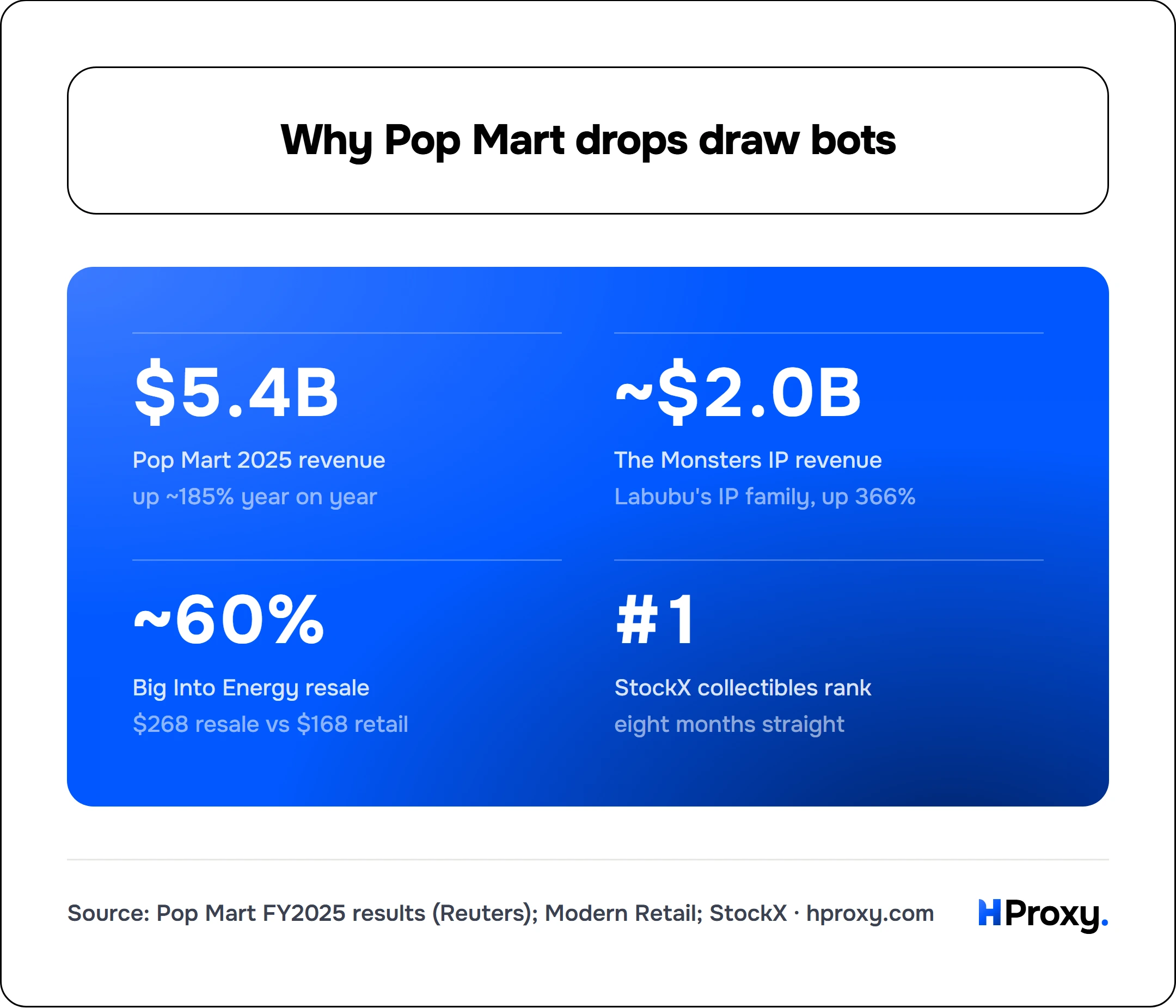
- $5.4B
- Pop Mart 2025 revenue
- ~$2.0B
- The Monsters IP revenue
- ~60%
- Big Into Energy resale
- #1
- StockX collectibles rank
up ~185% year on year
Labubu's IP family, up 366%
$268 resale vs $168 retail
eight months straight
The rest of the reasons are smaller but real:
- Region access. Pop Mart runs separate regional storefronts and its own app, and locks many drops to a country or region. A US release wants a US IP just to show the right catalog and let you buy. This matters more on Pop Mart than on most sites, which we get into below.
- More entries per drop. A blind-box restock is limited stock sold fast, so more believable, independent accounts mean more shots at the pile.
- Not burning your home IP. Hammering Pop Mart's site or app from one address all morning is how that address stops loading it.
How a Pop Mart drop actually works
Pop Mart restocks land on a schedule (frequently a weekly online restock through the official website) and sell out in a matter of seconds (Modern Retail). On the most hyped drops Pop Mart puts buyers through a virtual waiting room, the same kind of holding page adidas and other high-demand retailers use to keep the site from collapsing and to meter who gets in. Two features of that flow decide which proxy you need.
First, you have to hold one IP for the whole session. A waiting room parks you on a page, then admits you in a window (our guide on getting through a waiting room covers the mechanics). If your IP rotates or dies while you are in line, you lose your place and start over, usually after the stock is gone. That is exactly how free and low-quality proxies fail here even when they briefly connect.
Second, the buy is closer to a lottery than a pure speed race. Stock is tiny, the crowd is huge, and getting admitted to the store does not reserve a box for you. This is the same mechanical reason no proxy can promise a cop: the part that decides whether you get one, being admitted while stock still exists, is not something an IP controls. A proxy makes your entries look like separate real shoppers so they all get a fair shot at the queue. It does not move you up the line.
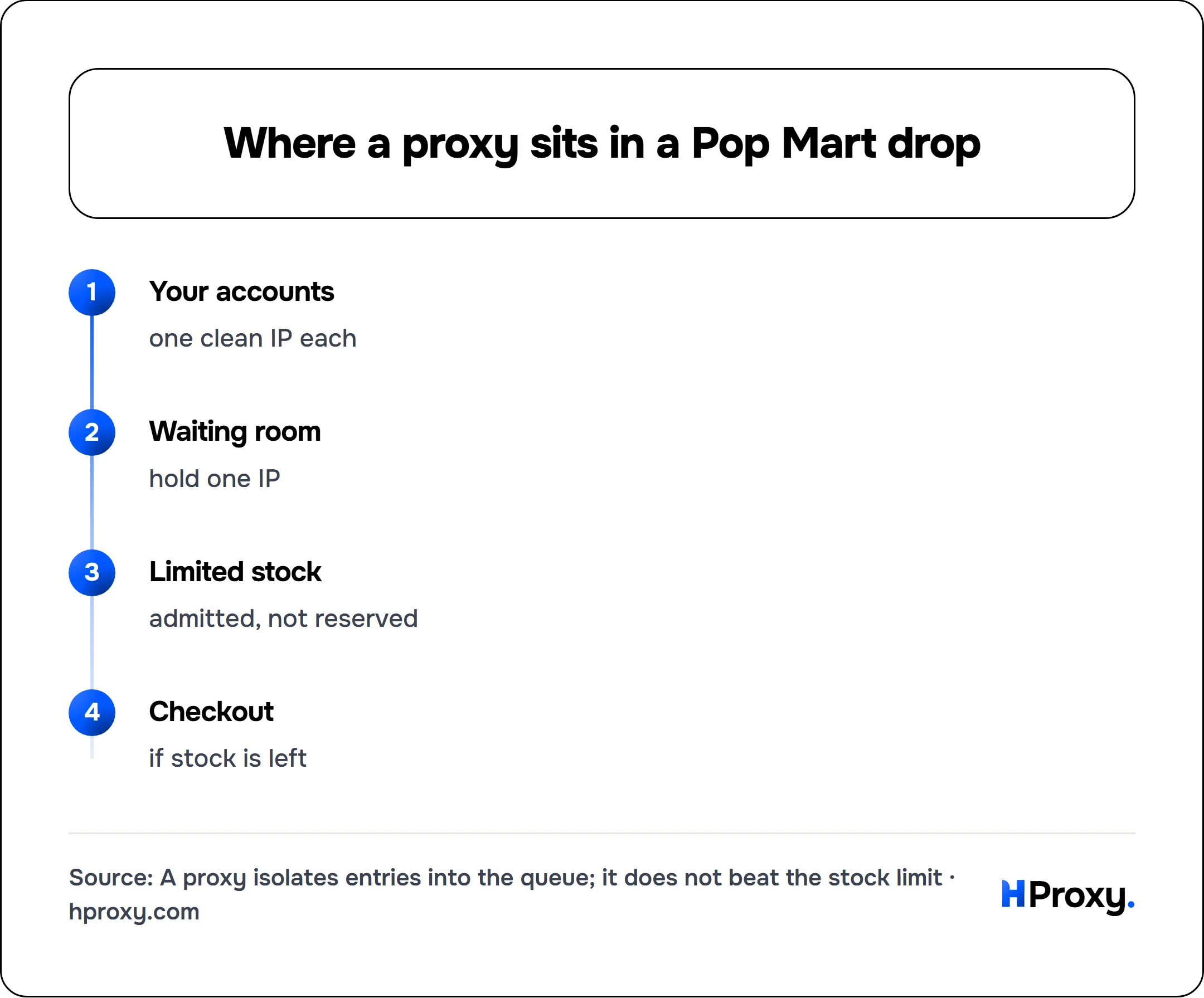
Your accounts
one clean IP each
Waiting room
hold one IP
Limited stock
admitted, not reserved
Checkout
if stock is left
A proxy solves one problem in that chain: it makes the IP read as a real home connection and keeps your accounts isolated from each other. It does nothing about the stock limit, a purchase cap tied to your account and payment, or a device fingerprint, which is why proxies are necessary for Pop Mart but never sufficient on their own.
Which proxy type fits Pop Mart
Four types show up in copping setups, and the most expensive is not always the right call. For the full background on the residential tier, our guide to what a residential proxy is covers it in plain terms.
Datacenter proxies come from hosting providers. They are the fastest and cheapest option, and on a lightly defended store that speed wins checkouts. On a protected Pop Mart drop it is the wrong tool: the reputation layer reads the hosting range and distrusts it, and its orders are first to be cancelled. Skip datacenter for anything that touches a real restock.
ISP proxies are static residential IPs: an address registered under a consumer internet service provider (ISP), so it reads as a genuine home connection, but hosted on datacenter-grade hardware so it stays fast and always on. For Pop Mart this is the warming-and-checkout tier. Because the IP is static, one trusted address can carry an account through days of ordinary use and then sit under it on drop day, and the low latency helps you move through the queue and checkout. ISP proxies are the sweet spot when you need speed and a consistent identity.
Rotating residential proxies draw from a large pool of real home connections, handing out a different IP per request or per short sticky window. They are the most believable to a reputation system and the easiest way to spread a large run of entries across many clean exits. The tradeoffs are the usual ones: real home lines are slower than ISP, and they bill per gigabyte, though blind-box traffic is mostly small text and images so the bandwidth cost stays low. Rotating residential is the reserve tier for the hardest drops and for running many accounts wide.
Mobile proxies are carrier IPs shared by many real handsets, the heavyweight tier for the most defended situations. They carry the strongest trust because blocking one risks blocking real customers behind the same carrier. Most Pop Mart setups never need mobile proxies, but they exist for when nothing else survives.
| Proxy type | IP source | Survives a hyped Pop Mart drop | Speed | Billing | Best Pop Mart job |
|---|---|---|---|---|---|
| Datacenter | Hosting provider | No, distrusted and cancelled first | Fastest | Per IP | Light checks on unprotected pages only |
| ISP (static residential) | Consumer ISP, datacenter-hosted | Often, if the pool is clean | Fast | Per IP | Account warming, checkout race |
| Rotating residential | Real home connections | Yes, best reputation | Moderate | Per GB | Spreading many entries, monitoring |
| Mobile | Cellular carrier | Yes, strongest trust | Moderate | Per GB | Fallback when residential gets flagged |
The rule the table encodes saves the most money: run the cheapest tier Pop Mart will tolerate for the job, and step up only when entries fail or orders get cancelled. Reaching for mobile where ISP would have held is just burning budget.
How many IPs you actually need for Pop Mart
Size your order from accounts, not from a number that sounds impressive.
Pop Mart link-bans, so the unit that matters is one account or one entry, and the safe default is one clean IP per unit. Two entries sharing an address is exactly the pattern that gets a cluster of orders cancelled together. Because a drop is limited stock sold fast, more independent, believable accounts mean more shots, which pushes the IP count up.
Sizing (one clean IP per Pop Mart account or entry):
  proxies needed  =  number of accounts you run
  10 accounts chasing one drop  ->  ~10 IPs + a couple spare

Assign one clean, region-matched IP per account:
  account A  ->  US residential exit 1
  account B  ->  US residential exit 2
  account C  ->  US residential exit 3
For rotating residential the counting changes: you buy bandwidth through a pool rather than named IPs, so you size by gigabytes and let sticky sessions hold one exit per entry. Either way, buy for the drop you are actually running. Our pricing is $0.50 per GB, pay as you go, with no know-your-customer identity check and a balance that never expires, so stocking up for a Thursday restock costs nothing on a quiet week.
Region gating and the China question
This is where Pop Mart differs from a plain sneaker site, and it is worth its own section.
Pop Mart is a Chinese company that expanded outward, so it runs distinct regional storefronts plus its app, and stock, pricing, and release timing differ by region. Some series appear in one market before another, and a drop can be locked to a country. That has two consequences for your IPs. Your proxy region has to match the storefront you are buying from, and it has to line up with the account's shipping and billing region, because a US-shipping account arriving on a US drop from a non-US IP reads as fraud and gets flagged. The scramble to find region-specific listings is real enough that shoppers reverse-engineer Pop Mart's URL structure to reach new listings before they are public (Modern Retail).
The practical rule: pick the storefront you can actually receive shipping from, then run region-matched residential IPs for that market, and do not mix a US account with an EU exit or the reverse. If you are only checking whether a regional page loads and shows the right catalog, our free proxy list spans 100-plus countries and is fine for that. For the drop itself, the IP region is part of your identity, not a setting to leave on default.
Sticky versus rotating for Pop Mart
Both, for different jobs, and the waiting room makes the sticky part longer than on a plain checkout.
Use a sticky session for the entire entry, and set the session length long enough to outlast the waiting room plus checkout, not just a quick add-to-cart. Dropping your IP mid-queue kicks you out, so the same address has to carry that account from the holding page through payment. Our explainer on sticky versus rotating sessions covers how to set the window.
Use rotating IPs to give each account its own clean exit and to spread any monitoring you run across the catalog. The Pop Mart pattern is rotating residential across accounts, each pinned to a sticky window long enough to survive the queue, so the actual buy holds still on one address.
The free versus paid reality for Pop Mart
The free-proxy question deserves a straight answer: they do not work for a real Pop Mart drop, and it is not close.
Most free proxies are datacenter IPs that die within minutes, and only a small fraction of any public list works at once. That is fatal here for two reasons: Pop Mart's reputation layer flags datacenter ranges, and a proxy that survives two minutes cannot hold a waiting-room session that runs longer. There is also the safety question of routing a Pop Mart login through a stranger's server, which we cover in are free proxies safe: a free proxy operator can read unencrypted traffic, so logging into an account you care about through an unknown host is a real risk.
Where free proxies earn a place is testing and light checks. To confirm a regional Pop Mart page loads and shows the right catalog from a given country, our free proxy list re-checks and refreshes every few minutes, spans 100-plus countries, and covers HTTP, HTTPS, SOCKS4, and SOCKS5. Pair it with our free proxy checker to see the real exit location before you rely on it. For the drop itself, paid residential is what actually works, and ours starts at $0.50 per GB, pay as you go, with no documents at an ordinary checkout.
Setting up and avoiding cancellations
The Pop Mart-specific habits that keep clean IPs clean:
- Match the region to the storefront and the account. The proxy country, the account's region, and the shipping and billing address should all agree. A mismatch either shows the wrong catalog or reads as fraud.
- Warm accounts on a stable ISP IP. Log in, browse, add to cart, maybe buy something ordinary, all from one consistent address over days, so by drop day the account and IP look aged instead of freshly minted. This is where static ISP proxies earn their keep.
- One clean IP per account, always. The fastest route to a mass cancellation is two entries sharing an address.
- Set the sticky window to outlast the waiting room. A session that expires while you are still in line is a wasted entry.
- Do not machine-gun the drop. Hammering refresh does not move you up a metered queue, it just flags the session. Pace like an anxious human, not a metronome. The request-hygiene checklist in our guide to avoiding IP bans applies directly.
- Test before the drop. Proxies bought an hour before and never checked are how people watch a restock fail live. Verify they are alive and exiting in the right region well ahead with our free proxy checker.
The part proxies do not solve
A proxy is one input, not the whole machine. The best residential IPs will not save an account Pop Mart already distrusts, a payment profile that keeps declining, a device fingerprint that screams automation, or a limited drop where the stock simply ran out before your turn. Proxies for Pop Mart solve one problem, IP reputation and isolation, and they solve it well. The rest is on the rest of your setup.
Two points worth stating plainly. First, running many accounts to buy limited stock cuts against Pop Mart's terms of sale, which is part of why orders get cancelled in review even when checkout succeeds. A proxy changes your network signal, not the rules you are operating under. Second, the resale economics are not what they were. Pop Mart has ramped production hard to meet demand, resale premiums on Labubu have cooled, and its own shares fell more than 22 percent in March 2026 on worries that the Labubu boom is peaking (CNBC). A proxy does not touch any of that. It makes sure your setup gets a fair shot at the drop, not that the flip is worth it.
What good proxies do is give your setup that fair shot: your entries look like separate, legitimate, region-correct shoppers instead of one bot wearing ten hats. For testing and light checks, start with our free proxy list and checker. For the drop that matters, run ISP proxies for the checkout race and residential proxies at $0.50 per GB, pay as you go, with no expiring balance. Match the region, one clean IP per account, a sticky window that outlasts the queue, and test before the drop, then let the rest of your setup do its job.
Sources
- Reuters (via Investing.com), Pop Mart 2025 revenue 37.12 billion yuan and The Monsters IP 14.16 billion yuan: investing.com
- Modern Retail, on Labubu drop mechanics, weekly restocks selling out in seconds, resale premiums and StockX ranking: modernretail.co
- CNBC, Pop Mart shares fall more than 22 percent on Labubu sustainability concerns: cnbc.com
- CNBC, Pop Mart welcomes falling Labubu resale prices as it ramps production: cnbc.com