IPMars is gone. The registry record for ipmars.com, last changed on 28 January 2026, shows the status "client hold" and a name server called "BLOCKEDFORABUSE" at pleasecontactsupport.com. On 27 September 2026 the name still did not resolve, and its last archived pages date from mid-January. Until then it sold proxies under the name MarsProxy: rotating residential from $0.77 a GB, residential SOCKS5 from $0.045 an IP, and static and datacenter IPs by the month. Its dashboard lived on the same domain. The alternatives table prices five sellers of the same products, read on 27 September 2026.
The record, with dates
| date | what happened |
|---|---|
| 28 December 2022 | The current registration of ipmars.com begins, at NameCheap. |
| March 2023 | First archived page, as HTTPMars: residential IPs from $0.06 each, and a free trial. |
| March 2024 | The legal pages carry the name MarsProxy. |
| November 2025 to January 2026 | The last archived price lists. |
| 14 to 16 January 2026 | The last archived pages. |
| 28 January 2026 | The registry record changes: "client hold", and the BLOCKEDFORABUSE name servers. |
| 27 September 2026 | Our check: the name does not resolve. |
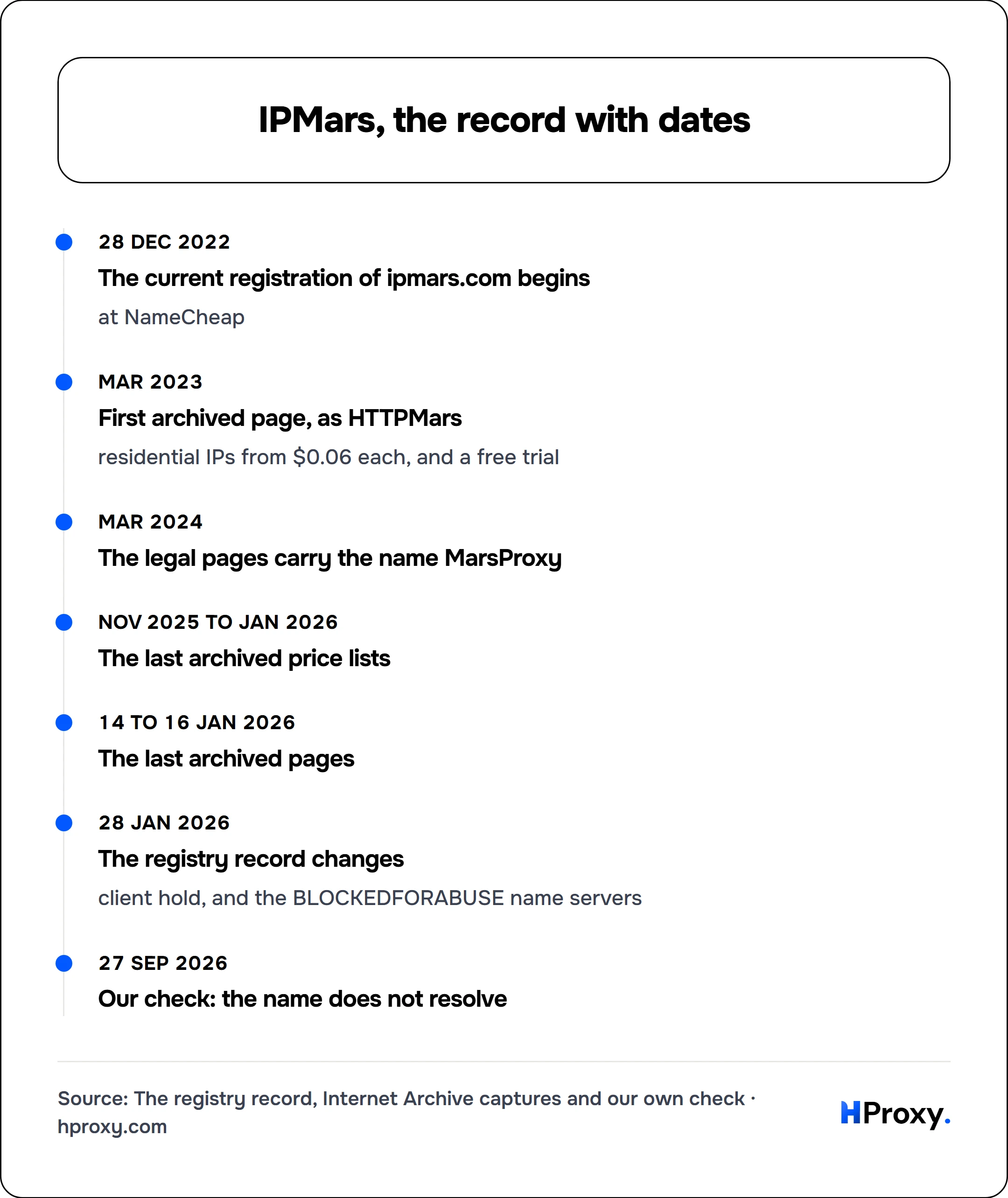
28 Dec 2022
The current registration of ipmars.com begins
at NameCheap
Mar 2023
First archived page, as HTTPMars
residential IPs from $0.06 each, and a free trial
Mar 2024
The legal pages carry the name MarsProxy
Nov 2025 to Jan 2026
The last archived price lists
14 to 16 Jan 2026
The last archived pages
28 Jan 2026
The registry record changes
client hold, and the BLOCKEDFORABUSE name servers
27 Sep 2026
Our check: the name does not resolve
Sources: the Verisign registry, the Internet Archive and our own checks on 16 and 27 September 2026.
What it sold, in its last archived pages
| product | how it was sold | entry price | larger or longer |
|---|---|---|---|
| rotating residential | per GB, used within 30 days | $32.40 for 12 GB, $2.70 a GB | $0.77 a GB: 3,000 GB for $2,310 |
| residential SOCKS5 | per IP, each usable up to 24 hours | $51 for 204 IPs, $0.25 each | $0.045 an IP: 10,000 for $450 |
| rotating ISP | per GB, used within 30 days | $2.21 a GB for 60 GB | $0.66 a GB, custom |
| static residential | per IP | $3 for 7 days | $5 a month, $10.70 for 3 months |
| datacenter | per IP | $2.50 for 7 days | $4.50 a month, $10 for 3 months |
The rotating plans came with a clock. Traffic was "valid for: 30 days", and the FAQ said expired traffic "will be frozen" until you buy another package. The SOCKS5 plans had "no expiration date", but each IP could be used for up to 24 hours. The refund policy, archived in March 2024, was short: "Please note that all payments are final." The pricing pages called crypto payments fee-free.
The homepage claimed "200M+ real residential IPs, covering 190+ countries" and targeting by country, city, ZIP code and ISP. It also promised "no charge for invalid IPs". We never tested any of it.
It was also resold. TradeProxy (tradeproxy.net) sold IPMars IPs as prepaid codes, "Cheaper Than the Original Website" in its words, and said each IP lasted "a few hours" and up to 24. A code had to be redeemed on the IPMars website or in its software. Those TradeProxy pages now redirect to its general catalogue and blog.
Who ran it
The footer named "KS TRADING LLC", with an address in Portland, Oregon. The About page placed the headquarters in Hong Kong. The site ran in English, Chinese, Portuguese, Indonesian and Turkish, and its footer linked many antidetect browsers.
What we could not check
- Why the registrar acted. The name servers it now points to are called BLOCKEDFORABUSE, but the record gives no reason.
- What happened to paid balances. The dashboard sat on the same domain, so it went down with it.
- Whether it trades elsewhere. We found no successor: ipmars.net and marsproxy.com have no address, and ipmars.io is parked.
- Reviews. The Trustpilot pages refused our server, and Scamadviser holds no report on the name.
What it offered that we do not
- Residential IPs sold one by one, for SOCKS5 in a browser, at $0.045 each at volume.
- ZIP code targeting. Our Premium pool, at $1.49 for one GB, targets by state, city and ISP, not by ZIP code.
Where HProxy is different
| IPMars, as last archived | HProxy | |
|---|---|---|
| site | offline since January 2026 | answers today |
| rotating traffic | valid for 30 days | a balance that never expires |
| smallest purchase of rotating traffic | 12 GB at $2.70 a GB | 1 GB of Lite at $0.50/GB |
| state, city and ISP | advertised, with no surcharge stated | Premium, at $1.49 for one GB |
| one IP for a long time | static residential, $5 a month | static ISP, $2.70/IP per month |
| refunds | "all payments are final" | our refund policy is public |
| who runs it | KS TRADING LLC in the footer, Hong Kong on the About page | the company is named in our imprint |
Five alternatives, priced the same day
Every rate below comes from each vendor pricing page, read from our server on 27 September 2026. A rate you cannot reach is not a price.
| provider | how it charges | entry rate | lowest published rate | worth knowing |
|---|---|---|---|---|
| 9Proxy | per IP, through its desktop app | $24 for 100 IPs, $0.24 each | $0.029 an IP: 50,000 for $1,438 | You filter by country, state, city, ZIP code or ISP. Unused IPs never expire. |
| DataImpulse | per GB | $1 per GB: 5 GB for $5, for new users | $0.80 per GB at 1 TB for $800 | SOCKS5 included. Traffic never expires, but state, city, ZIP and ASN filters count at double the rate. |
| Webshare | per GB, monthly plan | $3.50 for 1 GB a month, half a $7 list price | $1.40 per GB: 3,000 GB for $4,200 a month | SOCKS5, ZIP and ASN targeting. Monthly traffic does not roll over. |
| Evomi | per GB, or per IP for static residential | $0.99 per GB pay as you go, from 15 GB | $0.49 per GB on the 100 GB plan at $49 a month | Pay-as-you-go data has no expiry. Static residential IPs start at $1.00 each. |
| HProxy | per GB | $0.50/GB for 1 GB of Lite, country targeting | $0.44/GB at 2,000 GB+ | City and ISP targeting on Premium: $1.49 for one GB. |
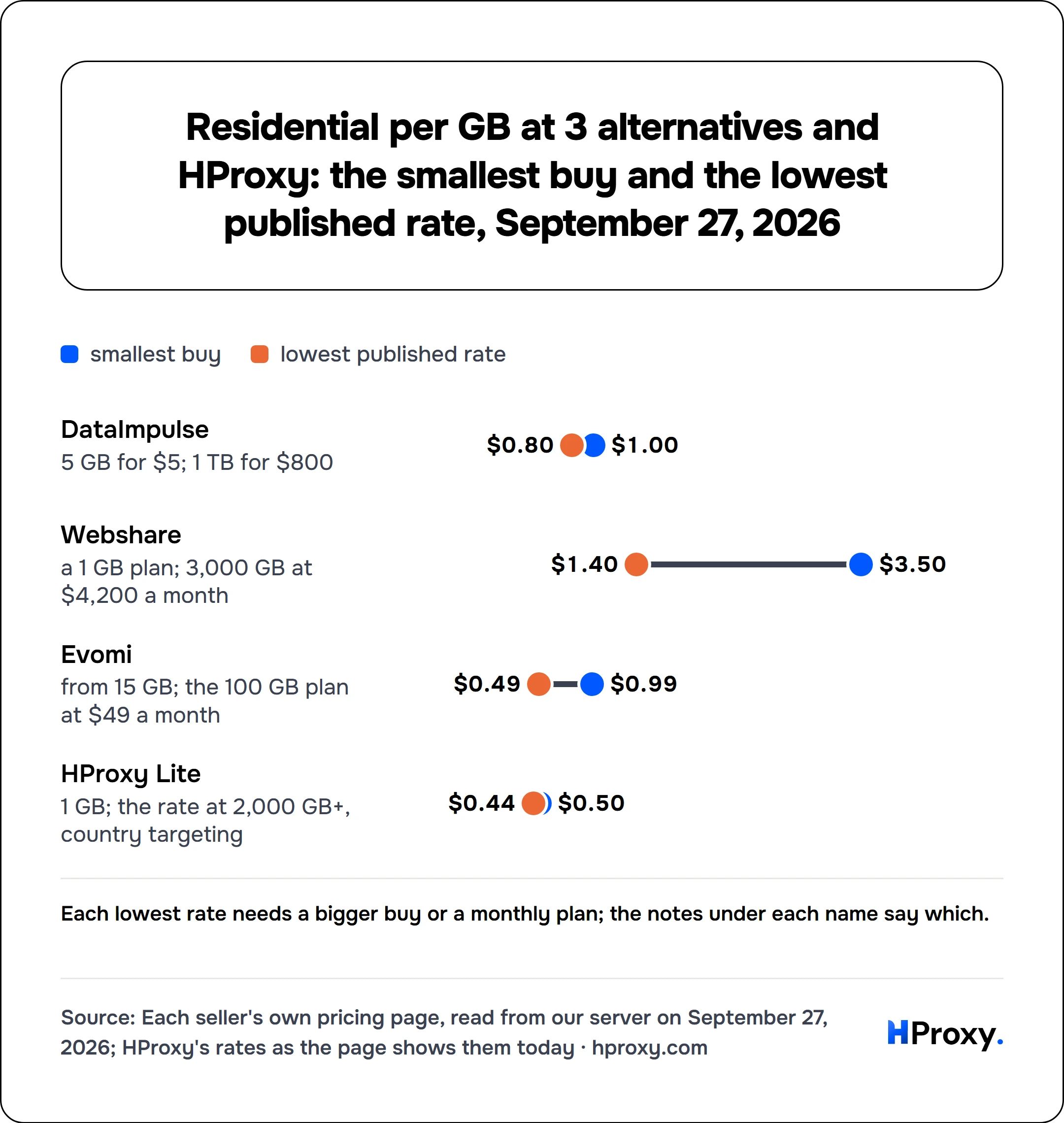
- smallest buy
- lowest published rate
9Proxy is the closest match to the IPMars SOCKS5 plans: it sells residential IPs one by one, each online for "several hours up to ~24 hours". Our pages on 9Proxy and DataImpulse go into each in detail.
Which one to pick
- You used its SOCKS5 IPs in a browser: 9Proxy sells the same model, and its unused IPs do not expire.
- You used its rotating traffic: pick a seller whose traffic does not run out, such as DataImpulse, Evomi pay as you go, or our balance.
- You need state, city or ISP targeting: our Premium pool at $1.49 for one GB, or DataImpulse at its double rate.
- You need one IP for weeks: a static one, such as our static ISP at $2.70/IP per month or Evomi static residential.
Whichever seller you pick, test what you get with our free proxy checker. It checks HTTP and SOCKS proxies with no sign-up.
The limits of this record
Every IPMars price here comes from the Internet Archive, and the newest is from January 2026. We never used its network. We checked the name on 16 and 27 September 2026 from our server. If it comes back, this page is due for a rewrite; otherwise, for a check by 27 December 2026.
Sources
Read on 27 September 2026, from our server:
- Verisign, registry record for ipmars.com, and our DNS checks of ipmars.com, ipmars.net, ipmars.io and marsproxy.com.
- Internet Archive: captures of ipmars.com from March 2023 to January 2026, among them the homepage, the pricing pages, the About page and the refund policy.
- 9Proxy, DataImpulse, Webshare and Evomi pricing pages, the 9Proxy docs, the DataImpulse targeting docs and the Webshare help center.
- HProxy, our product catalogue, documentation and legal pages.