Incogniton (incogniton.com) is an antidetect browser from the Netherlands: each browser profile gets its own fingerprint, so many accounts can run side by side on one computer. On 12 October 2026 its free package held 10 profiles for two months and then fell to 3, and keeping 10 cost $19.99 a month, about twice what AdsPower, GoLogin and MoreLogin asked. For a team, the picture turns: 150 profiles with three seats cost $79.99, second only to AdsPower among the plans we could price. The comparison lines up eight alternatives on both counts.
What Incogniton sells, and what it costs
Incogniton runs on Windows and macOS only, by its own download page. Alongside the profiles it offers a Synchronizer that repeats one profile's actions in others, a Cookie Collector that fills new profiles with cookies, typing that imitates a person, and free proxies by country, plus a shop for paid ones inside the app.
Incogniton's plans, 12 October 2026
| Plan | Profiles and seats | A month: monthly; 6 months; 12 months |
|---|---|---|
| Free | 10 for two months, then 3 | $0 |
| Starter Plus | 10 | $19.99; $13.99; $11.99 |
| Entrepreneur | 50; seats can be added | $29.99; $20.99; $17.99 |
| Professional | 150 with 3 seats | $79.99; $55.99; $47.99 |
| Custom | 500 to 5,000 with 10 to 25 seats | from $149.99; $104.99; $89.99 |
incogniton.com/pricing, its price cards, comparison table and FAQ, read from our server on 12 October 2026
Two details change the sums. The price cards open on six-month billing, so the first figure a visitor sees is $13.99; month by month the same plan costs $19.99. And "VAT may apply in certain countries": the FAQ adds that a registered business can avoid it by entering its VAT number. Payment goes through PayPal, Visa, Mastercard, American Express or several cryptocurrencies via Coinbase.
Starter Plus keeps your 10 profiles and nothing more. Its comparison table marks the Cookie Collector, the Synchronizer, cookie export, profile transfer, the REST API and Selenium or Puppeteer as missing on that plan; all of them start at Entrepreneur, $29.99.
How the price and the free plan moved, 2020 to 2026
The oldest price page in the archive, from August 2020, already asked $29.99 for 50 profiles, $79.99 for 150 and $149.99 for 500, the same figures as in October 2026. Team seats appear by December 2021, three on the 150-profile plan and ten on the largest. The archive first shows a discount for paying ahead in August 2022, 30% for six months or a year when you wrote to support; it became a switch on the page in 2023, and a yearly option at 40% joined it between January and June 2026.
The free plan is what moved. Every capture up to 4 August 2024 offers 10 free profiles and names no time limit; by 2 September 2024 the free package lasts two months and a paid Starter Plus plan has appeared to keep the ten:
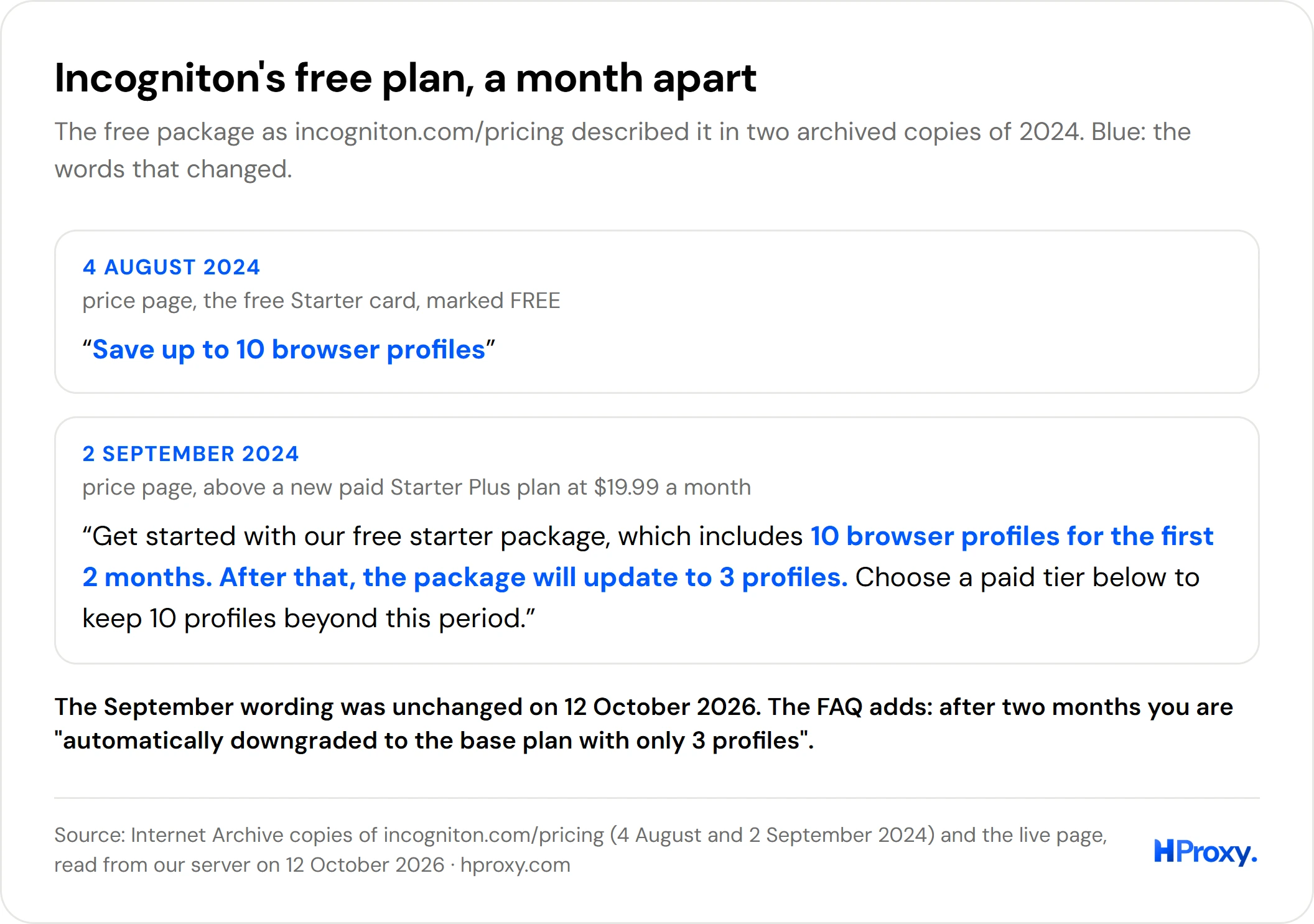
Before the cut the free version already had limits: its FAQ of 2023 and 2024 capped it at creating and deleting 50 profiles a month and, by July 2024, the Synchronizer at 4 profiles. In the copies of 2025 and 2026, the FAQ says that after two months you are "automatically downgraded to the base plan with only 3 profiles".
Who runs Incogniton
The terms are a contract with WorkingGreen B.V., at Tupolevlaan 65-75 in Schiphol-Rijk near Amsterdam, under Dutch law with the courts of Amsterdam as the forum. The Dutch register lists WorkingGreen B.V. under number 68942443 as an active private limited company, and the site's footer reads "Incogniton / WorkingGreen BV".
By its about page, two founders began building the first version in 2019, and the team now works from many countries around an office in the Amsterdam region. The domain incogniton.com was registered on 19 November 2019, and the archive's copy of August 2020 calls the product "a multiple browser environment tool". The home page now claims more than a million users. Refunds are narrow: the terms allow a request "within 24 hours of purchasing" and none after.
Why people look for an alternative
Keyword Planner counted 14,800 searches a month for "incogniton" worldwide on 12 October 2026, 880 for "incogniton download", and 90 each for "incogniton alternative" and "incogniton alternatives". Google's suggestions set it against Multilogin, Dolphin, GoLogin and Octo Browser, and ask about its free plan, its free proxies and versions for Mac, Linux, iOS and Android.
The reasons follow from the pages above. The free package runs out after two months. Keeping 10 profiles then costs $19.99, more than twice the cheapest rivals. There is no Linux build and no phone app. And the refund window closes a day after you pay.
The alternatives side by side
Every price below comes from the sellers' own pages and price services, read from our server on 12 October 2026, on monthly billing. We ran none of the browsers, so nothing here compares how well each hides a profile.
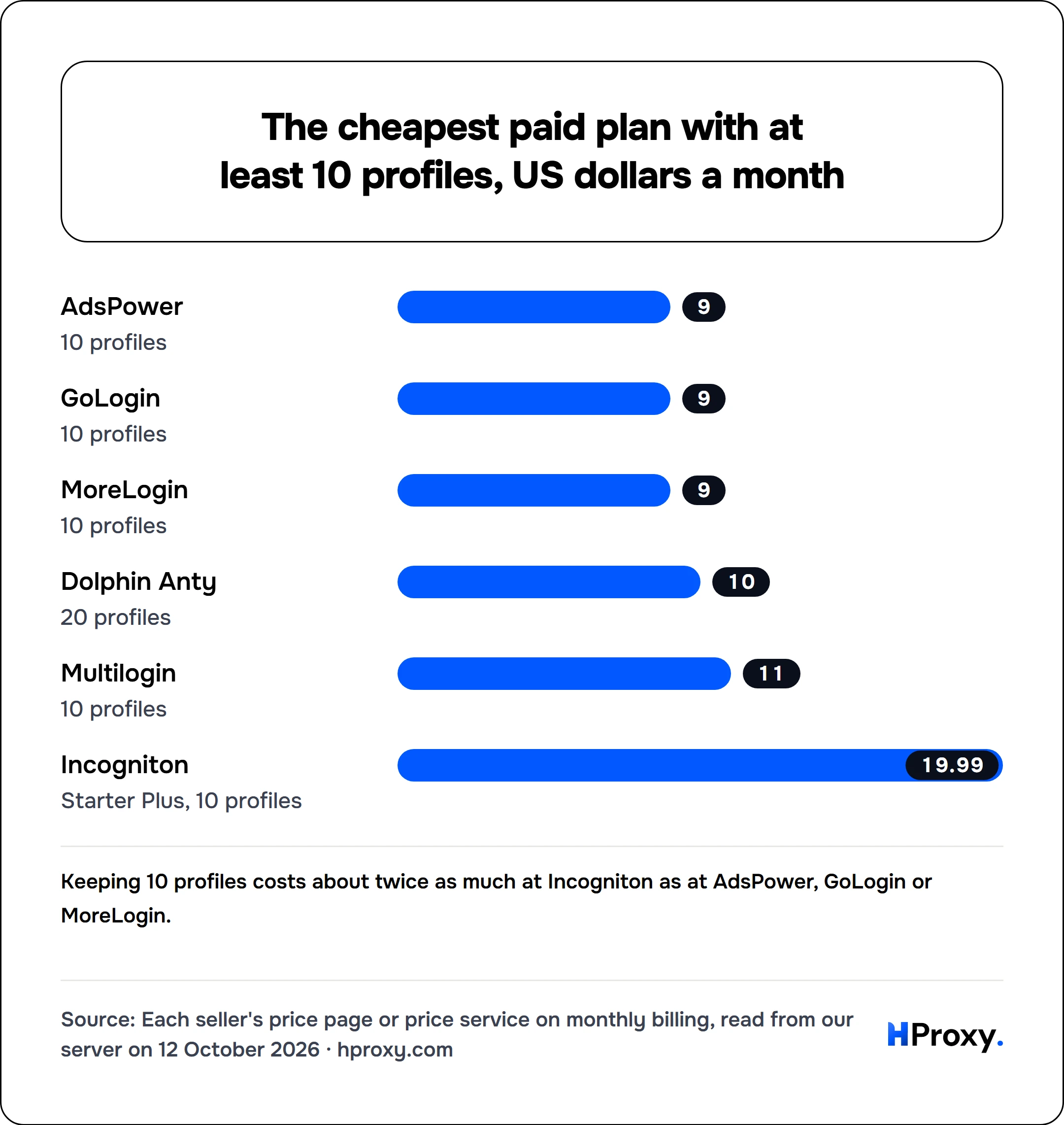
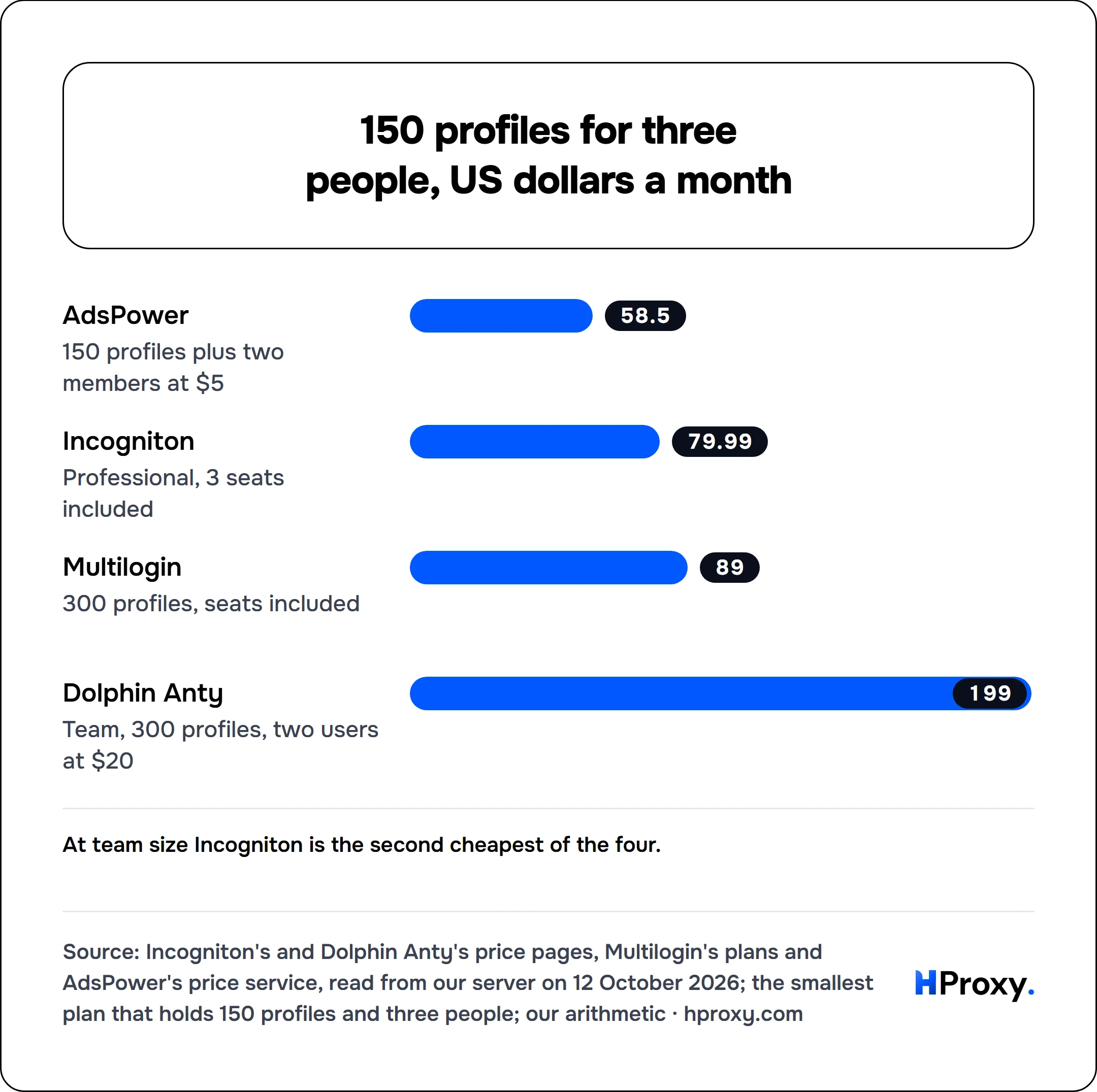
GoLogin is left out of the team chart because its page gives no price for an added member, and Octo Browser charges in euros: €169 a month for 350 profiles and 3 members.
Free plans and refund rules, 12 October 2026
| Tool | Free plan | Money back on a new plan |
|---|---|---|
| Incogniton | 10 profiles for two months, then 3 | within 24 hours |
| AdsPower | 2 profiles | no, once a package is confirmed |
| GoLogin | 3 profiles | 14 days in the EU and US, otherwise 7 |
| Multilogin | 5 profiles | unused time, pro rata, if asked |
| Dolphin Anty | 5 profiles | for outages on its side; otherwise its call |
| Octo Browser | none on a computer | 5 days, first payment |
| MoreLogin | 2 profiles | no; exceptions judged one by one |
| Kameleo | 100 cloud profiles, 300 minutes | at its discretion |
| Undetectable | 5 cloud profiles | no, once a plan starts |
Each tool's price page and terms or refund policy, read from our server on 12 October 2026
AdsPower
AdsPower prices by the profile through a price service behind its page: $9 a month for 10, $36 for 100 and $48.50 for 150, with $5 for each extra member. It ships two browser engines, one built on Chrome and one on Firefox, and runs on Linux. The catch for anyone used to Incogniton's day of grace: nothing is refunded once a package is confirmed.
GoLogin
GoLogin keeps 3 profiles free and charges $9 for 10 and $39 for 100, with apps for Android and iPhone besides Windows, macOS and Linux. It courts Incogniton users directly: a receipt showing that you pay Incogniton earns 90% off the first month, so 10 profiles cost $0.90. Its refund window is 14 days in the EU and the US.
Multilogin
Multilogin keeps 5 profiles free and sells 10 for $11 and 100 for $40; its Business plans include as many team seats as you need, which is why 300 profiles for three people cost $89. It also rents Android cloud phones. Its terms refund unused time on request.
Dolphin Anty
Dolphin Anty gives 20 profiles for $10 on its Starter plan, the most profiles for the money at the small end. Its fixed tiers hurt teams: Base holds 100 profiles for $89 and Team 300 for $159, plus $20 a month for each added user. It refunds for outages on its side and otherwise at its discretion.
Octo Browser
Octo Browser has no free plan on a computer and starts at €10 for 3 profiles; 100 cost €79, and its Team plan gives 350 profiles to three members for €169. Its phone apps for iOS and Android come with 100 free profiles, and a first payment can be refunded within 5 days.
MoreLogin, Kameleo and Undetectable
MoreLogin charges $9 for 10 profiles and keeps 2 free with 100 minutes on its cloud phones. Kameleo sells by the number of browsers running at once, €59 for 10, and keeps 100 cloud profiles free with 300 minutes of use. Undetectable puts unlimited local profiles on its paid plans and charges $49 a month for 50 cloud profiles. None of the three refunds a plan as a rule.
Where Incogniton still leads
- A team of three at 150 profiles: $79.99 with seats included, below Multilogin's $89 and well below Dolphin Anty's $199.
- Paying ahead: 40% off for a year and 30% for six months, the same discount on every plan.
- Proxies in the app: free proxies by country for light work, and a shop for paid ones without leaving the browser.
- Ways to pay: PayPal, cards and five cryptocurrencies.
Moving your profiles out
Incogniton's transfer feature moves profiles between Incogniton accounts, and exporting cookies needs Entrepreneur or above. Before the free package shrinks, export the cookies of the profiles you need, write down which proxy each one uses, and rebuild them in the new browser with the same address per profile, so a site sees the same connection it already knows.
Where HProxy fits
Incogniton's own page says its free proxies suit testing and low-priority work, and points anyone running accounts in different regions to paid dedicated proxies. Incogniton accepts HTTP, SOCKS5 and SSH proxies, so it can take any address you choose.
What a profile needs from that address is to stay put. Our Residential Premium keeps one home IP for up to 24 hours and can target a state, a city or an ISP, at $1.49 a gigabyte, and a static ISP address costs $2.70/IP a month with no traffic limit. The guide to proxies for antidetect browsers shows how to pair one address with each profile.
Which one to pick
- Stay with Incogniton if you run a team of three or more with about 150 profiles, or want to pay a year ahead at 40% off.
- For the cheapest 10 profiles: AdsPower, GoLogin or MoreLogin at $9 a month.
- For a free plan that does not expire: Multilogin or Dolphin Anty, 5 profiles each.
- For Linux or a phone: GoLogin, which has both, or Octo Browser for phones.
- For the longest refund window: GoLogin, 14 days in the EU and the US.
- The weakest fit for a small team: Dolphin Anty, whose fixed Team plan and $20 users made three people with 150 profiles cost $199.
What we could not find out
We ran none of these browsers, so how well each hides a profile is not compared. Incogniton's register entry gives no founding date in the copy we read, and its claim of a million users comes without a source. GoLogin's price for an added member is not on its page, and MoreLogin's prices above 10 profiles come from a calculator we could not read. We intend to check every plan on this page again no later than 12 January 2027.
Sources
- Incogniton: price page with its cards, comparison table and FAQ, home page, free-proxies and proxy-shop pages, about page, download page, privacy policy and terms of service, read 12 October 2026.
- Internet Archive: incogniton.com/pricing from August 2020 to June 2026, including 4 August and 2 September 2024.
- The Dutch register through OpenCorporates (WorkingGreen B.V., 68942443) and the .com registry record of incogniton.com.
- AdsPower's price service, and the price pages and terms of GoLogin, Multilogin, Dolphin Anty, Octo Browser, MoreLogin, Kameleo and Undetectable, read 12 October 2026.
- GoLogin's page for people switching from Incogniton, and the rival comparison pages of Multilogin, AdsPower, MoreLogin and Dolphin Anty, read 12 October 2026.
- Keyword Planner volumes, worldwide, and Google's autocomplete as our server received it on 12 October 2026.
- Our own prices: the HProxy price tokens in force when this was written.