Nstbrowser (nstbrowser.io) is an antidetect browser and cloud browser service from NST LABS TECH LTD., the company that also sells proxies as Nstdata. Each profile carries its own fingerprint, so separate accounts and scripts can run side by side. On 12 October 2026 its free plan held 500 profiles and three team members but opened only 30 profiles a day, at $0.01 for each launch beyond; paid plans cost $29.90 to $159.90 a month. Its home page still promised 1,000 free launches a day. The comparison shows which rivals beat it, and for whom staying is the better deal.
Nstbrowser's plans
Nstbrowser's plans, 12 October 2026
| Plan, a month | Profiles; launches a day | Members |
|---|---|---|
| Free, $0 | 500; 30 | 3 |
| Starter, $29.90 | 20,000; 3,000 | 20 |
| Growth, $49.90 | 100,000; 20,000 | 50 |
| Scale, $89.90 | 500,000; 50,000 | 100 |
| Developer Basic, $89.90 | 2,000; 500 plus 100,000 one-time | 50 |
| Developer Scale, $159.90 | 5,000; 1,000 plus 200,000 one-time | 100 |
nstbrowser.io/en/pricing and the price list it loads from api.nstbrowser.io, read from our server on 12 October 2026
Anything past a plan's limits is billed per use from prepaid credit. A launch beyond the daily allowance costs $0.008 on Scale, $0.01 on Free and Growth and $0.015 on Starter, so the cheapest paid plan charges more for an extra launch than the free one. A profile opened several times on one day counts once. Paying a quarter ahead takes 10% off and a year ahead 40%, which puts Starter at $215.20 a year. Subscriptions are paid by card or PayPal; the price page says credit cannot pay for them.
Nstbrowser also sells its own proxies inside the app. Residential traffic costs $1.80 a gigabyte on the free plan and falls to $1.50 on Scale; IPv6 runs from $0.40 down to $0.30, datacenter from $0.80 down to $0.60, and a static ISP address costs $2.50. The paid plans include 1, 1.5 or 2 GB of each kind a month, the free plan none. CAPTCHA solving is billed by the thousand: $1.60 for reCAPTCHA v2 on the free plan, $1.00 on Scale. Proxies bought elsewhere work too; the proxy page answers "Yes" to using your own.
How the price moved, 2024 to 2026
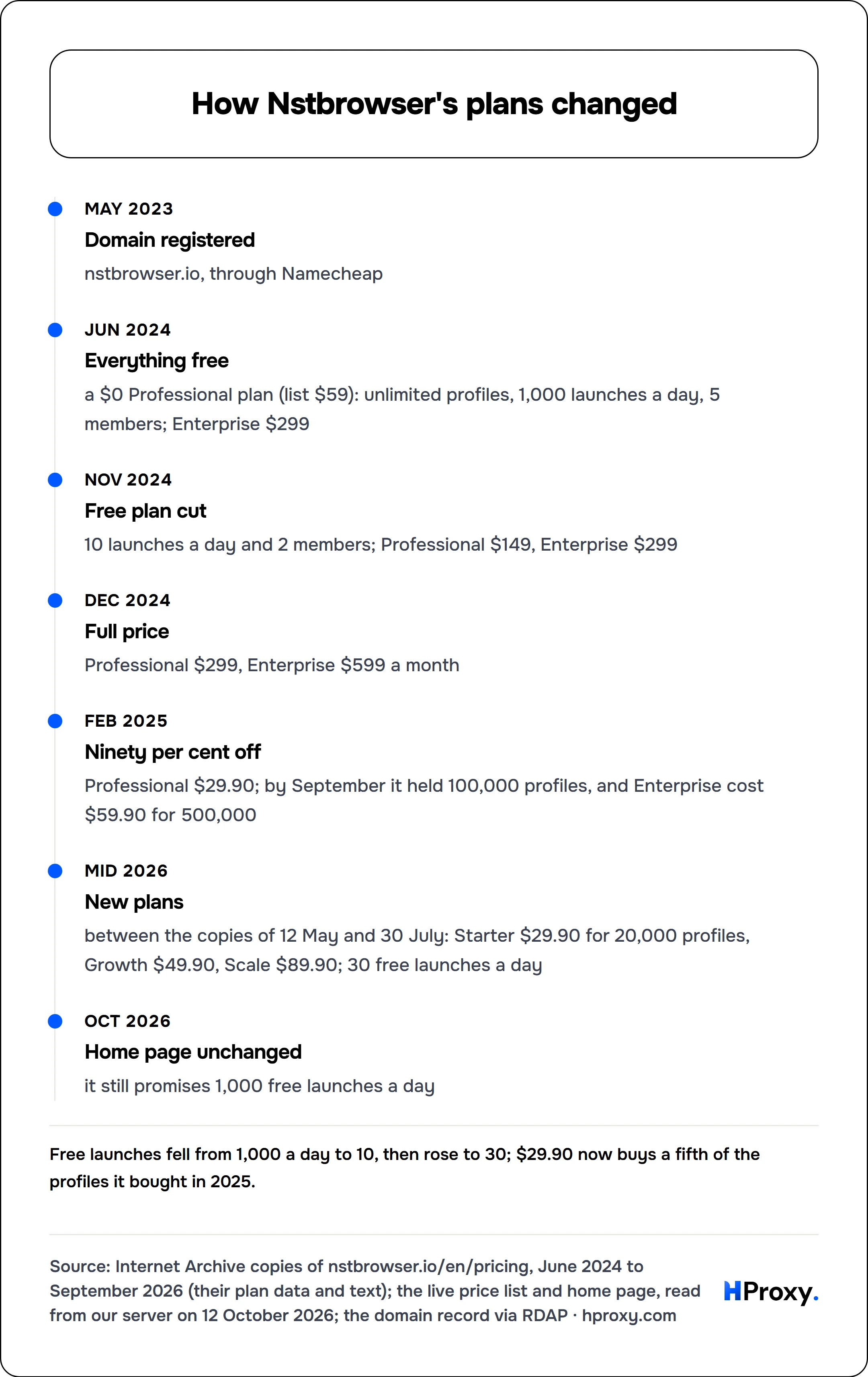
May 2023
Domain registered
nstbrowser.io, through Namecheap
Jun 2024
Everything free
a $0 Professional plan (list $59): unlimited profiles, 1,000 launches a day, 5 members; Enterprise $299
Nov 2024
Free plan cut
10 launches a day and 2 members; Professional $149, Enterprise $299
Dec 2024
Full price
Professional $299, Enterprise $599 a month
Feb 2025
Ninety per cent off
Professional $29.90; by September it held 100,000 profiles, and Enterprise cost $59.90 for 500,000
Mid 2026
New plans
between the copies of 12 May and 30 July: Starter $29.90 for 20,000 profiles, Growth $49.90, Scale $89.90; 30 free launches a day
Oct 2026
Home page unchanged
it still promises 1,000 free launches a day
The low prices of 2025 were a sale. From February 2025 the archive shows a "90% Off Your Subscription!" banner over list prices of $299 and $599, and the plan records carry the sale as their own type. When new plans replaced them in mid-2026 (the paid plan records were created on 15 and 16 June), the same money bought less.
The same money, 2025 and 2026
| What it buys | Sep 2025 | Oct 2026 |
|---|---|---|
| Profiles for $29.90 | 100,000 | 20,000 |
| Price of 500,000 profiles | $59.90 | $89.90 |
| Launches a day on that plan | 100,000 | 50,000 |
| Members on that plan | 200 | 100 |
| Free launches a day | 10 | 30 |
Plan data in the archive copies of nstbrowser.io/en/pricing of 6 September and 14 November 2025; Nstbrowser's price list, read from our server on 12 October 2026
The plan with 500,000 profiles kept its size, lost half its launches and half its members, and rose in price by half. The free plan moved the other way, from 10 launches a day to 30.
What the free plan holds today
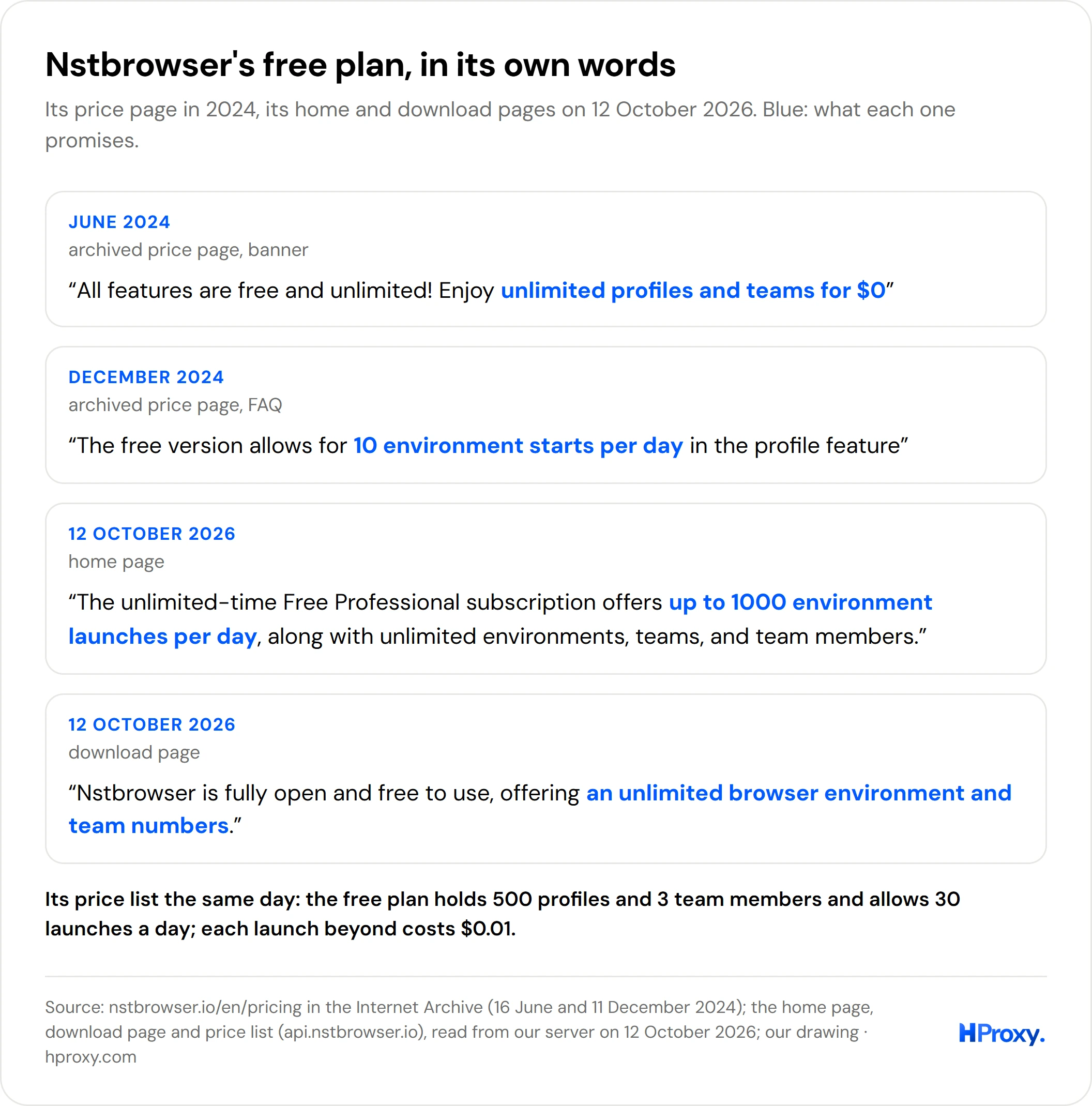
Three of Nstbrowser's own pages describe three different free plans. The account follows the price list: 500 profiles, three members and 30 launches a day. Beyond 30, each launch is charged to credit, and the terms warn that when credit runs low Nstbrowser "may limit your use of certain features".
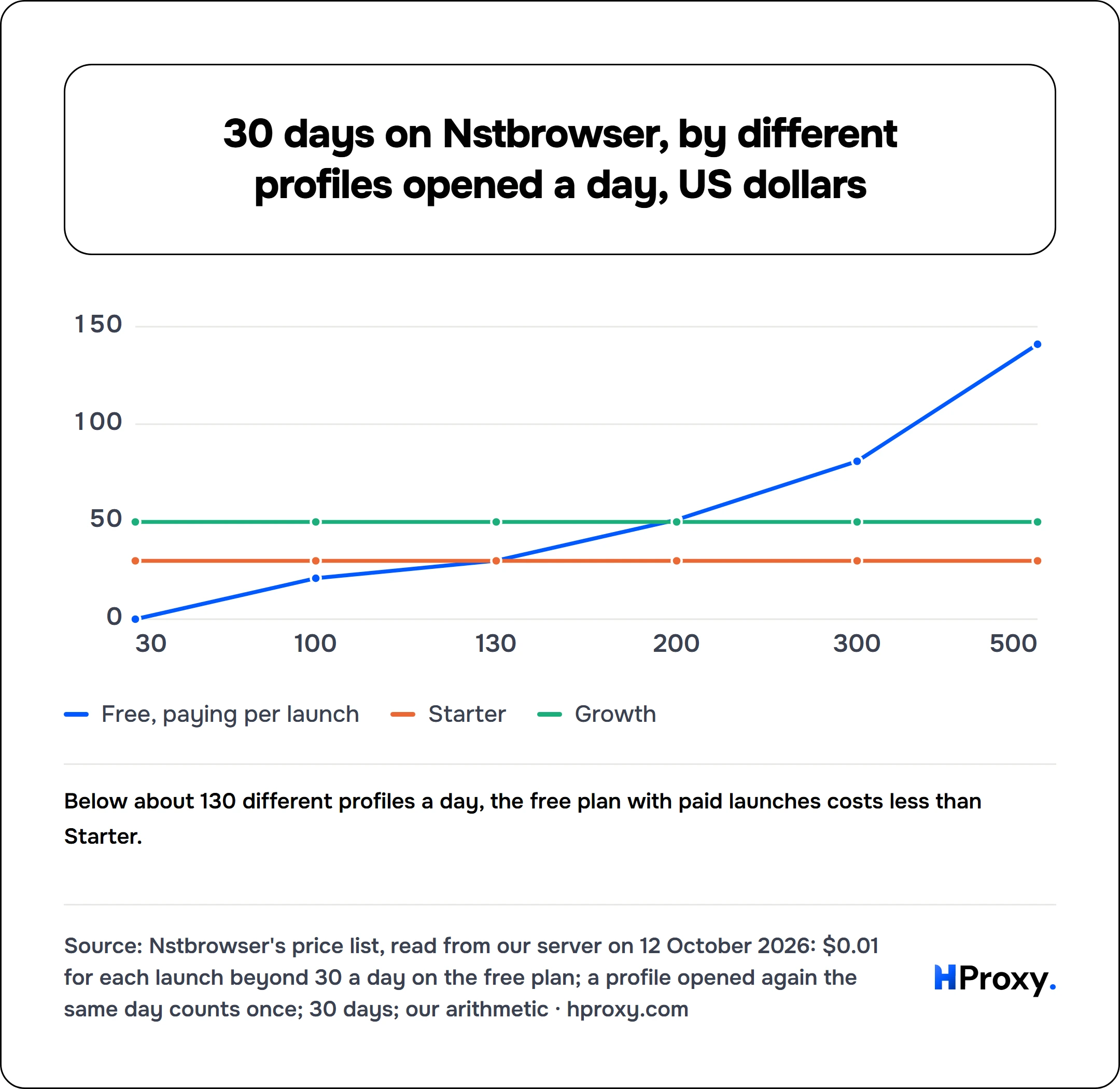
- Free, paying per launch
- Starter
- Growth
Someone who opens 100 different profiles a day pays $21 a month in launches on the free plan. From about 130 a day Starter costs less, and it allows 3,000 launches a day.
Who runs Nstbrowser
Every Nstbrowser page we read carries the footer of NST LABS TECH LTD. The same legal name appears in the page data of Nstdata, the proxy seller formerly called Nstproxy, and Nstdata's terms of 3 September 2026 call it "a company incorporated in Hong Kong". Nstbrowser's own terms name a different owner, "Nstbrowser LLC", refer to the "prevailing law of United States", and in one sentence protect equipment that "belongs to Virtual multi login". The home page speaks of "a technical team of over 150 people".
The terms rule out refunds: "we do not offer refunds in any form", and purchased credit is "strictly not refundable". They also say renewals are paid from credit, while the price page says credit cannot pay a subscription and that renewals charge the linked card. The terms name PayPro and Sellix as payment services. Nstdata sells the same kind of proxies directly, in 30-day packages: 50 GB of its Residential Prime cost $80.
The domain nstbrowser.io was registered on 16 May 2023 through Namecheap, behind a privacy service. nstbrowser.com, registered three weeks later through DNSPod, has no website at all.
What other pages get wrong about Nstbrowser
Sellers of rival browsers publish their own Nstbrowser comparisons, and several have fallen behind its price list:
- BitBrowser lists Nstbrowser at $9 for 10 profiles, $19 for 30 and $39 for 100, with three profiles free. No archived Nstbrowser price page since June 2024 shows those plans, and the free plan has held 500 profiles since 2025.
- Multilogin's alternatives page of January 2026 says Nstbrowser has no built-in proxies, and its comparison page, last changed on 9 August 2026, says it bundles none. The archive copy of 30 July 2026 already shows 1 to 2 GB of proxy traffic in every paid plan. Multilogin's review still quotes the 2025 plans at $29.90 and $59.90.
- Dolphin Anty's review, changed on 7 August 2026, says Dolphin itself "has a free plan for ten profiles"; that plan has held five since the autumn of 2025.
- Among proxy sellers' guides, Byteful puts the free plan at 10 profiles with $0.01 for each further profile created, and Massive lists Linux among the systems it runs on.
Incogniton's comparison, updated on 24 September 2026, was the one rival page we read that matched the current price list.
Why people look elsewhere
Keyword Planner counted 4,400 searches a month for "nstbrowser" and 2,400 for "nst browser" worldwide on 12 October 2026, against 10 for "nstbrowser alternative". Google's suggestions ask about Linux, Android, the free plan, pricing, promo codes and Nstbrowser against GoLogin.
The platform answers part of that. The desktop app, version 1.23.2, whose installers are dated 28 September 2026, runs on Windows 10 and later and on macOS for Apple Silicon and Intel. Linux gets Nstagent, a headless service that its own instructions support on Ubuntu 22.04 and 24.04 only, and there is no app for Android or iPhone. The public release notes end at version 1.12.0 of 23 October 2024, eleven minor versions behind the download.
Nstbrowser's Browserless and browserless.io
Nstbrowser calls its cloud browser Browserless. Its price list gives free accounts 10 hours of it, two browsers at a time, and charges $0.40 for each hour beyond; its 2024 price page reset those hours every month. A separate company, Browserless at browserless.io, rents the same kind of hosted browser under the same name. It gives 1,000 units a month free, a unit being up to 30 seconds of one browser, and charges from $25 a month billed yearly. "browserless" draws 8,100 searches a month, so check which of the two a guide means.
The alternatives side by side
The job priced here is Nstbrowser's free plan at work: 500 profiles shared by three people, 100 of them opened each day. Prices are each seller's monthly figures from 12 October 2026; Octo bills in euros, converted at the European Central Bank's rate of 1.1206 dollars. Nothing was installed.
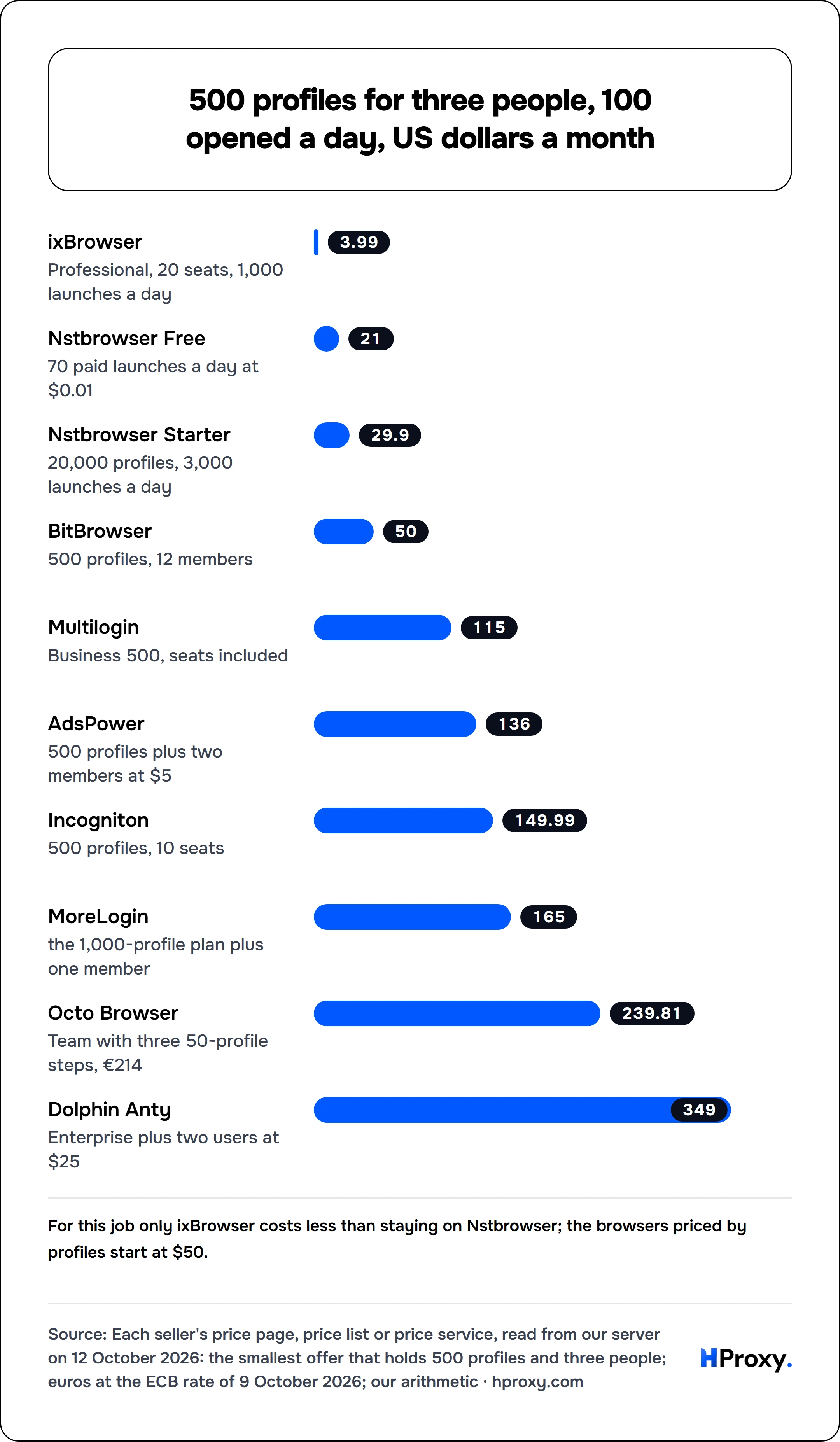
GoLogin is left out of the chart: it lists $139 a month for 500 profiles but publishes no price for added members.
ixBrowser
ixBrowser counts launches the way Nstbrowser does and puts no cap on profiles. Its $3.99 plan gives 20 seats and 1,000 launches a day, and its free plan two seats and 100 launches. It runs on Windows and macOS only, names no company, and refuses refunds without a special reason; our ixBrowser page sets out the rest.
BitBrowser
BitBrowser sells profiles in packages: $50 a month holds 500 with 12 members, and 10 profiles stay free. Like Nstbrowser it refunds nothing and has no Linux build, and it adds identity checks, described on our BitBrowser page.
Multilogin and AdsPower
Multilogin's Business plan holds 500 profiles for $115 a month with unlimited team seats, and five profiles stay free. AdsPower's own price service quoted $136 for 500 profiles and two members beyond the owner. Both have Linux desktop builds, where Nstbrowser offers only the headless agent.
Incogniton, MoreLogin, Octo Browser and Dolphin Anty
These four cost $150 to $349 for the job. What three of them add over Nstbrowser is a refund rule: Incogniton refunds within 24 hours and includes proxies, Octo Browser refunds a first payment within 5 days, and Dolphin Anty refunds outages on its side. MoreLogin needs its 1,000-profile plan at $160 to hold 500, and it rents Android cloud phones by the minute.
For automation: Kameleo, Camoufox and Browserless
Kameleo prices by browsers running at once: free with 100 cloud profiles and 300 minutes of browser time, then €59 a month for 10 at once, on Windows, macOS and Docker. Camoufox is a free, open-source Firefox build for scraping, released under the MPL-2.0 licence, and it presents Firefox identities only. Browserless rents hosted browsers by the 30-second unit, as above. For scripts that open fresh profiles all day, these fit better than any plan priced by profiles, and Nstbrowser's Developer plans compete with them directly: $89.90 a month for 100,000 one-time launches a day.
Where Nstbrowser still leads
- Profiles for the money: 500 free and 20,000 for $29.90, more than any rival on this page sells at that price.
- Automation at volume: Developer plans with up to 200,000 one-time launches a day, a cloud browser and an RPA tool.
- One bill: proxies and CAPTCHA solving are charged inside the same account.
Where HProxy fits
Nstbrowser's own residential traffic costs $1.50 to $1.80 a gigabyte, and its proxy page confirms that a profile can use proxies bought elsewhere. For a profile that must keep one address, our Residential Premium sticks to the same home IP for up to 24 hours. You pick the state, city or ISP, and it costs $1.49 a gigabyte. Static ISP proxies keep a fixed address with no traffic metering for $2.70/IP a month each. Our guide for antidetect browsers shows how to give every profile a proxy of its own.
Which one to pick
- Stay on Nstbrowser if you keep many profiles but open fewer than about 130 a day, or if your scripts burn through one-time profiles at volume.
- ixBrowser for the cheapest seats, with launch limits that suit a small team.
- BitBrowser for 500 profiles and 12 members at $50.
- Multilogin or AdsPower for a Linux desktop app.
- Kameleo or Camoufox for work that is mostly automation.
- The costliest move for this job: Dolphin Anty, at $349 a month.
What we could not find out
We installed and tested nothing, so fingerprint quality stays out of this comparison. We could not read Hong Kong's company register, so the number and directors of NST LABS TECH LTD are unconfirmed. We also cannot tell whether the proxies inside Nstbrowser come from Nstdata's pool. The archive's copies of January to May 2026 hold no plan data, so the change to today's plans is dated by the copies of 12 May and 30 July 2026. An earlier version of this page described nstbrowser.com as a dead proxy list; Nstbrowser's site is nstbrowser.io, and nstbrowser.com shows no website. These prices are due for a re-check by 12 January 2027.
Sources
- Nstbrowser: home page, price page and the price list it loads, built-in proxy page, download page, release notes, terms and privacy policy, read 12 October 2026.
- Internet Archive: nstbrowser.io/en/pricing from June 2024 to September 2026, read through their plan data and text; the RDAP records of nstbrowser.io and nstbrowser.com.
- Nstdata (formerly Nstproxy): its page data, its terms of 3 September 2026 and its residential price page.
- Nstbrowser's GitHub pages for its Linux agent and its AI agent.
- The price pages, price lists and price services of ixBrowser, BitBrowser, Multilogin, AdsPower, Incogniton, MoreLogin, Octo Browser, Dolphin Anty, GoLogin, Kameleo and Browserless, and Camoufox's GitHub record, read 12 October 2026; the euro's ECB rate of 9 October 2026.
- The Nstbrowser pages of BitBrowser, Multilogin, Dolphin Anty, GoLogin and Incogniton, and eight proxy sellers' Nstbrowser guides, read 12 October 2026.
- Keyword Planner's worldwide counts and Google's suggestions around Nstbrowser, taken 12 October 2026.
- HProxy's own Residential Premium and static ISP prices, taken from our live price data.