This page exists because the search you ran has almost no honest results. Nearly every page ranking for "W3Lookup alternative" earns a commission on the answer it gives you. We earn money if you pick us, which we are stating in the first paragraph rather than the footer.
The record we hold
The domain is w3lookup.net.
What we do not hold is a current, sourced price for W3Lookup. Rather than print a figure we cannot stand behind, this page leaves it out and tells you what to look for when you read their page yourself.
Copy down the entry rate, the commitment attached to the cheapest rate, the minimum top-up and the expiry rule. Those four turn a marketing figure into something you can compare.
What the registration record shows
The domain was registered on 4 July 2016, through GoDaddy.com, LLC, which makes it about 10 years old. Registry data as of 9 September 2026. It is paid up until 4 July 2027.
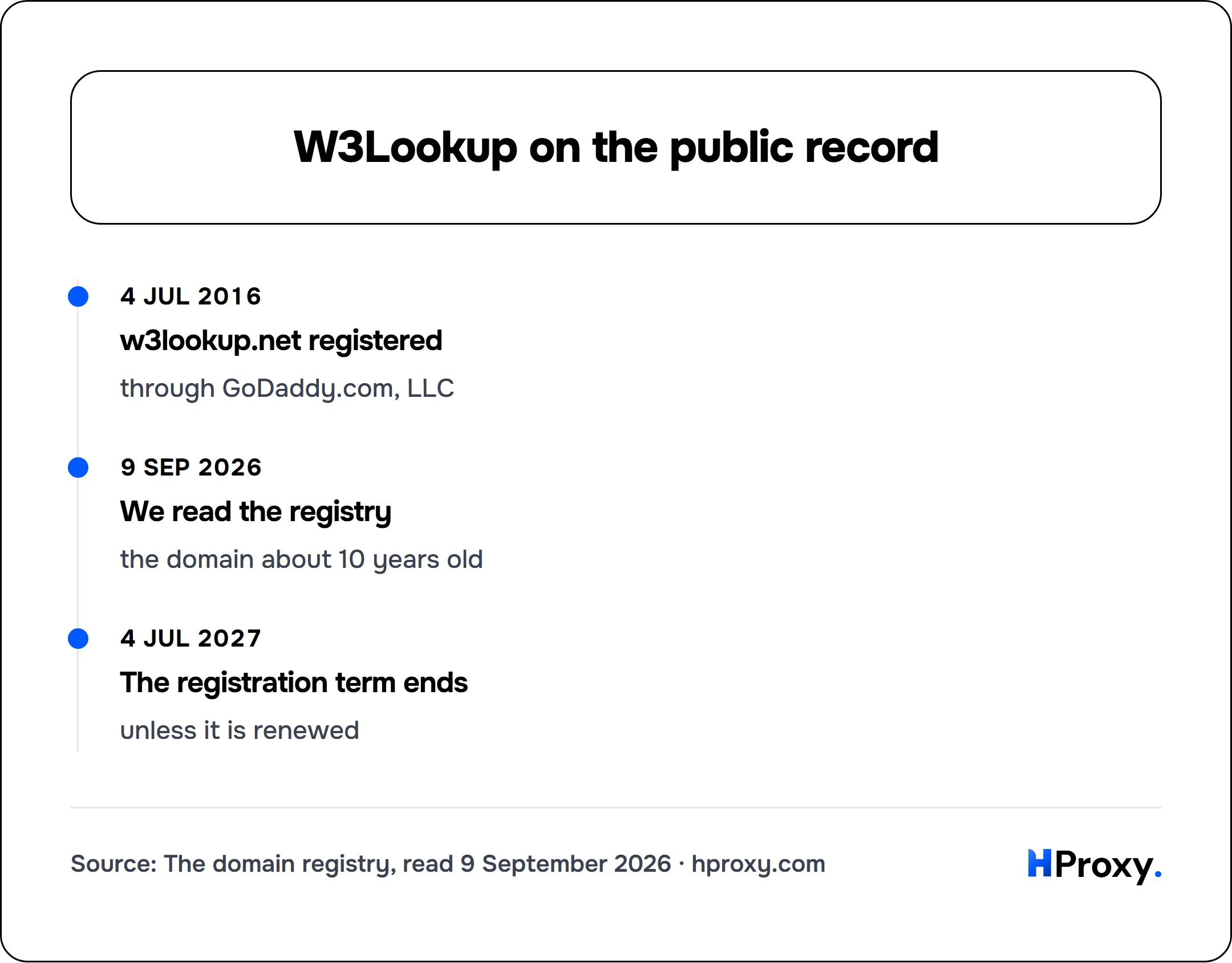
4 Jul 2016
w3lookup.net registered
through GoDaddy.com, LLC
9 Sep 2026
We read the registry
the domain about 10 years old
4 Jul 2027
The registration term ends
unless it is renewed
Read that as a floor rather than a recommendation. Longevity says somebody has kept paying the registrar, and in a market with this much churn that is worth ten seconds of your attention.
Where published figures stop being useful
Who else is using your address
Ask how many accounts can sit on one address at once. Where the answer is unlimited or unspecified, price the plan as shared regardless of what the product is called.
The line item hidden in the success rate
On a hard target, failures are the majority of your traffic. Whether those failures are billed decides the real cost, and the clause covering it is rarely on the pricing page.
What actually caps your throughput
Bandwidth is rarely the constraint on a real workload. Concurrent connections, requests per second and per-session caps are, and they are frequently buried in the documentation rather than the pricing page.
A comparison that admits what it cannot say
The rows below are the ones that change what you pay and whether the job runs:
| Question to ask | W3Lookup | HProxy |
|---|---|---|
| Entry price | Not verified by us, read their page | From $0.44/GB, pay as you go |
| Does unused balance expire? | On their own terms page | Never |
| Minimum commitment | Read their current terms | None |
| Identity checks | Worth confirming in writing before you commit | Card orders are screened, and verification is sometimes requested |
| Targeting | Read their current terms | Country, city and ISP |
| Free way to evaluate | Worth confirming in writing before you commit | Free proxy list and proxy checker |
Blanks in that table are deliberate. We print what we read and date it, and leave the rest empty rather than repeating something we cannot stand behind.
The ten minute version of this decision
For a few dollars you can get a verdict specific to your job, which no comparison page can honestly promise you.
- Open an account on each and add the smallest amount they take. Skip the trial if a paid unit is cheap enough to buy outright.
- Point both at your real target, through your real tool, on the same day, with the same mix of requests.
- Log successes, failures and gigabytes used. Cost per successful request is the figure you are after.
- Verify a slice of the exits independently. Country labels in this market are self-reported and are not always right.
- Buy the one that won on your target, and diarise a re-test in three months.
Who else is in this bracket
The same treatment, applied to the providers most often weighed against this one:
- S5Proxies alternatives
- Saglamproxy alternatives
- SAProxy alternatives
- ScoreHost alternatives
- Scrape alternatives
- Scrapegraphai alternatives
Where HProxy sits in that test
We sell residential proxies from $0.44 per GB with no subscription and a balance that does not expire, plus ISP, mobile and datacenter in the same account. That is the pitch, and the test above is a better judge of it than this paragraph.